Sam Dorf’s Vacancy Tax Advocacy: Misguided Policy That Would Harm Oakwood’s Business District

“We should collaborate with landlords to explore a vacancy tax on chronically empty storefronts” – Sam Dorf in the Oct 22, 2025, edition of the Oakwood Register

Oakwood residents, as we approach the city council election, it’s crucial to scrutinize the proposals put forward by candidates like Sam Dorf. As a left-wing activist with a vocal online following, Dorf has advocated for a vacancy tax on empty storefronts in our shopping and business district — a policy he frames as a solution to our community’s limited growth opportunities. While this may sound like a progressive fix to encourage leasing and revitalize our “pocket community,” a closer look reveals it as a risky, one-size-fits-all approach that ignores the realities of our small, well-maintained town with its older housing stock and modest business ecosystem. Drawing from experiences in other cities and economic analyses, this proposal could lead to unintended consequences that exacerbate our challenges rather than resolve them. Let’s examine why Dorf’s stance on this issue raises serious questions about his suitability for council.

Dorf’s advocacy for a vacancy tax stems from a desire to penalize property owners for unoccupied spaces, ostensibly to spur quicker rentals or sales. However, in a low-demand area like Oakwood, where empty storefronts reflect broader issues like e-commerce shifts and limited local foot traffic, this policy doesn’t address root causes. Rather, it piles additional financial burdens on owners already grappling with maintenance, taxes, and insurance costs. As seen in places like Oakland and Los Angeles, such taxes have led to increased defaults and foreclosures, with property values plummeting and owners forced to sell at losses. For Oakwood’s modest business district, this could mean fewer investors willing to step in, deepening the cycle of vacancy rather than breaking it.

Consider the deterrence to economic growth: A vacancy tax signals to potential investors that Oakwood is hostile to property ownership, especially when leasing can take 12-24 months due to marketing, negotiations, and costly tenant improvements—often exceeding $200,000 for a mid-sized space. In high-demand markets, this might work, but in our small community with little room for expansion, it risks scaring away the very capital needed for renovations or new ventures. Dorf’s left-leaning activism overlooks these market realities, prioritizing punitive measures over incentives like grants or zoning reforms that could genuinely attract businesses.

Worse still, this policy could accelerate an urban “doom loop” in our tight-knit town. By adding fees without boosting demand, it may lead to neglected properties, falling values, reduced city revenues, and even heightened crime—issues that hit small communities like ours hardest. Nationwide data reveals nearly one-third of office loans in distress, with cities like Chicago seeing over 75% affected, illustrating how such burdens shrink markets and limit options. In Oakwood, where our well-kept homes and limited commercial space define our charm, Dorf’s proposal threatens to undermine the vibrancy we cherish, potentially straining resources for essential services like schools and safety.

The inequities are stark: Smaller property owners, including low-income or minority individuals, bear the brunt, facing unaffordable penalties that force abandonment. Surviving landlords might pass costs to tenants via higher rents, making it tougher for local small businesses to thrive—leading to mismatched leases and more failures down the line. Oakwood’s limited resources should focus on proactive growth strategies, not punitive approaches.

Parents, teachers, students, and community members: Sam Dorf’s push for a vacancy tax exemplifies a pattern of ideological activism that prioritizes broad-stroke penalties over practical, community-tailored solutions. In light of his candidacy, this stance highlights a disconnect from Oakwood’s unique needs—a small town with old-world charm but real constraints on expansion. We can’t afford policies that risk further emptying our streets. Instead, let’s support approaches that foster investment and preserve our way of life.

If you’re concerned, join the discussion on our Facebook page for updates and stay informed ahead of the election. Oakwood deserves leaders who protect, not penalize, our local economy. Make sure to vote!
Sam Dorf Proposes Low Income Housing In Oakwood Shops??

Sam Dorf’s radical proposal would further deteriorate Oakwood’s commercial district

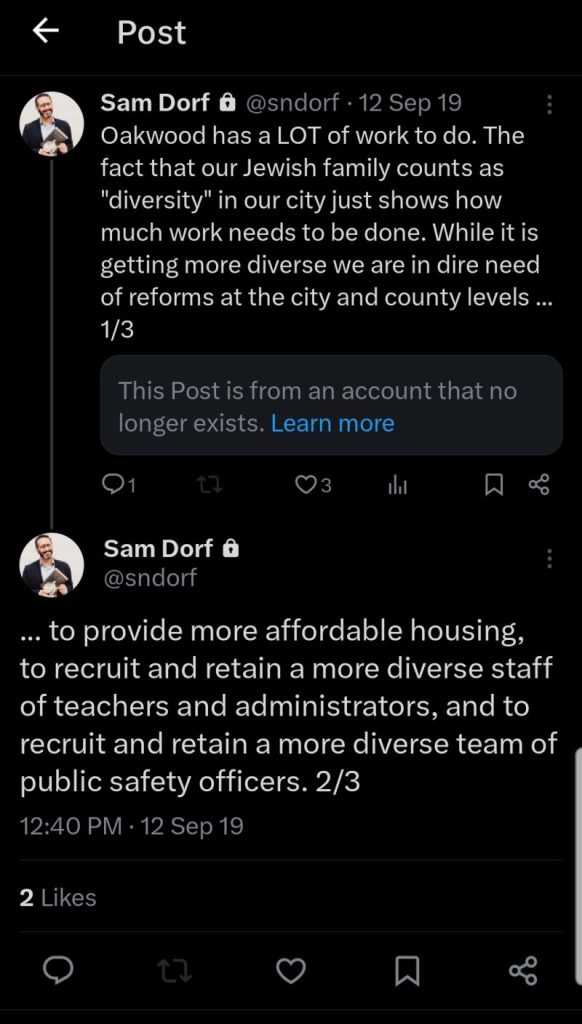
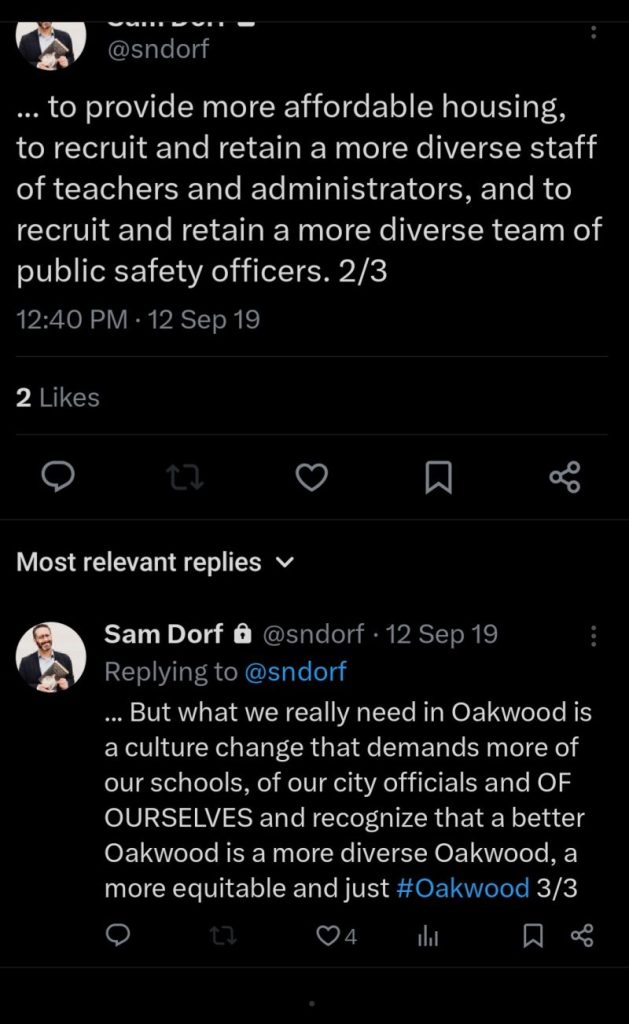
In the past several years, Oakwood City Council candidate Sam Dorf has repeatedly expressed great interest in expanding low income and multi-unit (aka “affordable”) housing in Oakwood, in conversation with residents and on social media. For example:

However well intended this idea may be, Oakwood is simply not designed for significant levels of this type of housing. Adding more of it here would likely bring in more congestion, more crime, possibly strain Oakwood’s schools, and lower our property values. Online crime maps show areas with this type of housing have higher crime rates, including around Oakwood (for example, see here). Oakwood residents living near existing low income housing have already reported problems with loitering, vagrants, drug paraphernalia and litter in and around those properties.

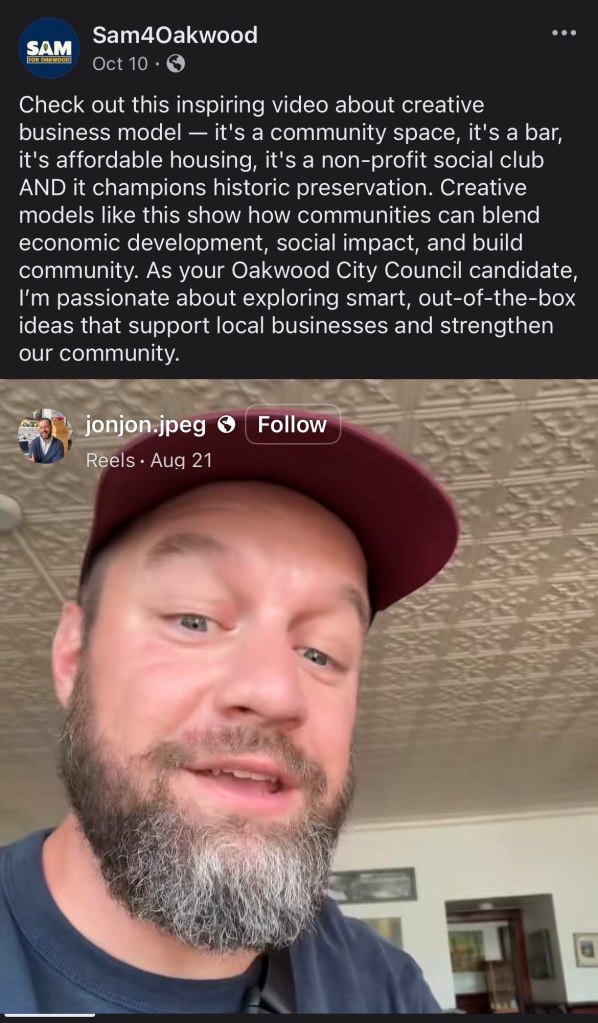
Now, the City Council election is in full swing, and one of the major issues in the election is addressing the vacant buildings and overall conditions in the shops of Oakwood. Mr. Dorf’s latest idea for expanding this type of housing is to bring it right into this very area the City is trying to revitalize. He recently proposed the following solution on his campaign Facebook page: converting vacant buildings to community resident-owned, non-profit businesses that sidestep “traditional access to capital”, with “affordable” rental housing right above them:

The video featured in his post can be viewed here.

Oakwood shops property owners have already struggled to bring in new businesses to their vacant stores and office spaces. Business owners have indicated one of the main reasons is the high rent, which owners must charge to cover Oakwood’s high property costs and taxes in that area. Another problem is restrictive zoning, which would have to be radically altered to allow housing in the shops area. One has to wonder how avoiding larger investors and relying on residents buying shares into a non-profit would raise enough funds to make Mr. Dorf’s proposal feasible, and whether the City would appreciate the loss of tax revenue that could otherwise be generated from for-profit businesses.

But the larger concern is the impact of having residential tenants living above the shops and offices, especially low-income or even subsidized tenants if that is part of the plan. How many business owners would appreciate having the commotion of families with infants or small children, wild parties or altercations, or a leaking shower or toilet right above their restaurant, store, salon or professional office? How would they like to have any of the more serious problems described above, which Oakwood residents have already seen with some of this housing, in or around their business properties? How many customers, or residents living near the shops area, would like more of those problems?

This sort of collectivist approach to improving Oakwood’s commercial district may look appealing from the ivory-towered vacuum of academia. But for real world business owners, that, together with Oakwood’s high rent and zoning issues, would be one more compelling reason to set up shop elsewhere. And for businesses already here, it would be one more reason to leave. In short, Mr. Dorf’s idea of injecting low-income housing in Oakwood’s commercial district would likely exacerbate its decline by driving away business and investment, and it could prove to be one of the worst things to happen to the district, to Oakwood’s economy and to the City as a whole.

Oakwood needs City Council members with more sensible approaches to this issue – approaches that are better attuned to the needs and concerns of businesses and residents, and to economic realities.

Sam Dorf Oakwood City Council Attack Ad Sparks Controversy Over Negative Campaigning

October 18, 2025

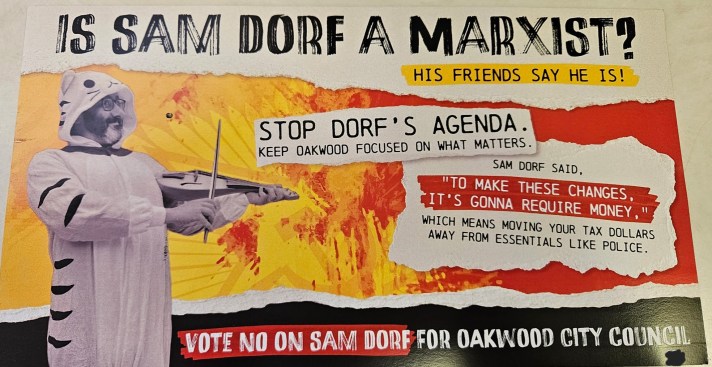
Controversy recently erupted on the eve of the Oakwood City Council election, when a negative ad appeared on internet streaming and television channels regarding City Council candidate Sam Dorf, which can be seen here: https://youtu.be/sdA9BnqtPro?si=RvzGn-jXe62FZuVm

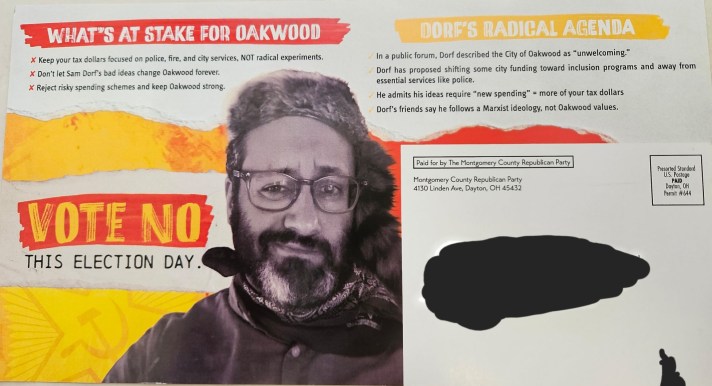
The ad says it was funded by the Montgomery County Republican Party, and the other two candidates in the election promptly confirmed no association with the ad and denounced negative campaigning of this sort, pledging to continue running positive campaigns focused on the issues. Mr. Dorf also condemned the ad, claiming it is inaccurate and “xenophobic”. The ad was then followed by this mailer, also from the Montgomery County GOP:

Like it or not, negative ads like this are typical during election season, though usually in larger elections. But how effective are negative ads in delivering their intended results? At a time of concern about the tone of our political discourse, are they the best approach versus purely positive campaign messaging? Look at the above examples. Do they discourage you from voting for Mr. Dorf, motivate you to vote for him, or have no effect on your voting decision? While these ads touch upon some policy issues, like claiming Mr. Dorf has called for diverting funds away from police, negative ads are often more substantive, focusing on a candidate’s record and stances on the issues. These appear aimed more at simply making the candidate look bad, rather than offering critiques that could be raised of Mr. Dorf’s extensive controversial record.

It is unusual to see these large ad campaigns in such local-level elections, and candidates for Oakwood’s City Council and Board of Education elections have generally run positive campaigns promoting their strengths. However, Oakwood has seen negative campaign messaging before, from sources other than the candidates, and their impact on election results is questionable.

In the 2023 Board of Education election, screenshots and pictures of one conservative candidate were circulated by residents, including by Mr. Dorf, and it fueled heated and sometimes rude criticism of the candidate on social media for her expressed religious and other views on social and political issues.

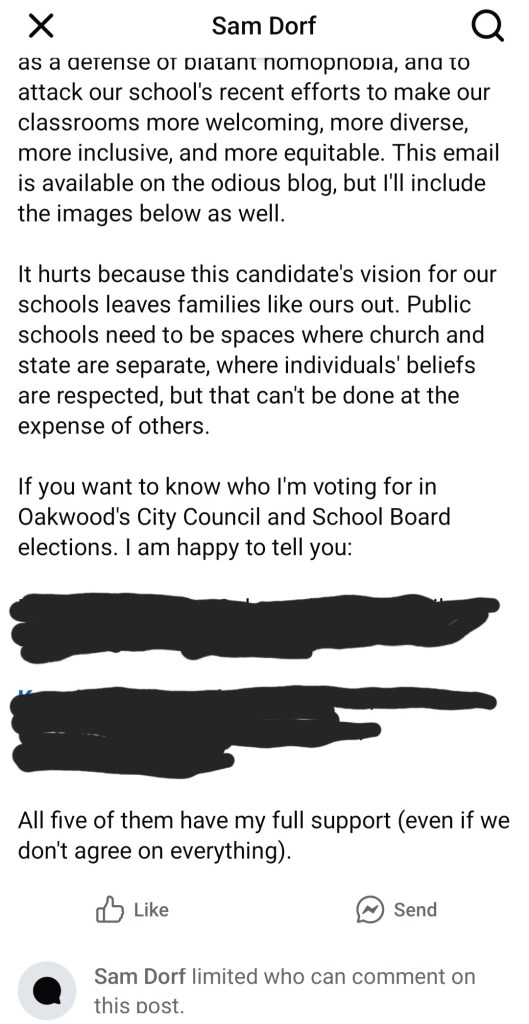
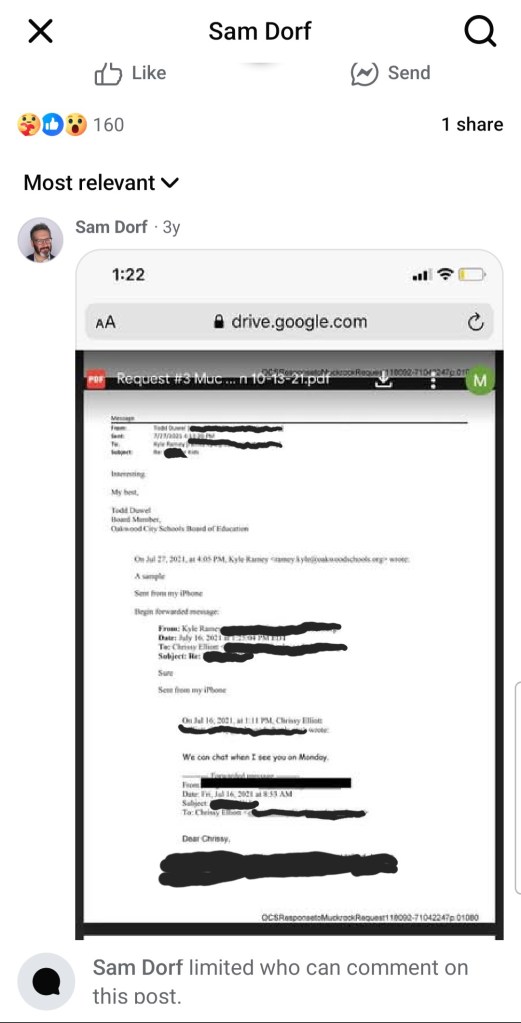
In the 2021 Board of Education election, a conservative candidate was vilified by progressive residents on social media and elsewhere, for statements she made in a private email to an Oakwood school official after the school district disclosed the email in response to a public records request. She expressed her religious reasons for asking the school to opt her children out of controversial classroom instruction on sexuality and gender identity. Her statements were entirely within mainstream Christianity, and her expressed view that public schools should be neutral on those topics is the most mainstream position on that issue. Her email was also personal, private, and sent before she was a candidate, in her role as a mother concerning her children. Nevertheless, residents posted the private email on social media during the election and used it as fodder to attack the candidate for her religious and other views on those topics, including Sam Dorf himself, who called her beliefs “homophobic” (candidate’s email is left out for privacy reasons):

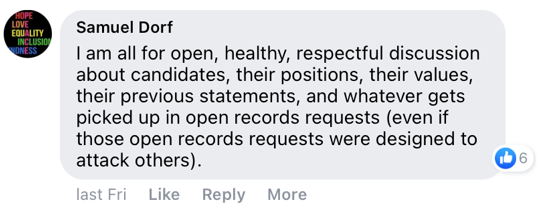
Mr. Dorf even defended the attacks (which were hardly “respectful”), and the use and disclosure of the candidate’s email for that purpose:

The Democratic Party even included the candidate’s email in campaign literature distributed in Oakwood.

This demonstrates a flagrant disrespect for the candidate, for her and her children’s privacy, and for her religious beliefs. It was later revealed that the Oakwood school district had disclosed the email in violation of student privacy laws, from a lawsuit the candidate filed against the district, which district settled with a public apology. And yet, that email remained published by Mr. Dorf and others on social media.

Mr. Dorf now presents himself as a victim of negative campaigning, but could one say that what is good for the goose is good for the gander? What was done to that candidate in 2021 was actually far more egregious than what these ads are doing to Mr. Dorf in this election. Or, is it better stick to positive campaigning to take the high road? Is some degree of negative campaigning acceptable as a way of informing voters of a candidate’s record if it is done respectfully?

Also, did that negative messaging affect those prior Board of Education elections? Those two disparaged candidates received about the same share of votes as the other conservative or Republican candidates in those elections, whose campaigns were not subjected to any negative messaging or controversy.

The effectiveness and propriety of negative campaign messaging is highly debatable, but one thing is certain: for better or for worse, it’s likely here to stay.