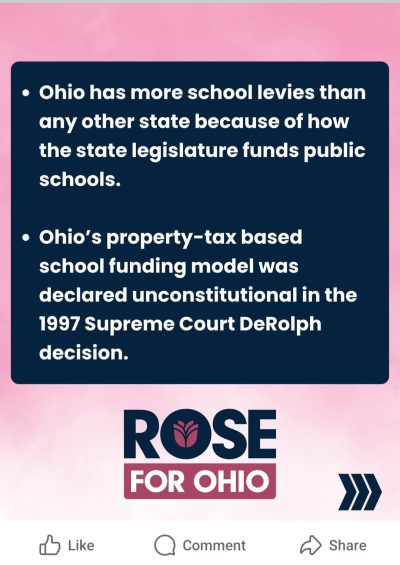
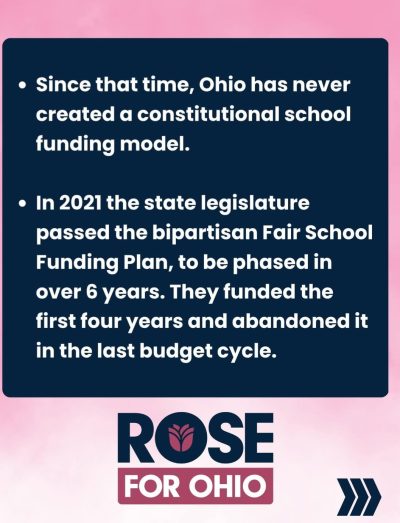
In her campaign social media posts, website and speeches, Ohio House District 36 candidate Rose Lounsbury has made a number of false or misleading statements regarding the Ohio state government’s funding of public education, and of Ohio’s popular EdChoice voucher program. Assuming this was unintentional on her part, they represent, at a minimum, a lack of proper understanding of public education funding and of the EdChoice program.
The following is the most recent example:
Here are the key facts and resources you need to know:
The state has NOT been cutting public school funding, such as to channel it to vouchers.
Rose’s above post implies the state has been cutting its public education funding. She also falsely claimed that Ohio Republicans have “continually cut funding to our public schools” (see here at 8:55). The reality is that the state’s funding of its public schools on a per-pupil basis, and adjusted for inflation, has steadily increased over the past 25 years both before and since the creation of EdChoice and other voucher programs. See this State Auditor’s report on school revenues here at its pages 9 and 10 for more information on that. In two other negative campaign ads (here and here), Rose falsely accused her election opponent, incumbent Ohio House Representative Andrea White, of voting to cut public education funding by diverting the funds to EdChoice vouchers via her vote for HB 96. To the contrary, HB 96 increases Ohio’s K-12 public school funding by $226 million for the 2026-2027 budget versus the already record-high 2025 levels (see here and here).
For in-depth analysis debunking these and other false claims about Ohio’s public school funding and how it is impacted by EdChoice vouchers, see the outstanding research articles published by the Thomas B. Fordham’s Institute here in Dayton, starting with this one: Don’t Blame EdChoice for District Budget Woes. This article notes that Ohio public school enrollment is down 15% since 2010 which reduces (the nevertheless increased) state funding from what it would otherwise be, since enrollment numbers are a factor under the state’s funding formula. However, rather than reducing staffing accordingly, school districts only reduced their teacher staffing by 5% and actually increased administrative staffing by 3% during that same time period. This article also points out that Ohio public school districts actually received nearly $1 billion more funding for 2026 than they had projected in a spring 2022 five year budgetary forecast, which was made prior to the 2023 EdChoice expansion. Therefore, EdChoice is not the cause of Ohio public schools’ budgetary challenges, it’s quite plausibly inadequate financial management and cost control to a significant extent.
The state has NOT been disregarding the funding changes required by the DeRolph v. State decision.
The DeRolph decision held the state’s then funding formula unconstitutional, based significantly on the formula’s primary reliance on local taxes for funding. Since 2022, the state has been phasing in the Fair School Funding Plan (FSFP), a bipartisan plan enacted precisely to comply with the requirements of the DeRolph decision. That plan shifts most funding to sources other than local taxes, with more funding from the state. The FSFP creates a more equitable distribution of state funding as well, based on a number of factors including property values and income levels of districts, and their actual costs and expenses of educating kids. Also, the Ohio government did NOT abandon that plan last year, it has continued phasing it in to the present day. See here. For sure, Democrats and Republicans disagree on whether the FSFP funding can and should be phased in more rapidly and on the adequacy of public education funding overall (Democrats will always favor higher spending), but it is not true that the Republican-led Ohio legislature or Governor have abandoned the FSFP.
Regarding the ongoing lawsuit seeking to eliminate the EdChoice Program, see these Fordham Institute articles here and here for further critiques of the lawsuit, and decision of the lower court, on the state’s public school funding and how it is impacted by EdChoice.
It is NOT true that school districts across Ohio have all had to pass numerous levies to compensate for insufficient state funding.
Rose may have a skewed perception on this from her unusual experience as an Oakwood resident. Ohio’s districts vary widely on the state funding they receive, and on the number and size of levies they pass. The latter is partially due to the former, and to differences in voter preferences. The Fair School Funding Plan varies state funding based in part on property values and income levels of a given district as a form of “equity”: poorer districts that lack the income and property values to carry as much of the funding load receive more state funding, while wealthy districts such as Rose’s in Oakwood receive less funding, since they are better able to “pay their fair share” of the funding burden. This is why, for instance, the relatively poor Dayton Public Schools district had, on a per-pupil basis, 19.6% more funding and 25% higher spending (just outside the top 5% highest of all Ohio districts) than Oakwood in 2025, despite having passed only ONE levy in the past 15 years. Further, Oakwood residents are more willing to pass more levies, whether needed or not, because they place a high priority on their prized, top-ranked schools, which are the community’s flagship attraction, and Oakwood’s voter turnout also leans heavily Democratic by 60-65%, thus favoring higher levels of government and school spending. If Rose is upset with her high property taxes from these levies, she has herself and other liberal Oakwood voters to blame. See this chart for the 2025 school funding and spending data.
Public school funding is NOT being “channeled” to, or “drained” by, EdChoice and other voucher programs.
Rose Lounsbury falsely claims EdChoice “drains” public school funding, when EdChoice doesn’t restrict Ohio’s budgeting levels for public schools. EdChoice enrollments don’t withdraw funds that would otherwise cover public schools, including, as Rose claims (here at 8:25), by the sheer fact that both are funded under the same Education budget line item. Ohio’s education budget line item includes funds for both public schools and EdChoice based on projected enrollment for each during the biennial budget cycle. Any leftover funds expire at the end of the budget cycle; they don’t go to public schools.
Further nothing in EdChoice’s design limits the amount the state can budget for public schools; the state and budget as much as it wishes for public schools. The most Rose can do is speculate that if these vouchers did not exist, state might have budgeted even more increased funding for public schools, but that is pure conjecture. There is no withdrawal of money to EdChoice that somehow belonged to or was allocated to public schools.
Again, see this and other Fordham Institute articles for analysis debunking these and other false claims about Ohio’s public school funding and how it is impacted by EdChoice vouchers: Don’t Blame EdChoice for District Budget Woes.
Eliminating vouchers would NOT significantly increase public school funding, even if all of the funding for the former were allocated to the latter, which is unlikely to happen.
The $1.09 billion the state budgeted for EdChoice for 2025 sounds like a large number, but that equals only 8.1% of the $13.51 billion the state budgeted for K-12 public schools in 2025. See here. A mere 8.1% increase in state funding of public schools would be a negligible funding increase, on a per pupil basis and if it were actually needed, the state could simply budget more for public schools without compromising EdChoice.
For example, for the academically struggling Dayton Public Schools district (DPS), if EdChoice had been eliminated and the money spent on it that year was instead allocated to an 8.1% increase in State public school funding, that would have only yielded an additional $919 in per-student spending for the DPS district (i.e., $11,343 state funding per pupil increased by 8.1%) See here for this funding data. In 2024, among that district’s 8th graders, only 8.9% were proficient in math and only 11.5% were proficient in English language arts, and the four-year high school graduation rate was only 72.3%. That is despite $23,209 in total spending that year, do we really think another $919 per student, plus a small increase in State funding from enrollment of returning former EdChoice students, would have been the transformative catalyst that would have significantly improved those outcomes?
For further information, see this article on this page, refuting Rose’s prior claims that eliminating EdChoice vouchers and allocating those funds to public schools would somehow improve failing school districts in Ohio. Higher levels of spending have not produced better outcomes, as seen by the dismaying student performance results in some of the highest-spending districts (Dayton, East Cleveland, or Baltimore City for an out-of-state example) versus those of Oakwood City Schools.
In this election, we have a choice between our experienced, incumbent Ohio House representative, Andrea White, who has championed mainstream policies fostering economic and job growth, affordability, public safety, assisting the needy and increased funding of public and private education, and her second-time challenger Rose Lounsbury, whose inexperience, polarizing partisan messaging, apparent unfamiliarity with core issues and controversial platform pose real concerns, including for our economy, affordability, healthcare and education.
In her six years representing us, Andrea White has supported the above priorities via legislation including: reduced taxes and regulations on businesses, bolstering economic and job growth and affordability; overhauling Ohio’s single-family homeowner’s tax credit and property tax exemptions to improve home affordability; supporting law enforcement and first responders; anti-crime measures such as legislation imposing tougher penalties, upgrading criminal background checks and combating vehicle thefts; increased funding of vocational and career training; and additional resources addressing Ohioans’ mental health needs (see generally, here). Andrea has worked across the aisle on bipartisan legislation, such as to combat infant mortality, assist low-income mothers and strengthen child support enforcement. She has repeatedly supported increased funding of both traditional public education and Ohio’s popular EdChoice voucher program for affordable access to private schools that can be life-changing for students in low-income families and failing school districts, and students whose public schools aren’t meeting their needs, most recently for her vote for Ohio House Bill 96 (see here and here).
Rose Lounsbury, while deservedly well-regarded, supports an agenda detrimental to Ohioans, and her inexperience is apparent in numerous inaccurate or misleading campaign statements that I doubt were intentionally false, but indicate a lack of understanding of key issues cloaked in boilerplate party talking points. As noted in my May 13th letter to the Oakwood Register editor (see sourced online version here), in one of her negative ads against Mrs. White and Ohio GOP leadership, she made outlandishly false claims that Ohio House Bill 249 would criminalize cross dressing and mainstream theatrical performances with cross-dressing characters, likely from her failure to either read the bill or to read it accurately, which are vital functions of a competent legislator.
In two other negative campaign ads (here and here), Rose falsely accused Mrs. White of voting to cut public education funding by diverting the funds to EdChoice vouchers via her vote for HB 96, when HB 96 actually increases Ohio’s K-12 public school funding by $226 million for the 2026-2027 budget versus the already record-high 2025 levels (see here and here). She has falsely claimed that Ohio Republicans have “continually cut funding to our public schools” (see here at 8:55), when funding of Ohio public schools on a per-pupil basis, from the state and overall, has been steadily increasing over the past 25 years (see here at page 10). She falsely claims EdChoice “drains” public school funding, when EdChoice doesn’t restrict Ohio’s budgeting levels for public schools, and EdChoice enrollments don’t withdraw funds that would otherwise cover public schools, including, as Rose claims (here at 8:25), by the fact that both being funded under the same budget line item. Ohio’s education budget includes funds for both public schools and EdChoice based on projected enrollment for each. Any leftover funds expire at the end of the budget cycle; they don’t go to public schools.
Rose blamed Republicans in Columbus for Ohio’s high property taxes and accused them of granting “tax cuts for the rich” at other Ohioans’ expense, when property taxes are driven mainly by local governments, mostly via voter-approved levies and bonds, have repeatedly given Oakwood among the highest property taxes of any municipality in the Dayton area. If she’s unhappy with her high property taxes, she has herself and other Oakwood voters to blame. The taxes controlled by the Ohio government are actually quite low, with among the 10 lowest income tax burdens of states charging income tax, including for the middle class (see here).
Mrs. Lounsbury’s platform presents serious concerns, particularly for our economy and affordability. Her campaign kickoff speech featured affordability as a reason voters should “flip” control of the Ohio House and government to Democrats, with logic exemplifying the correlation-causation fallacy: affordability (cost of living) has worsened for Ohioans in recent years, and Republicans are to blame since they controlled Ohio’s government during that same time period. She never mentioned prices and living costs also rose everywhere else nationwide, due to unprecedented deficit spending by the federal government financed with printed money, beginning with emergency COVID spending, but then continuing under the previous administration even as the pandemic waned. This brought inflation from only 1.4% in January 2021 to a staggering 40 year-high 9.1% in June 2022. This had nothing to do with Republicans in Columbus.
Rose is correct, though, that state government policies profoundly impact affordability. However, by equating a state’s cost of living with the political party controlling its government, she ironically makes one of the most powerful arguments against her entire candidacy. Blue states typically have significantly higher living costs, representing 9 of the top 10, and 16 of the top 20, states with highest costs of living, while red states represent 9 of the bottom 10, and 18 of the bottom 20, states with the lowest living costs, per 2025 rankings. If Rose thinks Ohio has an extraordinary affordability problem, she hasn’t looked at the data; Ohio’s cost of living is not only below most states, it’s lower than every blue state in America excluding New Mexico, which is ranked right behind Ohio. In other words, affordability is worse than Ohio’s in virtually every state with Democrats in control, as she is advocating.
This isn’t merely a correlation; it’s a result of blue state policies, including those in Mrs. Lounsbury’s platform. Blue states impose significantly higher taxes and regulations on individuals and businesses. This leaves residents with less after-tax income for affordable living, and drives up operating costs on businesses, who respond either by reducing or eliminating hiring, staffing or pay increases to offset those costs (thus hampering affordability for the workforce), or by transferring those costs to customers via higher prices. This is why things are often more expensive in blue states than red states.
Blue states account for all of the 10 states with the highest income taxes, and none of the 10 with the lowest among states that charge income tax (see here). Presumably, Rose supports raising income taxes given her “tax cuts for the rich” rhetoric, and even limiting tax increases to “the wealthy” is a job killer and inflates consumer prices from its impact on businesses. This is because 95% of all businesses pay income taxes through their owners’ individual income tax returns and tax rates (aka “flow-through” taxation), and 91% of all taxable income from these “flow-through” businesses – the backbone of our economy and job creation – is reported in the top 20% income level and 57% is reported in the top 1% level (see here).
Blue states impose higher regulations detrimental to affordability, including zoning and permitting laws that elevate housing costs, and labor laws such as raising the minimum wage, which has consistently inflated consumer prices and reduced jobs while crushing small businesses (see, e.g., here and here). Mrs. Lounsbury supports the latter with her website’s “living wage” rhetoric.
Like most blue states, Mrs. Lounsbury supports expanding unions, which impose an average of 15% – 25% higher labor costs by coercing employers to provide above-market compensation and benefits packages, including pensions that are unaffordable to most private companies and a leading cause of state budget deficits (see here at p. 7). This results in higher consumer prices and job losses. A unionized can hardly provide competitively-priced products if its labor costs are up to 30% higher than its non-unionized competitors. Unsurprisingly, private sector union membership has therefore plummeted by over 70% since 1980 and is now five times more prevalent among government employees, whose employers can force taxpayers to pay the inflated labor costs. A 2018 Ohio State University study found that one of the two main causes of Ohio’s loss of manufacturing fueling its over 50-year economic decline was effectively labor unions; specifically, manufacturers relocating to other states with “right to work” laws that prohibit requiring workers to join unions.
Rose has an entire webpage promoting unions, and while she cites her personal and family history of union membership, don’t think that’s the only reason. Her 2024 and 2026 campaign finance disclosures show multiple unions lining her campaign’s pockets. Therefore, if you vote for Rose Lounsbury, you are voting to double-down on a leading cause of Ohio’s manufacturing and economic decline, for the enrichment of her union donors. A key step to revitalizing Ohio’s economy is actually the opposite of Rose’s agenda: make Ohio a “right to work” state so we can bring back those lost manufacturing jobs.
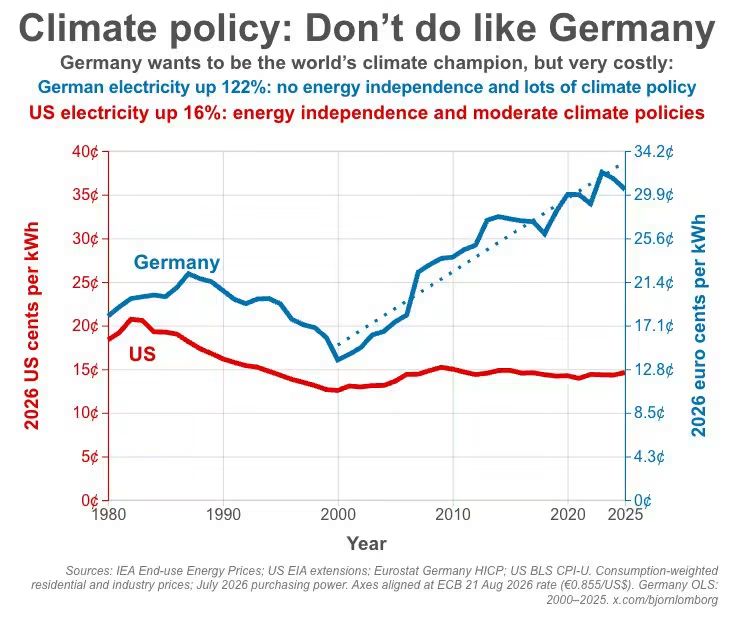
As with many blue states, Mrs. Lounsbury supports burdensome environmental regulations that inflate business operating costs and prices, including “cap-and-trade” initiatives that heavily tax and regulate fossil fuels to compel transitions to costly, inefficient and unreliable “green” energy such as wind and solar power, which her website ironically presents as making energy “affordable” as families struggle with high energy costs. In Germany, these policies increased consumer energy prices by over 120% to the highest in Europe and among the highest in the world (see here, here and here), with energy shortages in winter. Washington State’s similar program inflated energy prices by 41% in five years, and California’s program increased energy prices five times higher than anywhere else in the U.S. for a staggering 127% price increase, with periodic energy shortages. If you’d like your energy bills to balloon by 40% to 127% with possible shortages, then Rose Lounsbury is your candidate. While her campaign’s “Working Families” webpage laments high energy costs for families, her “Environment” webpage pushes these same energy policies. Further, that webpage suggests she supports restricting or banning fracking and other fossil fuel production, which would devastate eastern Ohio’s economy.
Similarly, Mrs. Lounsbury’s “Healthcare” webpage laments higher healthcare costs for families while prescribing policies that would drive them higher. Her proposal to mandate minimum staffing levels for healthcare facilities – likely higher than they would otherwise maintain – would trigger higher operating costs passed onto patients. Alternatively, facilities may resort to hiring staff willing to work for substandard compensation to satisfy the mandate, risking inferior healthcare, sanitation and overall patient experience.
Mrs. Lounsbury’s education agenda would produce poorer student outcomes and fewer educational choices, leaving many students trapped in schools that are failing or otherwise not meeting their needs. Her flawed education pitch blames sheer Republican control of Ohio’s government for Ohio supposedly ranking 30th in education (see here at 13:40) (it’s 12th per a July 2026 Ohio Capital Journal report), while falsely claiming Republicans have cut education funding (see here at 13:00) when the state’s funding of its public education has steadily risen over the past 25 years (see here at page 10). As with property taxes, she ignores the central role of local government. Ohio would rank significantly higher but for pockets of failing school districts with mismanaged municipal governments (e.g., Dayton, Toledo, Cincinnati, Cleveland, Columbus), and like most others in the U.S., the vast majority have been run by liberal Democrats and their teachers’ union donors for decades. A recent Progressive Policy Institute study found blue states with heavy teachers’ union influence frequently have worse student literacy than red states. Only 4 of 23 states with the highest scores were blue states (13 were red states), and 8 of the 10 states with the worst literacy scores were blue states with heavy teachers’ union influence. Teachers’ unions notoriously oppose any manner of education reform, accountability and school choice because they prioritize their self-interests over students. This hardly makes the case for “flipping” the Ohio House and government to Democrat control.
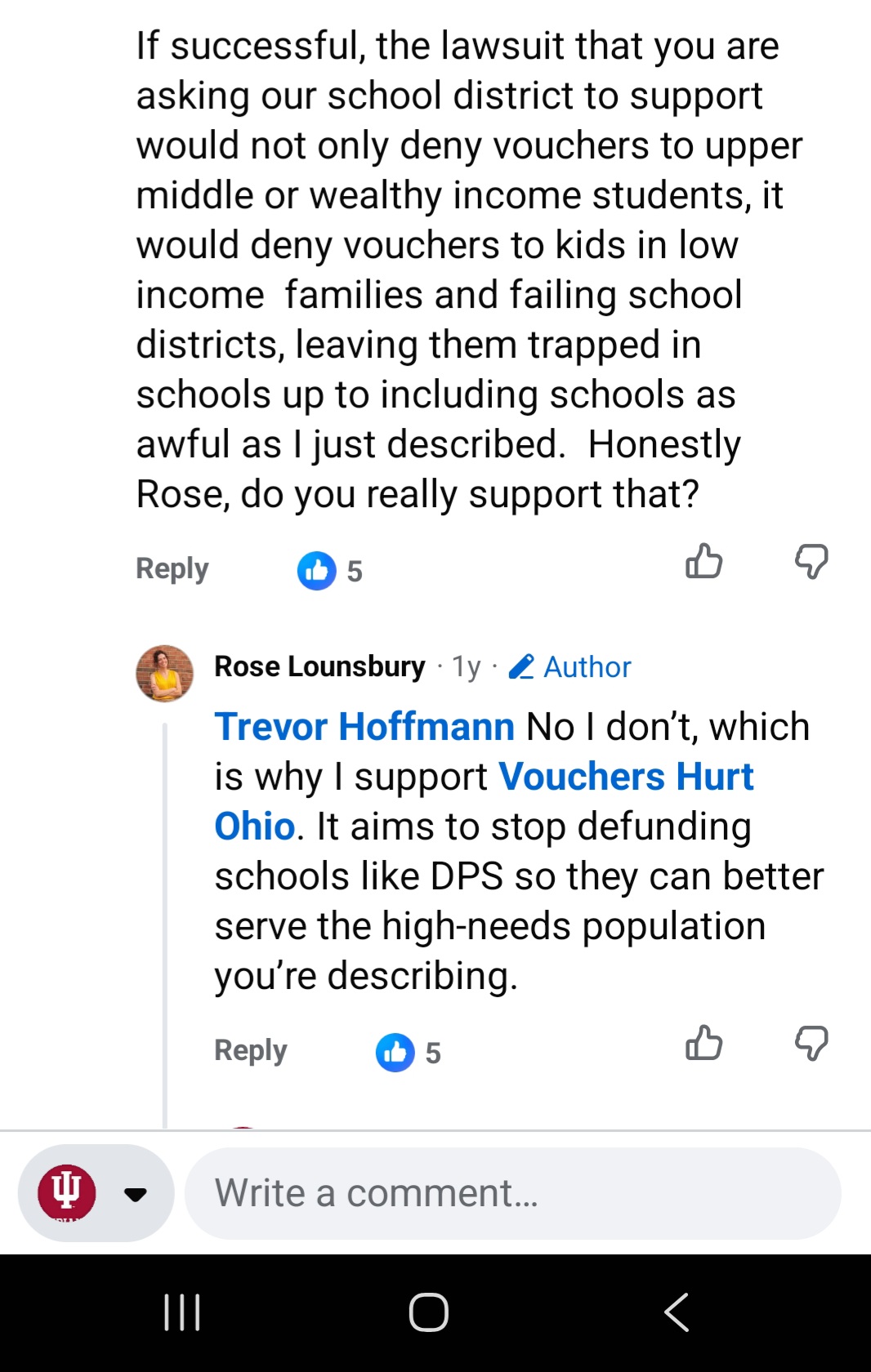
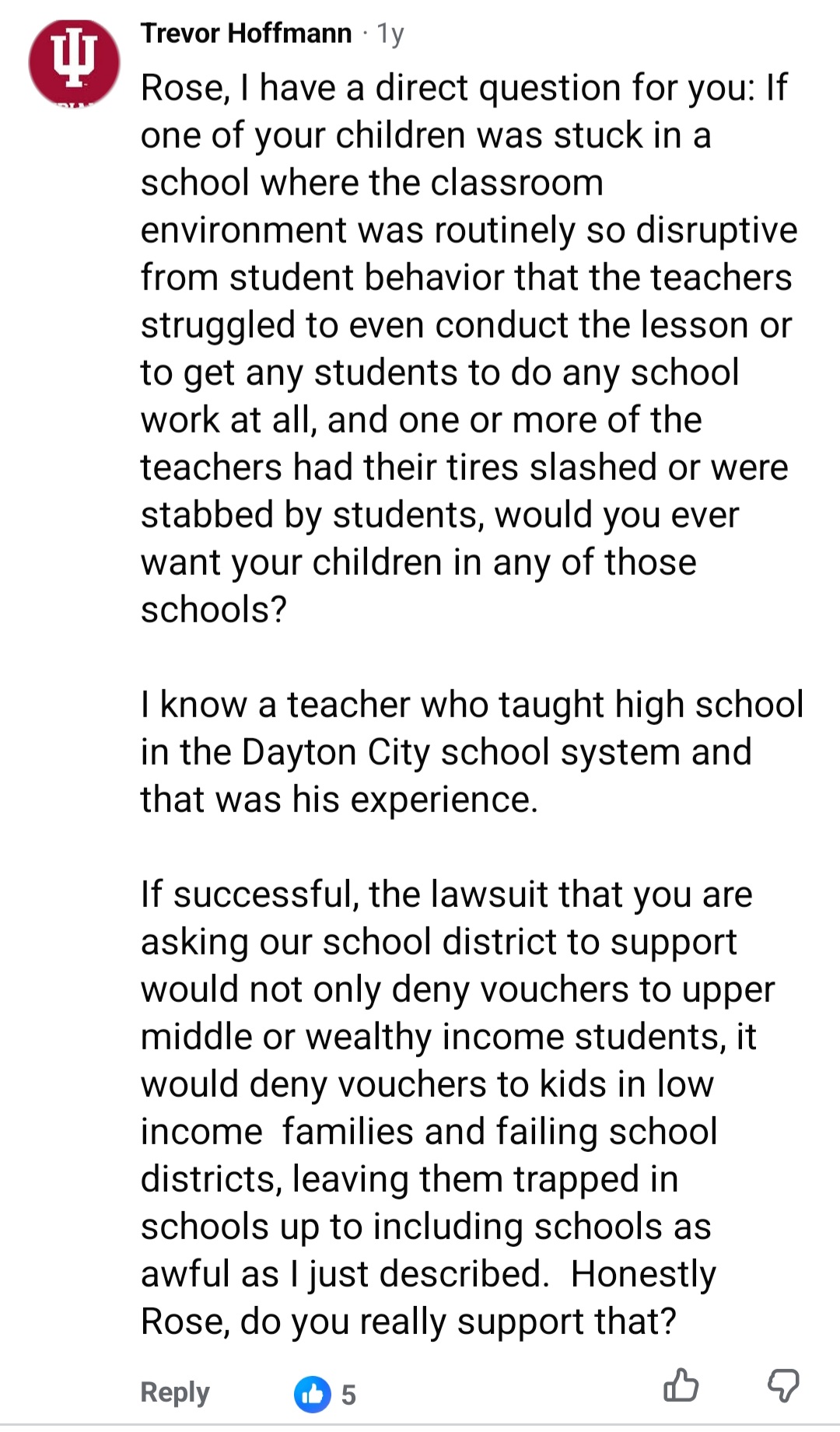
As a far-left Democrat and former teachers’ union representative, Rose Lounsbury would tow the line on policies that have perpetuated these pockets of failing districts and left their students without viable alternatives. Unsurprisingly, she vigorously supports eliminating Ohio’s entire EdChoice voucher program (not just the 2023 expansion). This would leave disadvantaged students trapped in troubled districts and learning environments that in the case of the Dayton Public Schools (DPS) district, Rose admitted to me she wouldn’t want to leave kids trapped in, given the disturbing conditions there as described by a former DPS teacher. She purportedly champions education, while seeking to deny disadvantaged students access to high-quality education such as her kids enjoy in Oakwood’s top-ranked district. I find this hypocritical.
Lastly, the abrasive, partisan tone of Mrs. Lounsbury’s campaign messaging with its continuous negative attacks against Mrs. White and other Ohio Republicans indicate that if elected, she will not work effectively across the aisle with the likely continuing Republican House majority to actually get things done. Rather, she will be a shrill, ineffectual performer, posturing from the margins of the House without delivering meaningful results for her constituents.
For these and many other reasons, I am voting for the candidate with years of experience successfully representing us that Mrs. Lounsbury lacks, and whose policies are grounded in a proven history of better affordability and opportunities for Ohioans. I am voting for Andrea White, and if you are concerned about Ohio’s future, I urge you to do the same.
In her second attempt to unseat our Ohio House representative, Andrea White, Rose Lounsbury posted an ad early last month on her campaign’s Facebook and Instagram pages, in which she attacks her opponent and the Ohio Republican Party for backing Ohio House Bill HB 249 (the Indecent Exposure Modernization Act), which the House recently passed. This bill is best known for seeking to prohibit sexualized drag queen and other graphic adult performances in public settings.
In her ad, Mrs. Lounsbury claims HB 249 would “ban Mrs. Doubtfire” from being shown or performed and “make it a felony, actually, to dress like a member of the opposite sex”. She sarcastically questioned if HB 249’s backers would make a citizen’s arrest at this month’s performance of Mrs. Doubtfire at the Schuster Center, and she criticized Representative White and the Ohio GOP for prioritizing “banning Mrs. Doubtfire” over more pressing issues facing Ohioans. In comments beneath her ad, she also affirmed claims that HB 249 would ban performances of Shakespearean plays with males playing female characters, and Hairspray and Chicago among other theatrical classics.
I reviewed HB 249, and if these claims sound too outlandish to be true, it’s because they are blatantly false. I don’t think Mrs. Lounsbury would deliberately make false statements in her campaign, but that leaves only two explanations: either she didn’t bother to read the bill before releasing her ad, or her reading of the legislation was astonishingly careless and inept, especially for someone campaigning to serve as a legislator. Either way, it gives little confidence she would properly perform those basic responsibilities of the office she is running for, which will often involve legislation substantially more complex than HB 249. If elected, her constituents would rightfully expect her to competently review and understand pending legislation before taking a public position or voting on it, and to communicate about it accurately to her district.
Nowhere in HB 249 does it make it a crime merely to dress like the opposite sex (see the text of the bill here). The bill prohibits “adult cabaret performance(s)” in settings other than restricted adult venues or other exempt locations where minors may be present, such as in public. That term does include performances involving cross dressing along with five other defined categories of performances (e.g., nude and other adult performances). However, the bill only prohibits such performances under limited conditions; most importantly, they must be “harmful to juveniles” or “obscene”, as those terms are defined in an Ohio sex crime statute (RC 2907.01) (see HB 249, lines 153-155; 174-175).
Go read those terms in RC 2907.01 (see here at paragraphs (E) and (F)). They refer to extremely graphic and salacious adult content that virtually no one would deem acceptable for public display in front of children – nothing like Mrs. Doubtfire or those other classic works mentioned beneath Mrs. Lounsbury’s ad. For example, they apply to highly explicit sexual material that: (a) involves nudity or graphic depictions of sexual acts without any serious literary, artistic, scientific or educational value; (b) is “patently offensive to prevailing standards in the adult community”; or (c) has a predominant appeal of inciting sexual arousal or sexual interest that is “prurient” (unhealthy or shameful under prevailing community standards).
Neither Mrs. Doubtfire nor any of those other works contain such explicit content to my knowledge, but if they did, they are hardly lacking in serious literary or artistic value or patently offensive to prevailing community standards; they are widely performed, highly acclaimed theatrical or literary works. I’m also quite certain that sexual arousal or unhealthy sexual interest are not their predominant audience appeal, least of all Mrs. Doubtfire’s character.
In case it wasn’t obvious enough that HB 249 would not criminalize Mrs. Doubtfire or those other works simply for including some element of cross dressing, the bill’s drafters went out of their way to make that clear with a provision stating that the prohibition of adult cabaret performances will not apply to “any bona fide film, theatrical, or other artistic endeavor or performance that is not obscene or harmful to juveniles”. Mrs. Doubtfire and those other celebrated works are unquestionably bona fide films and theatrical performances (see HB 249, lines 320-323).
In a comment beneath her ad, I politely asked Mrs. Lounsbury if she or her campaign had reviewed HB 249 before releasing the ad, and to explain the basis for her ad’s claims about the bill given its provisions. While she promptly and enthusiastically responded or reacted to all other comments to her ad, as she typically does, she never answered mine. Ironically, at the same time she was apparently ignoring my reasonable questions about her position on HB 249, she posted her next attack ad against her opponent, stating “I’m so done with politicians who [don’t] listen to the voters”. I totally agree.
Perhaps most striking about her ad is that it completely ignores the obvious, true focus of HB 249: to prevent displays of sexually graphic, patently obscene adult performances in public areas where children may be exposed to them without their parents’ prior knowledge or consent. Why? Does she see nothing wrong with that, and if so, is the “Mrs. Doubtfire” angle meant to distract from that larger reason for her opposition to the bill? If Mrs. Lounsbury believes that exposing children to such performances in public without their parents’ knowledge or consent is perfectly acceptable, then she should be transparent about it. But that would likely reveal that her position on this issue is at odds with the prevailing views and values of the district she’s campaigning to represent.
It might behoove her to recall that in her previous unsuccessful campaign for this House seat, she herself was the subject of a scathing ad from her opponent, based partially on her support for allowing transgender-identifying biological males to compete in female sports. Apparently, taking the 20% side of 80/20 social issues is not a winning campaign strategy2.
2For example, a Suffolk University/USA Today poll showed only 21% of Ohioans support allowing biological males who identify as transgender girls to play on girls’ sports teams, while 70% are opposed and 9% are undecided. See here.
Oakwood City Council candidate Sam Dorf has a history of collaborating with outside, controversial activist groups for guidance on Oakwood City policies.
As noted in a recent letter to the Oakwood Register (posted here), in 2019 Mr. Dorf effectively accused Oakwood police of racial profiling based on a deeply flawed study by ABLE, an activist organization, including in the October and December 2019 City Council meetings. Mr. Dorf even stated that the study’s claims were consistent with his own observations of Oakwood police. Even after the study was thoroughly discredited by the City in both meetings for lacking numerous critical facts to justify the accusations, Mr. Dorf doubled down on the study in the December City Council meeting, claiming it was nonetheless important to follow the study’s recommendations to address the “perception of Oakwood”. This can all be seen in the minutes from those meetings here and here.
The traffic stop statistics of the ABLE study were also the basis for Mr. Dorf’s writing to City Council members to urge the police department to end the practice of stopping drivers based on random license plate checks, even though the City noted it is a nationwide best police practice to catch drivers with suspended or revoked licenses or who are under arrest warrants (accounting for nearly 25% of criminal suspects under arrest warrants apprehended by Oakwood police) (see here). Mr. Dorf’s stated reason was to reduce the racial disproportionality of racial minority drivers stopped by police as reported in that study, with no mention of the impact on public safety from ending that practice (see here). Records obtained from Oakwood police show a significant drop in traffic enforcement since then and resident complaints of increased speeding and reckless driving, as noted in that letter to the editor on that issue.
Mr. Dorf’s call for a policy of suspending without pay and publicly identifying, and thus effectively doxing, Oakwood police officers who discharge their weapon against unarmed suspects (regardless of the circumstances), also noted in that letter, came from the Dayton unit of the NAACP (see here). Again, that would put officers at risk and deter them from making difficult but possibly necessary decisions in extraordinary circumstances.
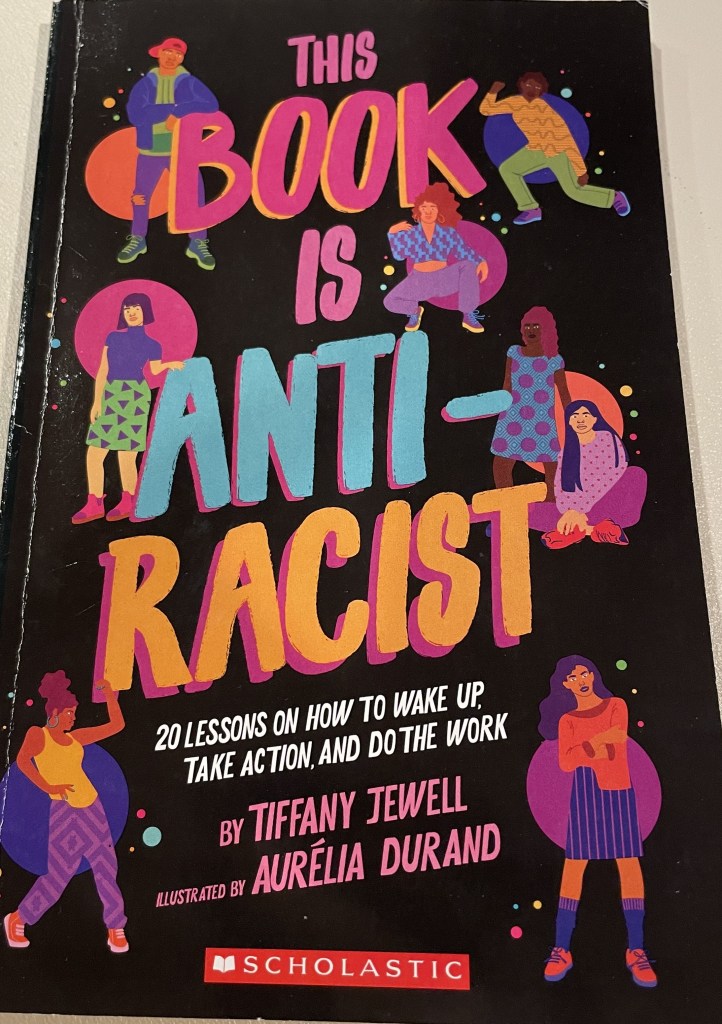
In July 2020, Mr. Dorf wrote City Council members to encourage them to participate in Bridging the Gap, an activist march demonstration whose message included that Oakwood and other Dayton suburbs and their police are unwelcoming and prejudicial to racial minorities (see here). He also wrote City Council members and Chief Hill to encourage them to participate in a book study of How To Be an Anti-Racist by Ibram X Kendi, and of Raising White Kids by Jennifer Harvey. Mr. Kendi’s book specifically rejects a colorblind, racially neutral standard of treatment and explicitly calls for racial discrimination (i.e., actual racism) across society to engineer equal racial outcomes. It commends Karl Marx, it denounces capitalism as inherently racist and born out of racism (racism’s “conjoined twin”), and advocates implementing unspecified “anti-capitalist policies” throughout society. What does any of that have to do with the operations of City Council? What sorts of radical policies does Mr. Dorf want the City Council to implement based on these beliefs?
More recently, in September 2024, Mr. Dorf wrote to City Council members to encourage the City to adopt model ordinances drafted by the Anti-Defamation League, through his collaboration with Dr. Kelly Fishman, a staffer at the ADL’s office in Cleveland. Dr. Fishman also wrote a recent letter to the Oakwood Register editor endorsing Mr. Dorf for City Council. These model ordinances would stifle and penalize a wide range of free speech, including speech having nothing to do with the ADL’s stated purpose of combatting demographic hatred. For example, under one the ordinances (Model Ordinance #4), someone who overlooks a “No Solicitations” sign on someone’s property or who is unfamiliar with the ordinance could be fined, or even criminally prosecuted, simply for leaving a flyer or pamphlet on the property to advertise their business or promote a candidate for office, or for ringing the doorbell to fundraise for their church or their child’s little league team.
It’s also easy to see how the enforcement of this ordinance could be susceptible to politicization and abuse. For example, someone who leaves a pamphlet or knocks on a door to promote a Republican candidate for office or fundraise for their church is fined, while someone who does so for a Democratic candidate or other reason is not, or vice-versa. In light of this and Mr. Dorf’s political orientation, what other sorts of overbearing regulations he would seek to impose on Oakwood if elected to City Council?
The City Council is not a platform for the sort of divisive political and social activism that has been the focus of Mr. Dorf’s extracurricular activity since moving to Oakwood. It is a non-political governing body entrusted with the stewardship of our community facilities, services, ordinances and fostering its economic development.
Oakwood needs City Council members who will focus on these nonpartisan tasks rather than activist causes and policies that could harm and divide the community.
“We should collaborate with landlords to explore a vacancy tax on chronically empty storefronts” – Sam Dorf in the Oct 22, 2025, edition of the Oakwood Register
Oakwood residents, as we approach the city council election, it’s crucial to scrutinize the proposals put forward by candidates like Sam Dorf. As a left-wing activist with a vocal online following, Dorf has advocated for a vacancy tax on empty storefronts in our shopping and business district — a policy he frames as a solution to our community’s limited growth opportunities. While this may sound like a progressive fix to encourage leasing and revitalize our “pocket community,” a closer look reveals it as a risky, one-size-fits-all approach that ignores the realities of our small, well-maintained town with its older housing stock and modest business ecosystem. Drawing from experiences in other cities and economic analyses, this proposal could lead to unintended consequences that exacerbate our challenges rather than resolve them. Let’s examine why Dorf’s stance on this issue raises serious questions about his suitability for council.
Dorf’s advocacy for a vacancy tax stems from a desire to penalize property owners for unoccupied spaces, ostensibly to spur quicker rentals or sales. However, in a low-demand area like Oakwood, where empty storefronts reflect broader issues like e-commerce shifts and limited local foot traffic, this policy doesn’t address root causes. Rather, it piles additional financial burdens on owners already grappling with maintenance, taxes, and insurance costs. As seen in places like Oakland and Los Angeles, such taxes have led to increased defaults and foreclosures, with property values plummeting and owners forced to sell at losses. For Oakwood’s modest business district, this could mean fewer investors willing to step in, deepening the cycle of vacancy rather than breaking it.
Consider the deterrence to economic growth: A vacancy tax signals to potential investors that Oakwood is hostile to property ownership, especially when leasing can take 12-24 months due to marketing, negotiations, and costly tenant improvements—often exceeding $200,000 for a mid-sized space. In high-demand markets, this might work, but in our small community with little room for expansion, it risks scaring away the very capital needed for renovations or new ventures. Dorf’s left-leaning activism overlooks these market realities, prioritizing punitive measures over incentives like grants or zoning reforms that could genuinely attract businesses.
Worse still, this policy could accelerate an urban “doom loop” in our tight-knit town. By adding fees without boosting demand, it may lead to neglected properties, falling values, reduced city revenues, and even heightened crime—issues that hit small communities like ours hardest. Nationwide data reveals nearly one-third of office loans in distress, with cities like Chicago seeing over 75% affected, illustrating how such burdens shrink markets and limit options. In Oakwood, where our well-kept homes and limited commercial space define our charm, Dorf’s proposal threatens to undermine the vibrancy we cherish, potentially straining resources for essential services like schools and safety.
The inequities are stark: Smaller property owners, including low-income or minority individuals, bear the brunt, facing unaffordable penalties that force abandonment. Surviving landlords might pass costs to tenants via higher rents, making it tougher for local small businesses to thrive—leading to mismatched leases and more failures down the line. Oakwood’s limited resources should focus on proactive growth strategies, not punitive approaches.
Parents, teachers, students, and community members: Sam Dorf’s push for a vacancy tax exemplifies a pattern of ideological activism that prioritizes broad-stroke penalties over practical, community-tailored solutions. In light of his candidacy, this stance highlights a disconnect from Oakwood’s unique needs—a small town with old-world charm but real constraints on expansion. We can’t afford policies that risk further emptying our streets. Instead, let’s support approaches that foster investment and preserve our way of life.
If you’re concerned, join the discussion on our Facebook page for updates and stay informed ahead of the election. Oakwood deserves leaders who protect, not penalize, our local economy. Make sure to vote!
Sam Dorf’s radical proposal would further deteriorate Oakwood’s commercial district
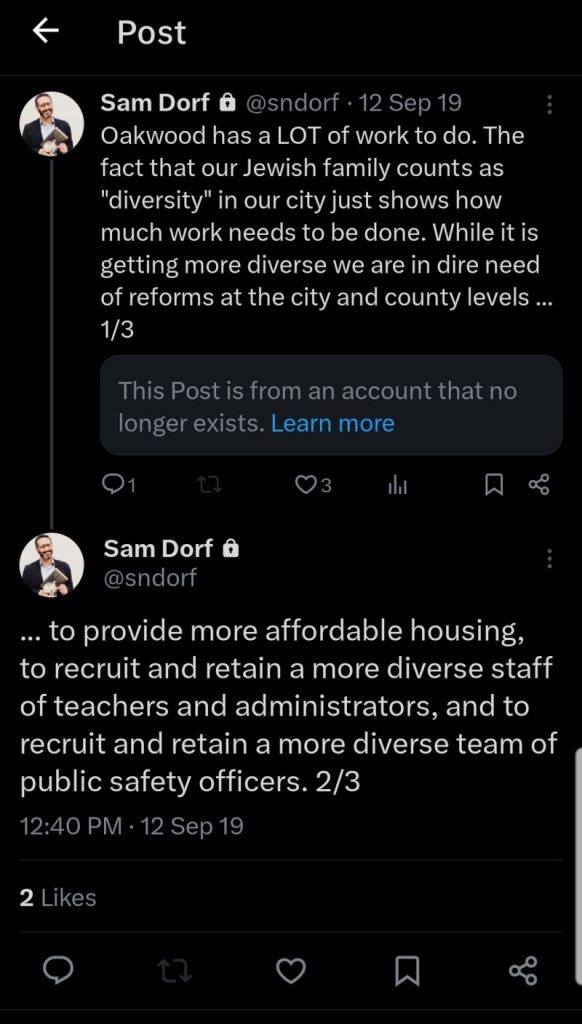
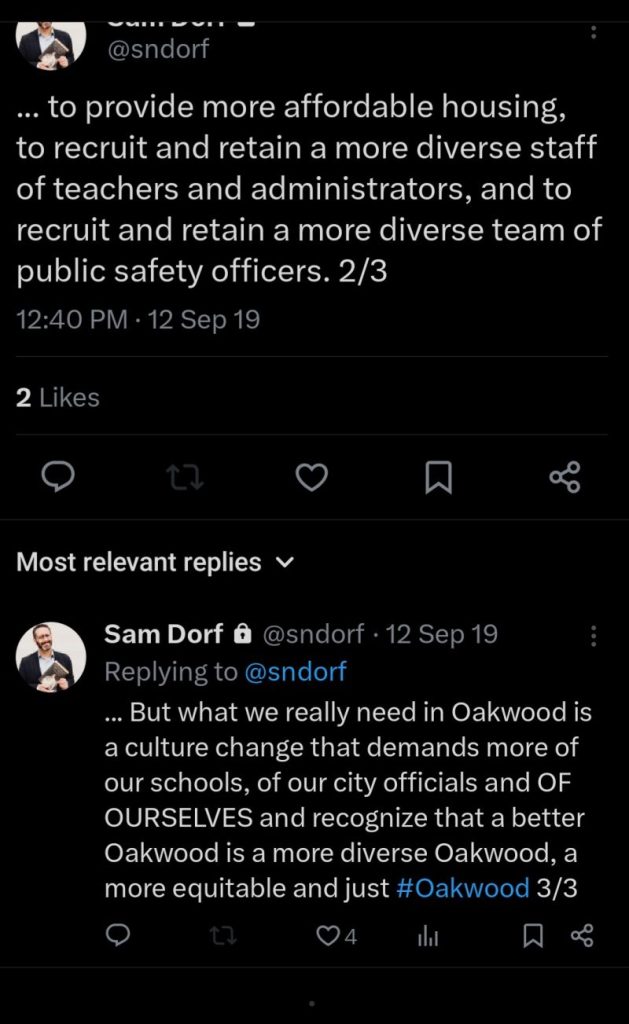
In the past several years, Oakwood City Council candidate Sam Dorf has repeatedly expressed great interest in expanding low income and multi-unit (aka “affordable”) housing in Oakwood, in conversation with residents and on social media. For example:
However well intended this idea may be, Oakwood is simply not designed for significant levels of this type of housing. Adding more of it here would likely bring in more congestion, more crime, possibly strain Oakwood’s schools, and lower our property values. Online crime maps show areas with this type of housing have higher crime rates, including around Oakwood (for example, see here). Oakwood residents living near existing low income housing have already reported problems with loitering, vagrants, drug paraphernalia and litter in and around those properties.
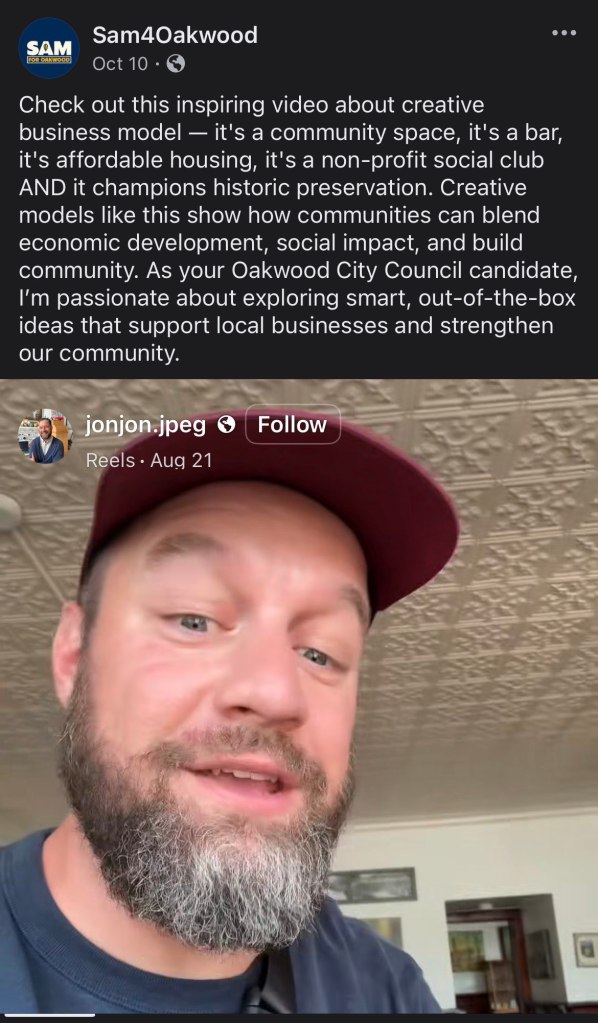
Now, the City Council election is in full swing, and one of the major issues in the election is addressing the vacant buildings and overall conditions in the shops of Oakwood. Mr. Dorf’s latest idea for expanding this type of housing is to bring it right into this very area the City is trying to revitalize. He recently proposed the following solution on his campaign Facebook page: converting vacant buildings to community resident-owned, non-profit businesses that sidestep “traditional access to capital”, with “affordable” rental housing right above them:
The video featured in his post can be viewed here.
Oakwood shops property owners have already struggled to bring in new businesses to their vacant stores and office spaces. Business owners have indicated one of the main reasons is the high rent, which owners must charge to cover Oakwood’s high property costs and taxes in that area. Another problem is restrictive zoning, which would have to be radically altered to allow housing in the shops area. One has to wonder how avoiding larger investors and relying on residents buying shares into a non-profit would raise enough funds to make Mr. Dorf’s proposal feasible, and whether the City would appreciate the loss of tax revenue that could otherwise be generated from for-profit businesses.
But the larger concern is the impact of having residential tenants living above the shops and offices, especially low-income or even subsidized tenants if that is part of the plan. How many business owners would appreciate having the commotion of families with infants or small children, wild parties or altercations, or a leaking shower or toilet right above their restaurant, store, salon or professional office? How would they like to have any of the more serious problems described above, which Oakwood residents have already seen with some of this housing, in or around their business properties? How many customers, or residents living near the shops area, would like more of those problems?
This sort of collectivist approach to improving Oakwood’s commercial district may look appealing from the ivory-towered vacuum of academia. But for real world business owners, that, together with Oakwood’s high rent and zoning issues, would be one more compelling reason to set up shop elsewhere. And for businesses already here, it would be one more reason to leave. In short, Mr. Dorf’s idea of injecting low-income housing in Oakwood’s commercial district would likely exacerbate its decline by driving away business and investment, and it could prove to be one of the worst things to happen to the district, to Oakwood’s economy and to the City as a whole.
Oakwood needs City Council members with more sensible approaches to this issue – approaches that are better attuned to the needs and concerns of businesses and residents, and to economic realities.
Sam Dorf’s run for Oakwood City Council should raise concerns for Oakwood voters as his divisive and partisan approach to politics undermines the public safety of our community.
Sam has publicly supported expansion of multi-unit and low-income housing in Oakwood. While that may sound compassionate, it’s not practical for our small city. I am concerned this will lead to more congestion, increased crime, strain on schools and services, and lower our property values. Oakwood residents living near existing multi-unit housing have reported seeing vagrants, drug paraphernalia and litter in and around those areas. We need a candidate who is dedicated to strong zoning and maintaining high neighborhood standards.
Sam has repeatedly criticized the Oakwood Public Safety Department in ways that have damaged morale and public trust. In 2019, Sam accused Oakwood police of racial profiling based on a flawed and discredited report from a partisan activist group. Regardless, he claimed its recommendations should still be followed to improve the “perception of Oakwood”. Following these divisive claims, police data show traffic enforcement has dropped significantly (average annual citations by more than one third, and fewer than half of traffic stops result in citations). Residents have noticed more reckless driving and reduced police presence. The timing hardly seems a coincidence — it appears our officers pulled back after being unfairly disparaged, and Oakwood is less safe as a result thanks to Sam’s advocacy.
Sam called for the department to end its use of random license plate checks, a standard policing practice that enables officers catch drivers with suspended or revoked licenses, no insurance, or open arrest warrants (accounting for nearly one-fourth of Oakwood police apprehensions of arrest warrant suspects). Sam opposed this because he didn’t like the racial breakdown of drivers stopped. But should that outweigh our responsibility to keep dangerous drivers off Oakwood’s streets?
Sam advocated a policy requiring any officer who discharges a weapon against an unarmed suspect – regardless of the circumstances – to be suspended without pay and publicly identified, effectively doxxing them. This would endanger good officers and discourage them from making tough but necessary decisions in extraordinary situations.
Sam’s polished ads and campaign website tell a story that doesn’t square with his record. He says he’ll “work collaboratively and transparently,” and support “open communication,” yet his past approach has divided neighbors and undermined trust in city leadership. He now praises the very Public Safety Department he once accused of bias. He claims to champion unity, but his history shows a pattern of divisive politicization. Oakwood deserves steady, reasonable leaders who protect our community, support our officers, and rely on facts – not polarizing activists who rely on flawed assumptions and put their politics ahead of public safety.
Controversy recently erupted on the eve of the Oakwood City Council election, when a negative ad appeared on internet streaming and television channels regarding City Council candidate Sam Dorf, which can be seen here:https://youtu.be/sdA9BnqtPro?si=RvzGn-jXe62FZuVm
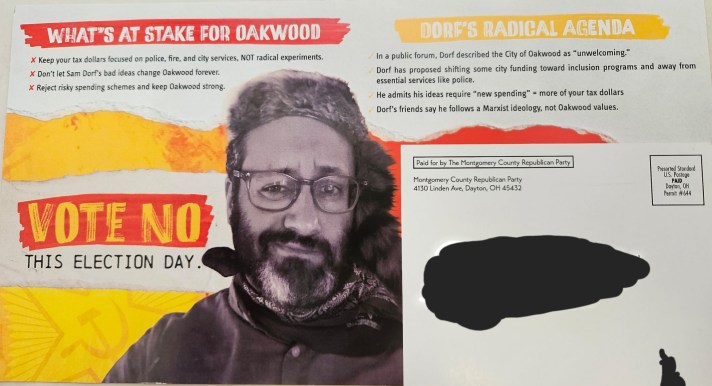
The ad says it was funded by the Montgomery County Republican Party, and the other two candidates in the election promptly confirmed no association with the ad and denounced negative campaigning of this sort, pledging to continue running positive campaigns focused on the issues. Mr. Dorf also condemned the ad, claiming it is inaccurate and “xenophobic”. The ad was then followed by this mailer, also from the Montgomery County GOP:
Like it or not, negative ads like this are typical during election season, though usually in larger elections. But how effective are negative ads in delivering their intended results? At a time of concern about the tone of our political discourse, are they the best approach versus purely positive campaign messaging? Look at the above examples. Do they discourage you from voting for Mr. Dorf, motivate you to vote for him, or have no effect on your voting decision? While these ads touch upon some policy issues, like claiming Mr. Dorf has called for diverting funds away from police, negative ads are often more substantive, focusing on a candidate’s record and stances on the issues. These appear aimed more at simply making the candidate look bad, rather than offering critiques that could be raised of Mr. Dorf’s extensive controversial record.
It is unusual to see these large ad campaigns in such local-level elections, and candidates for Oakwood’s City Council and Board of Education elections have generally run positive campaigns promoting their strengths. However, Oakwood has seen negative campaign messaging before, from sources other than the candidates, and their impact on election results is questionable.
In the 2023 Board of Education election, screenshots and pictures of one conservative candidate were circulated by residents, including by Mr. Dorf, and it fueled heated and sometimes rude criticism of the candidate on social media for her expressed religious and other views on social and political issues.
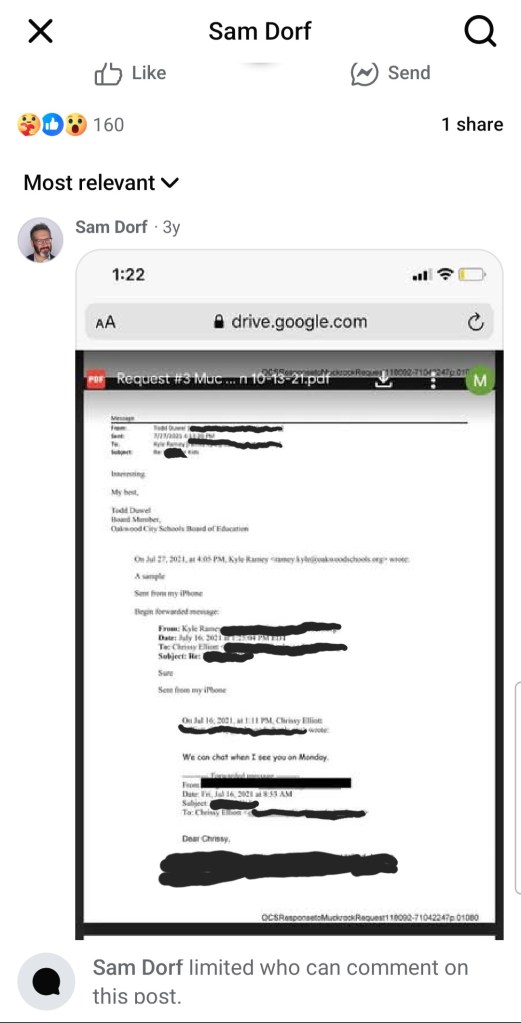
In the 2021 Board of Education election, a conservative candidate was vilified by progressive residents on social media and elsewhere, for statements she made in a private email to an Oakwood school official after the school district disclosed the email in response to a public records request. She expressed her religious reasons for asking the school to opt her children out of controversial classroom instruction on sexuality and gender identity. Her statements were entirely within mainstream Christianity, and her expressed view that public schools should be neutral on those topics is the most mainstream position on that issue. Her email was also personal, private, and sent before she was a candidate, in her role as a mother concerning her children. Nevertheless, residents posted the private email on social media during the election and used it as fodder to attack the candidate for her religious and other views on those topics, including Sam Dorf himself, who called her beliefs “homophobic” (candidate’s email is left out for privacy reasons):
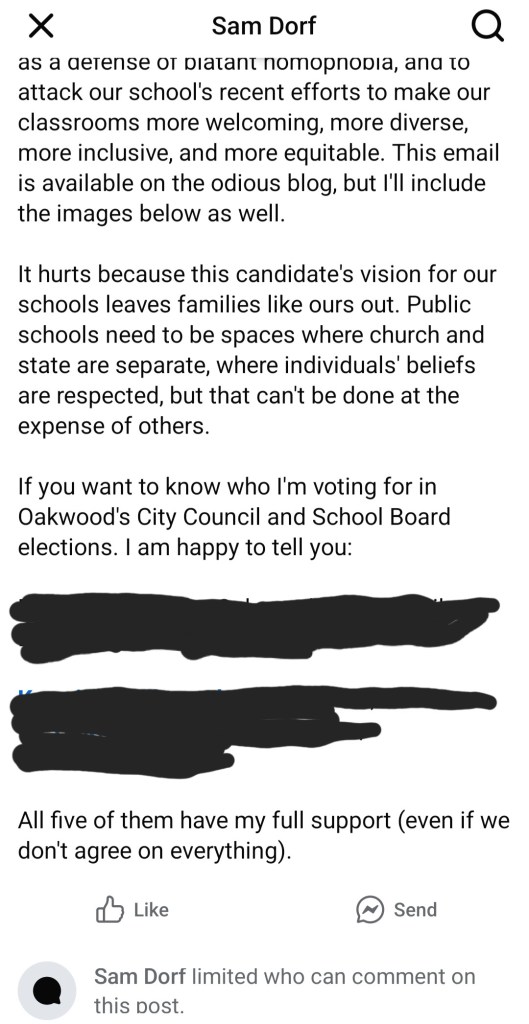
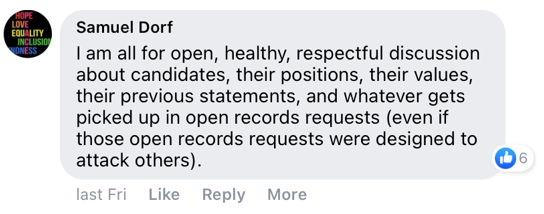
Mr. Dorf even defended the attacks (which were hardly “respectful”), and the use and disclosure of the candidate’s email for that purpose:
The Democratic Party even included the candidate’s email in campaign literature distributed in Oakwood.
This demonstrates a flagrant disrespect for the candidate, for her and her children’s privacy, and for her religious beliefs. It was later revealed that the Oakwood school district had disclosed the email in violation of student privacy laws, from a lawsuit the candidate filed against the district, which district settled with a public apology. And yet, that email remained published by Mr. Dorf and others on social media.
Mr. Dorf now presents himself as a victim of negative campaigning, but could one say that what is good for the goose is good for the gander? What was done to that candidate in 2021 was actually far more egregious than what these ads are doing to Mr. Dorf in this election. Or, is it better stick to positive campaigning to take the high road? Is some degree of negative campaigning acceptable as a way of informing voters of a candidate’s record if it is done respectfully?
Also, did that negative messaging affect those prior Board of Education elections? Those two disparaged candidates received about the same share of votes as the other conservative or Republican candidates in those elections, whose campaigns were not subjected to any negative messaging or controversy.
The effectiveness and propriety of negative campaign messaging is highly debatable, but one thing is certain: for better or for worse, it’s likely here to stay.
Recently, Rose Lounsbury, one of Oakwood’s most vocal opponents of EdChoice and other Ohio private school voucher programs, admitted to me that she would never want her own kids in a troubled school district like Dayton Public Schools (DPS), given the intolerable conditions there that I cited in my April 2ndletter to the Oakwood Register editor from a former DPS high school teacher (i.e., routinely disruptive classrooms making teaching extremely difficult, students resisting doing any schoolwork, and violence even towards that teacher). Despite the fact that EdChoice has allowed students to escape failing schools like DPS for private schools for nearly 20 years, she defended her support for dismantling those programs by claiming it would stop them from “defunding” failing districts like DPS so the needs of its students can be better served. Of all the specious arguments propounded by voucher opponents, this one is the least credible: that eliminating vouchers will somehow improve failing school districts by increasing their funding, when many such districts have already engaged in high spending levels with dismal results. Let’s walk though some numbers to see why.
First, with all the voucher opponents’ hysteria over the nearly $1 billion spent on Ohio’s vouchers last year, for context, that equaled less than 3% of the $30 billion in funding Ohio’s public schools received in 2024. The EdChoice program, the focus of the voucher controversy, accounted for $677.6 million, or only 5.2% of the $13 billion the Ohio government spent on all K-12 schools, and it equaled only 7.97% of the State’s $8.5 billion spent on traditional K-12 public school districts. So, would eliminating EdChoice and increasing the State’s public school funding by 7.97%, plus some additional funding from increased public enrollment by former EdChoice students, have significantly improved student outcomes in those failing districts?
Start with our own school district. In 2024, Oakwood City Schools spent $16,846 per student1, and among 8th graders, 90.4% were proficient in math and 83.6% were proficient in English language arts, and the district’s four-year high school graduation rate was 98.3%. Very respectable metrics. Meanwhile, the DPS district spent about 38% more, for a staggering $23,209 per student1, which was among the top 10% spending levels per student among all Ohio districts in 2024 (hardly a “defunded” district, is it?). Nevertheless, among that district’s 8th graders, only 8.9% were proficient in math and only 11.5% were proficient in English language arts, and the four-year high school graduation rate was only 72.3%. Why didn’t this far greater spending translate into better student outcomes, versus these far worse metrics, compared to our own district? Do we simply need to spend even more to overcome the troubled circumstances surrounding these districts? How much more?
If EdChoice had been eliminated and the money spent on it in 2024 was instead allocated to a 7.97% increase in State public school funding, that would only yield an additional $796 in per-student spending for the DPS district since 43% of the district’s funding came from the State (i.e., $23,209 times 43% times 7.97%). If that district’s metrics were so dismal with $23,209 per student of spending, do we really think another $796 per student, plus a small increase in State funding from enrollment of returning former EdChoice students, would have been the transformative catalyst that would have significantly improved those outcomes? How about $7,000 more, for $30,209 per student? Think again. Last year, the East Cleveland City School district spent over twice as much ($14,240) more, for a whopping $37,449 per student1, the second highest per-student spending level among all Ohio districts. Rather than generating better student outcomes, by most metrics they were even worse than DPS. Among 8th graders, only 3.5% were proficient in math and only 11.5% were proficient in English language arts.
If spending more money translates into better student outcomes, how do we explain these results for these two troubled school districts? Another school district’s story helps answer this question. The Baltimore City Schools district made local and national headlines in 2017 and again in 2023, when in each year there were 13 high schools without a single student proficient in math. In 2017, the district also had five high schools and one middle school without a single student proficient in either math or reading, and among 8th graders, only 11% were proficient in math and only 13% were proficient in reading. Any educator reading this should be appalled at those statistics. If you think this was due to a lack of spending, think again. In 2017 the district had among the top 10 highest levels of spending per student among all districts in the United States, and yet it had about the same dismal 8th grade proficiency levels as the DPS district last year. In 2023 it spent $22,424 per student, which adjusted for 2024 dollars was almost exactly the same as DPS last year, and it had $1.7 billion in funding. In an interview, the Baltimore City Schools district’s CEO, who holds a Ph.D. in education from Harvard, advised that the root cause of this problem – despite such profligate spending – was chronic absenteeism. That refers to a student being absent at least 10% of the days of the school year. In fact, a study by the National Center for Educational Statistics found a strong correlation between chronic absenteeism and poor standardized test performance. In the Baltimore City Schools district, 30% of students were chronically absent in 2017, followed by 54% by 2023.
With that in mind, let’s return to these three Ohio districts discussed above. When comparing last year’s data for the Oakwood, DPS, and East Cleveland school districts in that order, we see dramatically increasing levels of spending and yet dramatically declining math and English proficiency. Here’s what else we see: dramatically increasing rates of chronic absenteeism, from 8% in Oakwood, to 45.1% in Dayton to 63% in East Cleveland. It’s not hard to understand this relationship between chronic absenteeism and poor standardized testing or academic performance; chronically absent students have significantly less exposure to classroom teaching and schoolwork that helps develop the knowledge and skills measured on standardized tests. But it also reveals a more fundamental cause: a lack of overall engagement or motivation in one’s education by the students, and most troubling, by their parents or guardians. Those are obviously the people in the best position to ensure students make it to school each day, and to undertake disciplinary and other corrective measures when students are found to be chronically absent. As further evidence of this, the former DPS high school teacher also shared with me that on parent-teacher conference nights, virtually no parents or guardians would show up to meet with teachers, leaving them to resort to doing lesson planning or other tasks to pass the time while they sat there. Think about that; with such serious problems among students in that district, from low math and English proficiency, to neglected schoolwork (per the teacher), chronic absenteeism, behavioral problems and likely very poor grades, there should be a line out the door of concerned parents and guardians eager to discuss these many problems regarding their kids. Instead, it was the opposite.
These are not problems we can remedy with even more spending, clearly it’s not a money problem; as shown above, some of the highest levels of spending in the State of Ohio and even the entire United States have proven that. During a May 14th anti-voucher presentation by Oakwood Advocates for Public Education, the group attempted to counter this by asserting that State-subsidized pre-K programs (funded by eliminating vouchers, presumably) would solve the problem. However,studies have instead shown that among economically disadvantaged kids, the beneficial effects of such programs on student performance and behavior are short-lived and fade out after a few years, and studies are mixed as to purported long-term beneficial impacts (see, e.g., here, here and here). Again, spending even more money in these failing districts won’t solve these problems. Feel free to offer other arguments for doing away with vouchers, but that is the least credible of them all.
Here’s how we can move the needle and make a difference: keep in place a voucher program for students in those failing districts, so that the students and parents who are motivated enough to do so can get out of those troubled schools and take advantage of a much better educational environment that can be life changing for those kids and their families. In fact, a study published last month, and cited in the Wall Street Journal, found that students who enrolled in Ohio’s EdChoice program during 2008-2014 (when EdChoice was primarily for students in failing schools) were significantly more likely to attend and graduate from college than their classmates who remained in public schools. Note the study also narrowed the comparison to students from the same public schools, with similar racial, socioeconomic and other demographics, and with similar pre-enrollment standardized test scores. Note also that, in the actual study report downloadable from this article, the researchers refute the common claim of Ohio’s voucher opponents: that private schools supposedly provide inferior education based on the fact that students who left public schools for private schools showed slight declines in performance on state standardized tests. The researchers point out that unlike various private schools, Ohio public schools’ academic curricula are designed to align with those state tests, and those public schools have a powerful incentive to tailor their curricula and lesson plans for state tests since unlike private schools, they are publicly graded and ranked based on their students’ performance on those state tests.
-Trevor F. Hoffmann
1 For all per pupil spending and funding levels of Ohio districts, and the State’s share of funding, go to this Ohio Board of Education website, then click the link titled “click here to access the report” to download the spreadsheet, then refer to the second tab of the spreadsheet for this data. For each school district, per pupil spending is shown in column AU, the state’s share of the district’s revenue is in column AW, and per pupil revenue is under column BD.
How much money should Oakwood City Schools hold in reserve? This is the levy’s central question. I’ve reviewed the data and spoken with district officials. Here’s what I’ve learned:
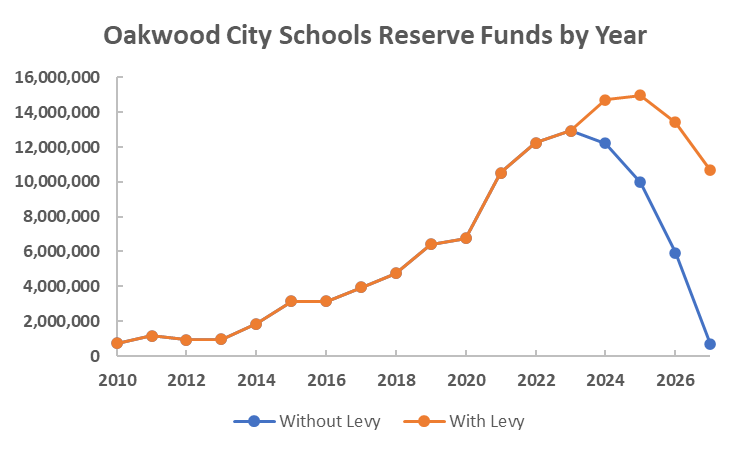
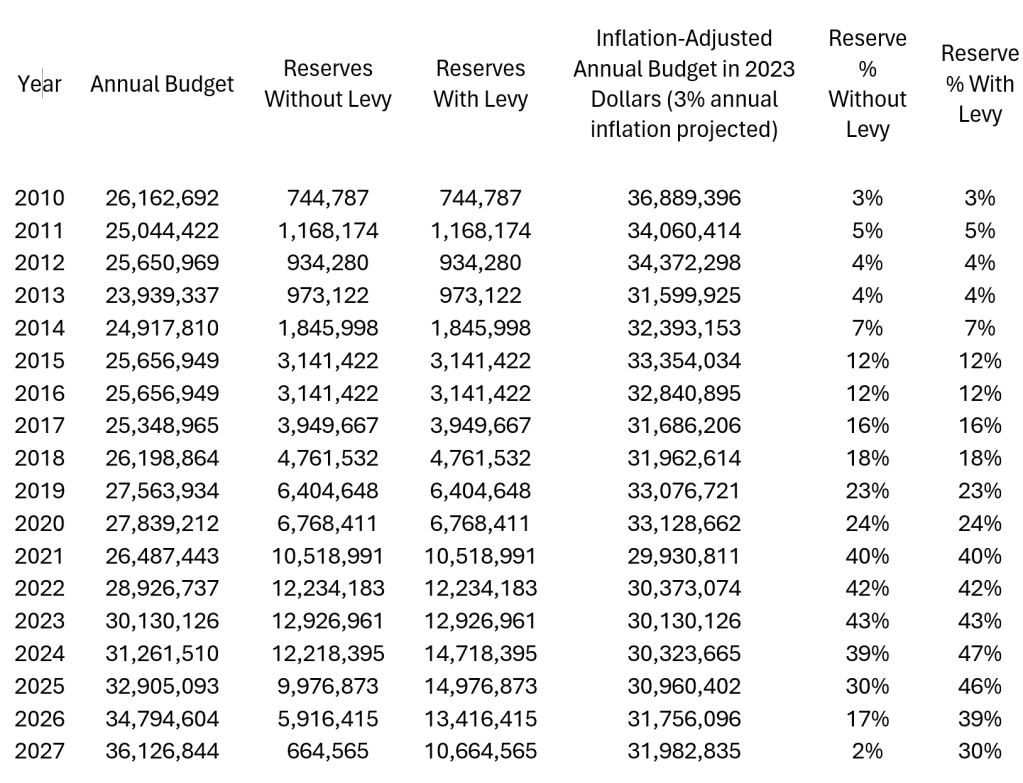
Ten years ago, our district had no significant reserves, going from surplus to deficit between levies, and sometimes borrowing money. Any levy failure carried immediate consequences. As Figure 1 shows, that has changed.
Figure 1: Reserves by Year.
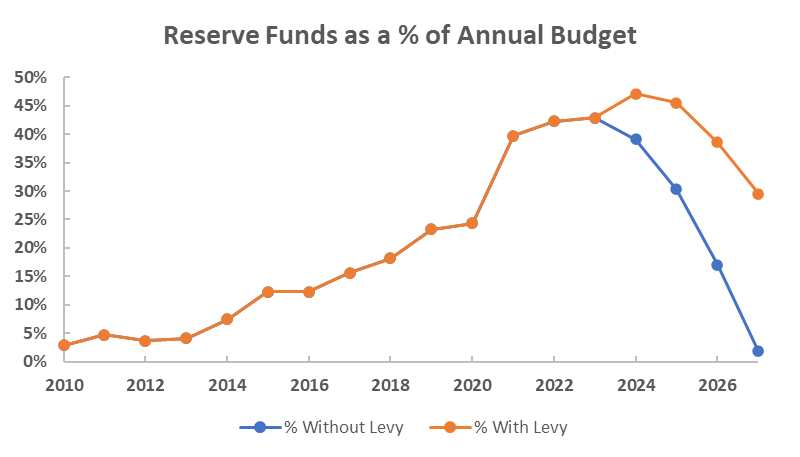
Since 2013, our district’s reserves have grown. Like personal emergency funds, these reserves provide security against setbacks like unplanned and significant infrastructure expenses, stability of operations in case of levy failures, or resources for unanticipated unfunded requirements. Current reserves are $13M, or 43% of 2023’s budget. Figure 2 shows reserves as a percentage of annual budgets, which flattens recent and projected increases.
Figure 2: Annual Reserves Normalized to Budgets.
For context:
Today’s reserves could fund 5 months of operations without income.
Our district could operate until 2027 without any levy. Then we would have to make cuts or pass a levy more than twice as large as this year’s levy.
Current reserves provide $650K in annual revenue.
This levy would raise reserves to 47% of the 2024 budget. This figure would hover at 46% in 2025, then drop.
Rejecting this levy would cap reserves now at 43%. With smaller tax revenues and reserve investments, reserves would fall faster.
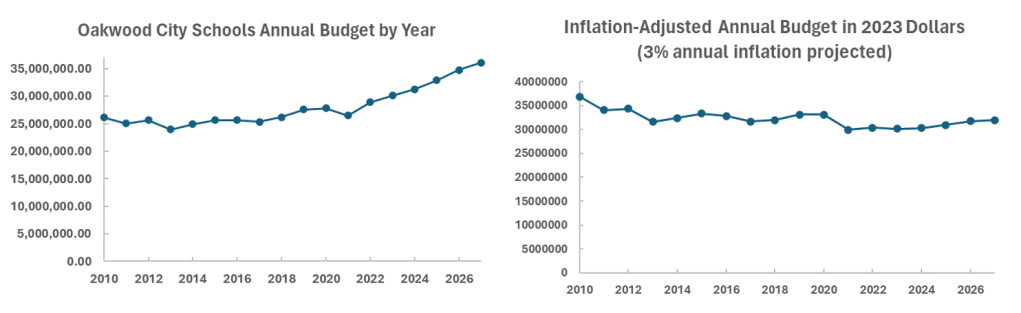
It’s reasonable to question our district’s spending habits. Figure 3 shows budgets since 2010. Corrected for inflation, spending has been flat since 2013.
Figure 3: Oakwood City Schools’ Budget in Real Dollars (left) and 2023 Inflation Adjusted Dollars (Right)
District leaders say they won’t grow these reserves indefinitely. Eventually, the district will shift to sustaining reserves, proposing smaller levies or waiting longer between levies. Without borrowing, we’ll return to fluctuating between surplus and deficit.
Thus, the levy’s central question is: How big should these reserves be? We might consider a floor and ceiling for these reserves.
We could reach a ceiling of 50% with this levy and something similar in a couple of years. If you want that, you should vote yes. There are sound reasons for large reserves. This would be a public commitment to sustain our district’s excellence: a literal vote of confidence helping to keep property values high. Larger reserves increase stability, empowering leaders to plan with confidence. Larger reserves also mean more non-tax revenue.
If you prefer smaller reserves, you should vote no, understanding that future tax hikes to avoid hitting a reserve floor must be larger than this levy. There are reasonable arguments for smaller reserves. Sustained surpluses discourage thrift. Although inflation-adjusted budgets have been flat, that might not continue. Our levy approval streak since 1978 may foster complacency in our schools’ partnerships with parents and volunteers, an atrophied partnership that has yet to recover to pre-pandemic levels at some schools. Taxpayers can also seek better returns with their tax savings than Oakwood Schools can. Our district faces no financial crisis, nor will it if this levy fails. The strength of Oakwood’s community and schools transcend any levy. However we vote, we can build this strength by engaging, volunteering, and partnering with our schools to give our kids the best upbringing we can provide.
The term equity is used frequently by many organizations in politics, business, government, and our schools. The term sounds like equality in the American tradition, where equality has been traditionally defined as equal opportunity for all Americans and put forth in the vision of the American Dream. Equity is a distortion of this American tradition, a repackaged form of socialism that is based upon the theory that any form of unequal outcomes is a result of systemic injustice. This becomes the basis to argue for power to change the system by reallocating resources and forcing equal outcomes. This principle can be applied to any area in which you can identify unequal outcomes. In traditional Marxist socialism, this would be applied to perceived inequities in the distribution of money across social classes. In modern America, this is more typically applied to racial, gender, or educational “capital,” where any difference in outcomes based upon these categories is attributed to systemic injustice and requires action to force changes.
Diversity is another term that has been appropriated by the political left and given a new meaning that does not refer to a diversity of backgrounds and experiences. Diversity now refers to representation of racial, gender, or other woke identities. This is fundamentally a political movement that sees the world through power dynamics. This perspective rejects the color-blind approach to diversity that has been pursued by American culture since the Civil Rights movement of the 1960s. The woke diversity movement limits the way we see the world – their lens is one that classifies everyone by their race, gender, or class status. Diversity experts claim to be the ones who get to determine what is truly diverse, and when placed in a position of authority they enforce the party line view. This can be easily observed in the objections to diversity programs that seem to only push specific groups as diverse, especially in schools.
Inclusion is the next term to be hijacked by the woke left. Inclusion has been redefined to mean that anyone who does not support the DEI paradigm will be “called out” and excluded from the group. It is a rhetorical technique that enables censorship of the power dynamics based upon the identity groups. Who wants to be accused of not being inclusive? The accusation alone is often enough to undermine your moral authority and results in self-censorship, even when one just is pointing out the lack of authentic inclusion in DEI programming. Some programs will also reference the idea of belonging, which is inclusion plus positive affirmation. This affirmation, whether applied to racial or gender categories, often defies logic and is therefore destructive of the hard sciences such as physics, mathematics, chemistry, medicine, and engineering. The transgender movement can easily be seen as an extreme example, as men appropriating the female body for themselves shout down anyone who questions this in the public domain as not sufficiently inclusive.
The goal of this DEI movement is ultimately one of control, undermining the freedoms that we enjoy in an open society like America. The Marxist radicals of the 1960s and 1970s all moved into the education field, as they knew that they could push their strategies into the schools and push their agenda, and when social equity has been injected long enough into our children society will behave in the way the woke want it to behave. It’s no longer time to sit back and let this happen in our schools. We must step up, protect our kids, and preserve the excellent education they deserve. If you want to join the discussion about these topics, stop by our Facebook group or send us a note at admin@oakwoodstrongschools.com.
In 2021, a student club titled SPIDEE (Students Promoting Inclusion, Diversity, and Equity through Education) began operating at Oakwood High School, followed by Harman and Smith schools. While SPIDEE is portrayed to students and the public as a “student run” club, parents discovered that the club, its concept, its contact person for students, its curriculum (or at least the supervision of its development), the initial running and organization of its student meetings, and then the supervision and logistics of those meetings are all the work of an outside activist organization that created it: the National Conference for Community and Justice (NCCJ). In SPIDEE meetings, NCCJ staff work directly with and train OHS students, who then give presentations about SPIDEE and its curriculum to sixth graders in Harman and Smith schools. Information obtained from the Oakwood School District shows NCCJ actively recruits for its other youth programs such as its Agents of Change and Anytown programs (also covered in this article) from among students participating in SPIDEE, and by enlisting the help of SPIDEE club students and the school system’s administrators and staff.
NCCJ and SPIDEE students have asserted the club’s purpose is to promote ostensibly noble objectives of fostering diversity, equity, and inclusion and opposing bias and bullying, as NCCJ claims with its other youth and adult programs. If that is the sole purpose and function of SPIDEE and other NCCJ programs operating in Oakwood schools, then they should be wholeheartedly welcomed. However, as this article shows, an extensive review of NCCJ’s publications and its programs and seminars for adults and youth reveals that the organization also consistently advances radical, divisive, and controversial Critical Race Theory (CRT)/Critical Theory-oriented and other social and political agendas similar to those used in “student run” groups across the country that are run by other activist groups such as the GSA Network, and the Anti-Defamation League whose No Place For Hate club is also operating in Oakwood schools. Curiously, NCCJ deleted several of its web pages that display evidence of these teachings less than two months after some of them were reported in the first publication of this article in late October 2022, and less than a month after emails show Principal Waller and Traci Hale met with NCCJ staffers Lake Miller and Adriane Miller to discuss “concerns” about this article. At the time they were deleted, they had been published for more than two years; however, those web pages are preserved here[i].
The agendas and teachings advanced by these programs include the following, as evidenced by sources in this article and a related OCSS article on NCCJ’s Anytown overnight youth camp program:
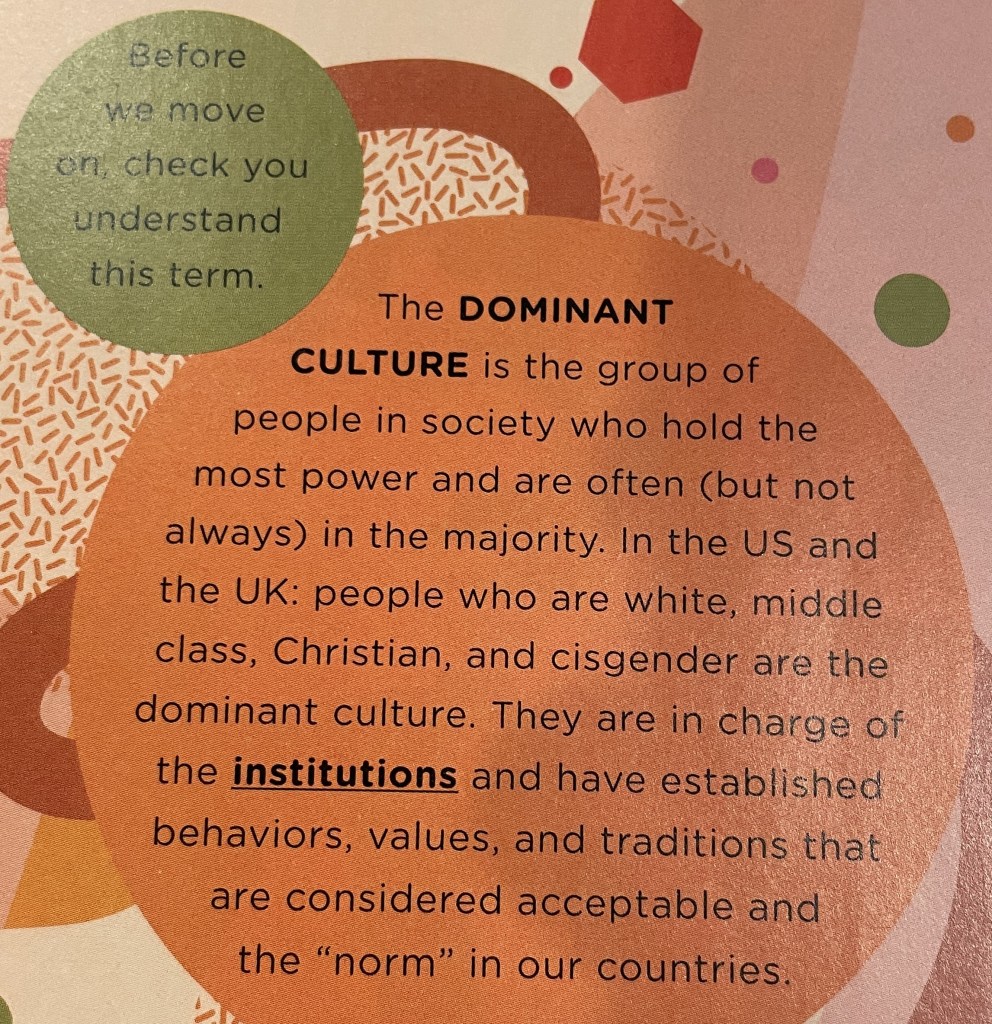
core CRT teachings of ubiquitous “systemic” or “structural” racism, white supremacy and “white privilege”[ii], together with other forms of systemic demographic oppression and privilege as taught by Critical Theory and Critical Legal Studies;[iii]
lumping individuals into “privileged” or “oppressed” identity group categories and negatively generalizing them based on their demographics such as race, sex, income, sexual orientation, gender identity and even religion rather than viewing them for who they are as individuals, effectively conditioning kids to think like racists and bigots. Examples range from the SPIDEE curriculum teaching “privilege” to Harman and Smith 6th graders, to “white privilege” in the Agents of Change curriculum for OHS students, to videos of high school students in NCCJ’s Anytown program being lined up, singled out by race and tearfully expressing guilt and shame for their “white privilege”, while other Anytown participants admit in Instagram posts to being taught about “systems of oppression”, to “check” their “privileges” and learn their “responsibilities” for being white, male, middle class and/or “cis(gender)”;
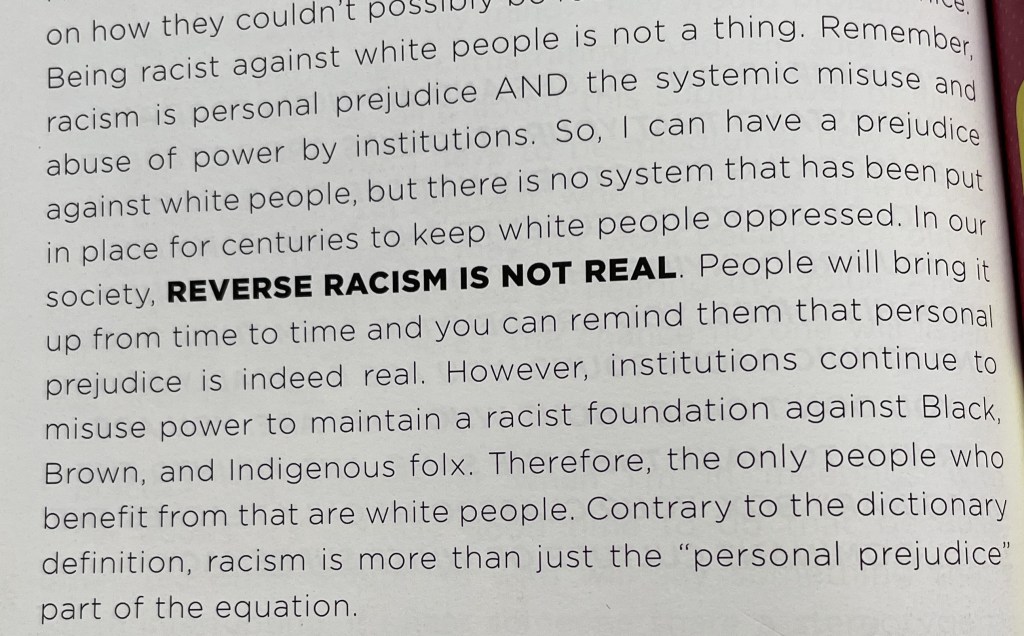
advocating or condoning reverse discrimination, with seminars advocating slavery reparations, promoting Ibram X. Kendi and his book that explicitly calls for racial discrimination and reparations, and “Social Justice Definitions” of “racism” and “religionism” that expressly exclude prejudice and mistreatment towards whites and Christians, respectively;
content that advances, and effectively pressures kids to agree with, controversial positions on sexuality and gender identity; and
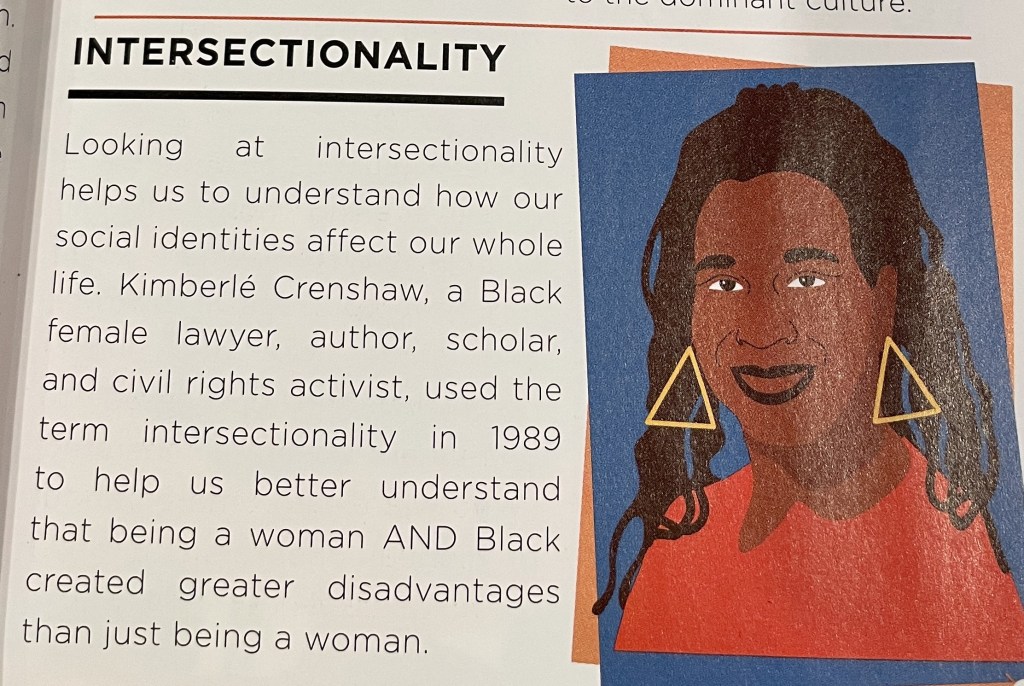
promoting BLM, key CRT figures such as Kimberlé Crenshaw, and along with Ibram X. Kendi, other extremist authors teaching that whites are inherently ingrained with and contribute to white supremacy as part of a reading list “for white people to read” distributed to NCCJ seminar participants.
In short,these teachings and agendas promoted by NCCJ are more akin to political and social indoctrination than genuine attempts to reduce bias, prejudice, and bullying. Further, they display characteristics of DEI programs that studies have shown to fail rather than those that have been shown to succeed in achieving their stated purposes.
Just how pervasive are those teachings in SPIDEE and NCCJ’s other youth programs? At this point, it’s not entirely clear, since NCCJ’s website on its SPIDEE and other youth programs gives no meaningful, specific information about their curricula or teachings and NCCJ staff have repeatedly failed to honor, or have outright ignored, repeated requests by multiple Oakwood school student parents and residents to disclose SPIDEE’s curriculum and program materials. Further, as explained in this article, during a May 11, 2023 meeting among Oakwood parents, Principal Waller and key NCCJ staffers Lake and Adriene Miller, NCCJ staff expressly refused requests from parents to disclose the curriculum and program materials for SPIDEE and other NCCJ programs that are operating or being promoted in Oakwood schools. To the amazement of the parents, the NCCJ staff also reacted with surprise when the parents raised concerns about their organization promoting the radical content discussed in this article, effectively denying it despite compelling evidence to the contrary that is detailed in this piece.
A request for curriculum, meeting, and other program materials for the SPIDEE and other NCCJ programs in Oakwood schools has also been submitted to the Oakwood School District under the Ohio Public Records Act, and despite multiple follow-ups on that request to date, the District has failed to comply with those requests, possibly in violation of the Act.
However,information obtained thus far shows that SPIDEE program and other NCCJ programs promoted in Oakwood schools include at least some of the problematic teachings discussed above. More importantly, information obtained from the Oakwood School District and NCCJ shows that NCCJ is using the SPIDEE program, and Oakwood students and staff, to actively recruit Oakwood students into NCCJ’s other activist youth programs (e.g., Agents of Change, Anytown and possibly others) that clearly appear to include these controversial CRT, Critical Theory, sexual and gender identity teachings.
Please peruse the article below for more details and pay close attention to what NCCJ has published and promoted on its web and social media pages, and in its programs and seminars as summarized above, including in Oakwood schools, be it SPIDEE, Agents of Change or Anytown. Note their similarity to the contents of the GSA Network’s and Anti-Defamation League’s publications and actual student club materials (not to mention their similarity to certain professional development materials presented to Oakwood school personnel). Then ask yourself: Is this what we want to teach our children to believe? If this is what these NCCJ programs teach, as is apparently the case, would it really achieve NCCJ’s purported goals of reducing bias, division, discrimination, and bullying? Or, would it do the opposite by actually inciting more of it? Would it instead amount to controversial political and social indoctrination without the knowledge or consent of parents? Is this really an organization that should be given such a direct and elevated platform of influence over Oakwood school children?
If you share our concerns and desire for more transparency and disclosure about NCCJ’s SPIDEE and other youth programs operating in Oakwood schools, please see the CALL TO ACTION section below for the NCCJ contact information to inquire about SPIDEE, and for questions that should be asked of NCCJ and the Oakwood school administration. If you aren’t doing so already, please follow our Oakwood Community for Strong Schools (OCSS) website and Facebook group (https://www.facebook.com/groups/oakwoodstrongschools) for information and updates about this and other topics impacting our treasured school system and community, and sign up here for regular email updates.
In May 2022, parents observed the following poster throughout the halls of Oakwood High School, inviting students to join a “student run” organization titled SPIDEE (Students Promoting Inclusion, Diversity, and Equity through Education):
SPIDEE Flyer at OHS in May 2022
The representation of the organization as “student run”, however, is misleading at best. The email address that the poster provides for students to contact and get involved in the club isn’t the address of a student or even a staff member of Oakwood schools, but an outside adult who works for the Dayton chapter of a nationwide activist organization called NCCJ, the National Conference for Community and Justice. Interestingly, the poster doesn’t make clear to students who the contact person is or her role as an outside activist. Furthermore, it is clear from NCCJ’s website (https://nccjgreaterdayton.org/spidee/) and from the presentation NCCJ and some students gave to the Oakwood Board of Education during its August 2022 meeting (see here starting at 3:18) that NCCJ, not students, designed and operates the SPIDEE program and concept, designed its curriculum and instructional materials, and organizes and runs the initial regular program meetings with students, and only then transfers the running of those regular meetings to OHS students, with NCCJ staff then continuing to handle the “logistics” of those meetings and sit in on them to provide ongoing advice and coaching. A SPIDEE club member nevertheless repeated the representation that the club is “student run” during the presentation to the Board of Education, while mentioning that NCCJ staffers had been running the meetings. The student then noted the meetings had been “more student run” only over the previous couple of months.
Based on remarks from an NCCJ staffer, Lake Miller, during the Board of Education meeting, those trained high school students then give presentations to sixth graders in Harman and Smith schools to promote the SPIDEE program, which they planned to do three times that year. He noted those presentations are intended prepare the sixth graders to involved in SPIDEE once they reach ninth grade, or to get involved in other NCCJ programs such as “Agents of Change.” He added that there are discussions about possibly expanding SPIDEE’s role at the middle school level as well, and that SPIDEE-trained high school students can get involved in running “Change at the Middle,” an NCCJ program for middle school students currently operated in other school districts.
Given the obvious role NCCJ plays in the design and operation of SPIDEE, one must ask, how did this “student run” club come to operate in the Oakwood school system? Was it at the organic request of students, or was it initiated by outreach from NCCJ or other outside organizations, and/or Oakwood school administrators or staff?
How Did NCCJ and SPIDEE Get Involved in Oakwood Schools?
Contrary to what the “student run” slogan would suggest, the SPIDEE club, NCCJ and its other programs did not arise in Oakwood schools as a result of any organic action or expressed desire of students to introduce clubs and programs that promote these radical agendas or even diversity, equity and inclusion. Quite the opposite, emails obtained from the Oakwood School District show the organization and its programs were injected into the school system in a top-down arrangement between senior officials of the District and NCCJ, beginning with NCCJ’s Executive Director Adriane Miller soliciting Oakwood Board of Education member John Wilson to bring NCCJ and its programs into Oakwood schools. In an August 7, 2020 email from Mr. Wilson to Kimbe Lange, Mr. Wilson cites a message he just received from Ms. Miller, in which she stated that she “just saw your post about making Oakwood more equitable and inclusive”, and that “NCCJ has funding from ADAMHS to provide FREE school programming.” She then noted NCCJ’s Agents of Change (discussed in this article below) and Changing In the Middle as programs that could be offered, and asked that the District execute an MOU (shown in the emails linked above) to initiate NCCJ’s involvement in the District with those programs.
Mr. Wilson enthusiastically promoted NCCJ’s involvement in the school system, noting his familiarity with NCCJ and its programs: “I have worked with them for years and their training is top notch for students and staff. If you and Traci (Hale) are looking for an ‘off the shelf’ program in addition to what you all are putting together in house… this would meet the high standards of Oakwood and is something to implement this year without a heavy lift.” Mr. Wilson even noted his familiarity with NCCJ’s Anytown camp which is addressed in this separate article on the camp program. One must wonder if Mr. Wilson was aware that NCCJ and its programs promote the highly controversial and divisive teachings addressed in this article, such as Anytown’s CRT-fueled, virtual race-shaming privilege exercise, teachings of “systemic oppression” and the “responsibilities” that white and “cis” individuals have, or NCCJ’s and its programs’ teachings on sexuality, gender identity, and transgenderism.
In any case, it appears from these linked emails that the District’s Prevention Counselor, Joan Bline, was at least familiar with the basic elements of the Agents of Change curriculum, including its teaching of “White Privilege: What is it and do I have it?” and “Gender/Who Am I Now and What Do I Take With Me?” from Adriane Miller’s email with the curriculum. In the email, Ms. Miller explains “[t]his curriculum was designed from the Anytown Youth Leadership Institute curriculum to help offer the program to more students and build future change agents” (query whether Agents of Change then include these troubling exercises and teachings of the Anytown camp explained later in this article and the separate OCSS article on that camp). In a subsequent email from the District’s Director of Curriculum Kimbe Lange, she confirmed that Ms. Bline “vetted” those Agents of Change curriculum materials and signed the MOU to initiate NCCJ’s involvement in the school system with that program.
Similarly, the operation of the SPIDEE program in the school system was initiated by its staff rather than by any organic action of students seeking a “student run” club. Emails in January 2021 show the school system’s Elementary School Counselor, Michael Wadham, asking NCCJ staffer Lake Miller whether NCCJ offers a program like Anytown at the elementary school level, to which Mr. Miller mentions the programs they do offer for those grade levels, including SPIDEE, “in which we train high school students to go into elementary schools and teach about bullying peer pressure and diversity.” Mr. Miller then states, “I actually think SPIDEE would fit very well into Oakwood.”
Emails since then have repeatedly shown Oakwood staff actively promoting these NCCJ programs to Oakwood school students, and even to their families in school publications in some instances.
Our Initial Reasons for Concern
Contact Persons for the SPIDEE and Other NCCJ Programs
After parents first discovered the above poster for the SPIDEE program in May 2022, the first cause for concern was an initial review of the undisclosed SPIDEE contact person whose email address appears on the above poster displayed throughout OHS, and who is also one of the two NCCJ staff members who has been running and then coaching the SPIDEE meetings. A review of her social media postings included, among various left-wing political content, a pair of posts made just days after the outbreak of deadly and destructive riots following George Floyd’s death: one post voicing support for the Black Lives Matter movement whose name, slogans and logos were displayed by many of those who perpetrated the riots without any condemnation from the BLM organization; and, most troubling, a post that was clearly intended to defend the riots by likening them to other “riots that created change”, such as the American Revolution, and even the Marxist revolutions in Russia, Cuba, and South America:
SPIDEE Contact Facebook Post
SPIDEE Contact Facebook Post
Just five days after her above posts, it was reported the riots had already left19 people dead (see here), and as a reminder, the riots went on to leave dozens dead, thousands injured, and approximately $2 billion in property damage, with stores looted and destroyed along with the livelihoods and finances of many of their owners, a historical 19th-century church in Washington D.C. and a police precinct in Minneapolis severely burned, a city block in Seattle overrun by violent extremists, and a federal courthouse in Portland besieged by Antifa and other rioters who attempted to set it on fire while federal employees were barricaded inside. BLM not only failed to condemn the riots, but the Chicago BLM leader defended the looting as “reparations” (see here), and within about three weeks of this NCCJ staffer’s posting, the New York Chapter BLM leader declined to condemn the rioting and stated, “[i]f this country doesn’t give us what we want, then we will burn down this system and replace it … I could be speaking figuratively; I could be speaking literally. It’s a matter of interpretation.” (see here). This NCCJ staffer’s Facebook posts remain on display (as of June 29, 2023), and this is the individual who is given direct access to Oakwood students to influence their views on diversity, inclusion, and quite possibly, political and social advocacy.
A review of the social media posts of Lake Miller, the other key NCCJ activist operating NCCJ’s programs in Oakwood schools and the Dayton area, also reveals both his and his organization’s advocacy of core CRT concepts with their reference to “systemic racism” and “systematic racism” as the cause of unequal outcomes among racial groups[ii]. In one prominent Facebook post that also features similar official statements by NCCJ of Greater Dayton, Mr. Miller even goes so far as to state “there is no debating” that “[s]ystemic racism exists”, and he issues a call to “dismantle systems that allow for this inequality to exist in our world”, which would include our criminal justice system, or laws and our economic system, assuming he like other CRT proponents view those as the causes of these inequalities. This embodies the neo-Marxist activism from which CRT was derived[ii][iii].
Notice that among those “liking” Mr. Miller’s post is NCCJ of Greater Dayton’s Executive Director, Adriene Miller, who also plays a central role in NCCJ’s involvement in the Oakwood School District. As mentioned earlier in this article, she and Lake essentially denied their organization teaches these CRT concepts in a May 11, 2023 meeting with Principal Waller and parents.
Growing Trend of Activist Groups Injecting Their Agendas Into Schools via “Student Run” Clubs
For general background, the emergence of SPIDEE in Oakwood schools comes as a larger nationwide trend has emerged, of outside activist organizations injecting their influence into schools under the cover of “student run” clubs and organizations. They often represent themselves to schools and the public under the reasonable and agreeable mission of promoting “diversity, equity and inclusion”, “justice” and “anti-bullying”, while imposing curricula that reflect attempts to indoctrinate children to accept CRT/Critical Theory-themed and other highly-controversial political, sexual and gender ideologies. Two prominent examples are the Anti-Defamation League’s No Place for Hate club currently operating in the Oakwood School District and the Gay Straight Alliance (GSA) Network, which according to a thoroughly-sourced investigative report (GSA Clubs Smuggle Gender Ideology into K-12 Education) operates over 4,000 student clubs in elementary, middle and high schools across the country – including in Ohio – under the above-stated purposes of promoting inclusion and preventing bullying.
While the GSA Network’s presumed purposes of combating bullying and fostering respect and inclusion of LGBTQIA+ individuals would certainly be respectable and agreeable, a review of the GSA Network’s publications and its instructional materials for its student clubs show its agendas, including for student clubs, extend far beyond such aims. As the above report shows, the organization’s administrative materials and literature advance the beliefs that “white European men created an oppressive system based on capitalism, white supremacy, and heteronormativity”, that “to fight back, racial and sexual minorities must unite under the banner of ‘intersectionality’ and dismantle the interlocking ‘systems of oppression’”, and the GSA Network’s manifesto calls for the abolition of the police, of borders and of ICE, and “the overthrow of the cisgender heterosexual patriarchy.”
Further, the GSA Network’s instructional materials for its student clubs, which it repeatedly brands to the public as “student run” as NCCJ does with SPIDEE, include a Digital Organizing Toolkit (see here) teaching children to do the “self work” to understand “’how [their] actions, lack of actions, or privileges contribute to the ongoing marginalization of the oppressed”. The Toolkit includes a Critical Theory/CRT-themed chart that groups individuals into those holding “Systemic Power (Privilege)” who are allegedly responsible for specified forms of “SYSTEMS OF OPPRESSION” and “PREJUDICE”, versus those holding “LESS OR NO SYSTEMIC POWER (OPPRESSED)”. These groups are assigned these judgmental classificationsbased on their race, sex, gender expression, sexual orientation, and even their lawful citizenship status. For example, white people are deemed responsible for “White Supremacy”, straight and “cisgender” people are responsible for “heteronormativity” and “transphobia”, and citizens are responsible for “imperialism” and “settler colonialism”. The Toolkit includes common neo-Marxist themes of repeated calls to work for “(collective) liberation” and “dismantling” of “systems of oppression” and features a photograph of children each with an activist fist in the air, along with a quote from longtime activist and former longtime Communist Party USA member Angela Davis. It is clear that much of the content and apparent purpose of this toolkit strays far from LGBTQ+ inclusion or anti-bullying. The investigative report also notes the GSA Network’s literature is replete with anti-capitalist rhetoric. These concepts of white privilege, systemic racial oppression, and anti-capitalist sentiment are hallmark concepts of CRT[ii].
The GSA Advisor Handbook, which is the manual for GSA personnel to use in “setting up, running and sustaining” the “student-run” club, includes instructions on hiding student participation in the clubs from parents: “Know the laws in your state around students’ privacy rights and what you do and don’t have to tell parents/guardians/families. This is important so you don’t inadvertently out a student as a member of the GSA.” It further states, “[n]ote that in many cases, it is not required that parents/guardians know that students are part of a GSA” (see p. 24 of the Handbook).
A more recent and troubling example is the No Place for Hate club developed and operated by the left-wing Anti-Defamation League. This club is also operating as a purported student and teacher run club in Oakwood Junior High School (see here). As seen by the above link for the club, the pages of ADL’s website for the club describe it as a “movement” and a “student-led” program with more than 1,800 participating schools and “[o]ver 1.4 million students supported by 100,000+ educators”. The website represents that the program’s purposes include to “proactively address bias and bullying incidents” and “[i]mprove your school climate through anti-bias and bullying prevention education”. The program and website include resources for teachers as well, such as lesson plans and webinars (see here).
The program’s activist CRT, Critical Theory, sexual and gender ideologies are more blatantly revealed in its official manual, the No Place for Hate® Coordinator Handbook & Resource Guide (see here). The manual’s “guidelines for brave spaces/classrooms” includes a direction to “[e]xplore, recognize and acknowledge your privilege.” Under the ”SYSTEMS OF BIAS” section, the handbook effectively parrots a core tenet of Critical Theory and CRT with the statement that “[t]he specific, pervasive systems of oppression and marginalization described below are upheld by institutionalized, cultural and historical ideologies and discrimination.” [ii][iii] As with other purveyors of CRT and Critical Theory, though, the manual never attempts to specifically identify – much less prove – where these systems are that constitute “systems of oppression” (or “systemic racism” for CRT in particular), or which component(s) of those “systems” actually discriminate based on race or other demographics. The manual avoids this by conflating “systemic” with “individual acts of” discrimination, to perpetuate the myth of “systemic” oppression as follows: “Individual acts of prejudice and discrimination are informed by and perpetuate these systems, which exist regardless of individual prejudices and interpersonal acts of bias.”
The manual then defines various forms of “systems of oppression”, revealing its support for these ideologies:
No Place for Hate Manual (emphasis added)
Therefore, program participants presented with these terms are pressured to agree with transgender ideology, that gender is malleable, subjective, and separate from biological sex, and that sex is “assigned at birth” rather than determined genetically at conception as was universally recognized by biologists. Participants must also reject the belief that heterosexuality “is the norm”, and presumably adopt the beliefs of activists that homosexuality, and presumably its sexual behavior, is just as normal, moral, and healthy as heterosexual behavior, possibly without regard to one’s moral, religious or biological science and/or public health-based views on the subject. One must also agree with the core CRT teaching that racism is “systemic” or “structural” and results in “systemic oppression” of non-white people and “privilege” for white people.
What Does the SPIDEE Program Teach to Students?
NCCJ’s SPIDEE webpage states that its lessons “focus on diversity and inclusion, the danger of stereotypes, and the value of differences”, and its programs are “designed to promote anti-bullying behaviors and positive-decision-making in the lives of the students served.” In its presentation to the Board, NCCJ presented itself as a “diversity, equity, and inclusion nonprofit dedicated to eliminating bias, bigotry, and all forms of discrimination”. A SPIDEE club member then asserted that the SPIDEE curriculum for Oakwood schools was made to be “special so that it could really touch on the heavy subjects that we think are really important and that can make Oakwood a better community and make everybody feel more accepted and included”.
If the SPIDEE program is simply focused on teaching students to foster an inclusive environment that eschews and works to eliminate bias, prejudice, and bullying while leading students to treat each other with equal respect and dignity without regard to demographic differences, then the program should be welcomed as a valuable addition to the Oakwood school system and community for so long as it adheres to those laudable aims and does not incorporate divisive or the controversial teachings such as those discussed below. Unfortunately however, that does not appear to be the case based on information about SPIDEE, NCCJ and its other programs that has been obtained since the initial publication of the article, and which is reported below.
At this point, however, it is unclear what the SPIDEE program actually teaches or presents to students. NCCJ’s SPIDEE webpage provides only scant and very general information about what the program actually teaches. Moreover, multiple Oakwood residents and parents of students in the school system have reached out to NCCJ via the “REACH OUT TO US TO LEARN MORE” portion of its SPIDEE web page to inquire about the program, and while they initially received a prompt and enthusiastic reply from the same NCCJ staffer whose email address appears on the above poster, or from other NCCJ staff, as soon as those residents and parents then asked for copies of the SPIDEE program and curriculum materials, they received no further answer, even in response to follow-up requests. As noted, a request for curriculum, meeting, and program materials for the SPIDEE and other NCCJ programs in Oakwood schools has also been duly submitted to the Oakwood School District under the Ohio Public Records Act, and to date, despite multiple follow-ups, the District has failed to comply with that request, possibly in violation of the Act.
During a May 11, 2023 meeting among NCCJ staffers Adriane Miller and Lake Miller, Principal Waller and Oakwood parents, NCCJ staff expressly refused to disclose SPIDEE and other NCCJ program curriculum materials to the parents, on grounds that they are NCCJ’s “intellectual property”, while stating that such materials could be disclosed by the Oakwood School District. This is a rather dubious excuse for NCCJ’s refusal to disclose these materials. If the intellectual property rights they are citing are copyrights, parents are not requesting the right to copy those materials, they are merely asking to be provided copies for their review. If they are citing trade secrets, i.e., that the materials provide commercial value and competitive advantage to NCCJ by virtue of their being kept secret, why, then, does NCCJ readily disclose those materials to school districts and students? Emails show the SPIDEE 6th grade curriculum was presented to school officials, and that NCCJ has reviewed and developed other curriculum and program documents with Oakwood school officials and students in various meetings. Further, the Yellow Springs School District produced more than 450 pages of NCCJ curriculum and program materials in response to parental requests, for the same programs and others that NCCJ of Greater Dayton operates in that school district. Obviously, those materials would have been disclosed to that school district by NCCJ. If NCCJ could claim any risk to its commercial advantage from disclosing these program materials, though, it would seem to be from disclosing them to school districts not parents, since school districts might engage with other competing DEI program providers at some point and possibly share such materials in the process. Why, then, do these intellectual property concerns only apply with a few Oakwood parents and residents ask to see those materials? Or perhaps, it’s a pretext for hiding materials they don’t want parents to see.
What We Know So Far About SPIDEE’s Agenda
What we know so far is based on information obtained from school personnel and representatives, and this article will be updated as more information becomes available
SPIDEE Apparently Includes CRT Teachings Common to NCCJ Programs with Teaching and Recruitment Starting in Harman and Smith 6th Grade Classrooms
A SPIDEE club social media post and emails obtained from the school system regarding the SPIDEE presentation to Harman and Smith 6th graders show that the SPIDEE program – approved by Principal Waller – does include, at a minimum, CRT/Critical Theory teachings of racial and other demographic privilege, and thus presumably, the accompanying principles of systemic racism and systemic oppression[ii][iii]. This is fully expected since, as this article shows, those teachings are consistently interwoven throughout NCCJ’s other publications, seminars, and programs, including for youth. Specifically, an Instagram post from the presentation notes “privilege” was among the topics presented to the 6th graders, along with “equity, inclusion, diversity” and “prejudice”:
The post claims the curriculum was created by the students, which is unlikely given that, as this article shows, the SPIDEE program and its student meetings are effectively run or supervised by NCCJ staffers, who presented this curriculum to and negotiated it with Principal Waller months before SPIDEE meetings transitioned to being “more student run” according to a student at the August 2022 SPIDEE presentation to the Board of Education. Further, these just so happen to be largely the same topics covered in NCCJ’s other DEI programs for youth and adults (whose curricula are not purported to be designed by the program participants). That seems an improbable coincidence.
Emails exchanged among NCCJ staffer Hannah Brown, Oakwood High School Principal Paul Waller, and Smith and Harman School Principals Chrissy Elliott and Sarah Patterson also show that “privilege” was among the topics to be included in the curriculum those Principals approved for the SPIDEE presentation to Smith and Harman 6th graders (see e-mails here and referenced Kahoot quiz here).
NCCJ Sought to Ask Harman & Smith 6th Graders About Their Gender Identity and Discuss Their “Pronouns”
These emails linked above also show the 6th grade presentation curriculum NCCJ initially proposed to Principal Waller included asking 6th graders whether they “identify” as male, female or “out of the gender binary” in a “Closing the Circle” exercise, and it included discussing their “pronouns”. That content was removed, apparently at Principal Waller’s direction. In an email to Principal Elliott (and possibly Principal Patterson), NCCJ staffer Hannah Brown noted she met with Principal Waller regarding the curriculum and that she “will make those changes in the curriculum about pronouns and the first three Closing the Circle questions”.
SPIDEE’s Program Materials in Yellow Springs Schools And Other NCCJ of Greater Dayton Events Include the Same “Privilege Exercise” Used in NCCJ’s Anytown Camp, Which Effectively Singles Kids Out and Negatively Generalizing Them By Their Race
While little information has been made available about SPIDEE’s curriculum in the Oakwood School District other than as noted above, records obtained from the Yellow Springs School District reveal that NCCJ’s SPIDEE and Changing In The Middle programs in that district included conducting the “privilege exercise” used in NCCJ’s Anytown camp program according to NCCJ’s own videos featuring that program. The Anytown camp is summarized in this article below (see here) and in more detail in the separate OCSS article on the program (see here). The exercise lines kids up and directs them to step forward or backward based on whether positive or negative life circumstances apply to them, with the calculated effect of sorting kids by race and leading them to believe the false narrative and core CRT teaching that those life circumstances are occasioned by their race, with no regard to other well-documented causes of these statistical disparities among racial groups. The separate article on Anytown shows kids expressing shame and guilt for their supposed white “privilege”, with testimonials of Anytown participants on NCCJ of Greater Dayton’s Instagram page acknowledging having been taught they were privilege for being white, among other demographics.
The excerpt of the Yellow Springs SPIDEE program training document (see here) shows this privilege exercise is included in the SPIDEE program’s presentation to 8th graders who participate in NCCJ’s Changing In the Middle program for middle school kids. Since records obtained from that district show the same NCCJ activists (including Hannah Brown and Lake Miller) are operating NCCJ’s programs in that district as in the Oakwood School District, it seems likely this racist and divisive indoctrination exercise is used in the SPIDEE program in this district as well. It would align with the fact that “privilege” is clearly included in the SPIDEE presentation to 8th graders for Harman and Smith schools.
Other evidence of how widely NCCJ of Greater Dayton uses this privilege exercise can be seen in footage of its Friendship LIVE 2020 event, in which a student’s remarks at the podium mention the exercise being done in an NCCJ of Greater Dayton event held between students and local police (see here at 9:50: https://youtu.be/8Toh-04uv1g?feature=shared). As a side note, this video also shows that this event, and NCCJ of Greater Dayton itself, are actively supported by the Rubi Girls, a Dayton-based drag queen group, with members of the group discussing how they gain confidence by their sexualized cabaret performances.
NCCJ Uses SPIDEE to Recruit Students for its Other Activist Programs
Emails obtained from the school system also make clear that once Oakwood students are in contact with NCCJ staff to participate in the SPIDEE club, they are actively recruited to participate in, and to encourage other students to participate in, NCCJ’s other activist youth programs. Those programs also promote many of these same CRT-related concepts of white/demographic privilege, systemic racism or other systemic demographic oppression, and controversial teachings on sexuality and/or gender identity. These include NCCJ’s Agents of Change program, which NCCJ is pushing for students to attend before or at the beginning of their involvement in SPIDEE (see here and here), and NCCJ’s Anytown overnight camp (see here), for which this email shows Agents of Change participants being recruited to attend. Emails also show NCCJ staff directing Oakwood school personnel to promote these NCCJ programs to students and within the school system, such as for the Anytown camp which is addressed in this separate article on the camp program.
Little else is known at this point about what is taught to students in the SPIDEE program due to the above-noted failure of NCCJ personnel to respond to multiple requests for curriculum information, and the ongoing failure, thus far, of the Oakwood School District to comply with a longstanding Ohio Public Records Act request for curriculum and program documents for SPIDEE and other NCCJ programs, and despite multiple follow-ups to that request.
In addition to NCCJ’s failure to respond to multiple requests for the SPIDEE instructional and program materials, there are compelling grounds for concern about the scope of the program’s advocacy. Specifically, the content uncovered above and other content from NCCJ’s website and programs show that the SPIDEE program almost certainly extends beyond the noble purposes described above and into highly controversial, divisive, and even radical political and social activism. This includes activist content that even contradicts the stated purposes of the program and of NCCJ that are represented on its website and its presentation to the Board of Education. Further, this is consistent with the content seen from other activist organizations operating programs that are purportedly “run” by students or staff under the banner of diversity, equity, inclusion, or preventing bullying.
While virtually anyone would agree these are ostensibly noble and respectable goals, the website also makes clear that the program’s underlying ideology and teachings include the Critical Theory (including CRT) belief in ubiquitous “systemic oppression” of various demographic identity groups in our society, by noting one of the program’s core activities is to “[e]xamine the relationship between individual biases and systemic oppression, including the impact of intersecting oppressions.” (see here).
What About SPIDEE’s Sponsor Organization, NCCJ? What Does It Teach?
NCCJ’s Publications, Seminars And Other Youth programs Promote CRT/CRITICAL THEORY Ideologies, BLM, and Judging Individuals Based on Race, Sex, Sexual Orientation, Gender Expression, Income and Religion
A review of NCCJ’s website similarly shows the organization actively promotes and teaches concepts of CRT and Critical Theory generally, including in its online publications (some recently deleted) and in seminars it offers to the public, some of which are presented under the oft-used rubric of supporting “diversity, equity and inclusion”, “anti-racism” and “anti-bullying”. These include promoting blanket judgments of whites and other demographic groups of people based on their racial and other demographics as “privileged” oppressors versus “oppressed” victims, teachings of the existence of “systemic racism” and other forms of systemic oppression as the cause of racial and other demographic disparities[ii], that any system or standard that yields or permits unequal outcomes is therefore systemically unjust, as well as controversial activist positions on sexuality and gender ideology.
NCCJ’s Agents of Change and Anytown Programs Push Controversial CRT, Sexuality and Gender Identity Teachings
NCCJ’s other youth programs also teach these CRT concepts of white and other demographic privilege, systemic racism and oppression, and appear to pressure students to accept controversial activist positions on sexual orientation and gender identity.
Agents of Change includes teachings about “white privilege”, controversial sexual and gender concepts of “heterosexism”, “cisgenderism”, “Gender Issues”/”Who Am I”, various purported gender identities, “sex assigned at birth” and other aspects of transgender ideology, based on disclosed emails that were sent by NCCJ to Oakwood students and to top Oakwood School District personnel (see here, and here, and here). The last of these sets of emails shows that the Agents of Change curriculum was developed from Anytown’s curriculum; one must wonder, then, if it includes the divisive and disturbing privilege exercise, teachings of “systemic oppression” and other teachings encouraging negative generalizations of people based on demographics that are discussed in the next paragraph below and in more detail in OCSS’ separate article on the Anytown program. See here in this article for a discussion of these teachings and the problematic nature of pressuring students to accept them in these programs. Again, the predictable result of teachings of “heterosexism”, “cisgenderism” and other concepts of gender ideology is to pressure kids to accept their underlying, controversial positions on sexuality and transgender ideology to avoid those disparaging labels
The Anytown overnight camp program, as shown by this separate article, includes a privilege exercise where students are lined up, singled out and led to believe that various favorable or unfavorable life circumstances are caused their race, with even videos published by NCCJ about the program showing kids reduced to tears expressing guilt for their white privilege. A news report shows the camp segregating kids by race, with a camp counselor acknowledging the program is no longer takes a colorblind approach as before but instead teaches about white privilege, while another teen participant acknowledges the program conveys the appearance of racial shaming. NCCJ Dayton’s Instagram page includes numerous testimonials of kids acknowledging the camp led them to believe they were privileged for being white or middle class, that they were educated about “systemic oppression” or that they have certain “responsibilities” by virtue of their status as being white, middle class, male and “cis(gender)”. It effectively teaches kids to develop negative generalizations about people based on their race or other demographics. Brochures also show the camp teaches about gender identity and “heterosexism” alongside the seemingly contradictory teaching about religion (assuming it is intended to oppose prejudice against others based on their religion or religious beliefs). Again, see here in this article for a discussion of these teachings and the problematic nature of pressuring students to accept them in these programs.
NCCJ’s Online Seminars and Workshops On “Privilege”, “The Role Of The White Accomplice” (vs. an “Ally”) and Promoting “Reparations”
NCCJ has hosted a series of online seminars, workshops, and “training” sessions whose titles and descriptions show they also promote these CRT/Critical Theory-driven ideologies of white and other demographic privilege, that such demographic privilege and oppression are systemic or structural, and calling on participants to do the “self-work” to “dismantle” “systems of oppression” as seen with GSA Network’s Toolkit for student clubs. Some seminars go so far as to advocate slavery reparations, and claim that oppression akin to slavery still exists in the present-day United States.
For example, NCCJ’s summary of its 2021 workplace DEI seminars stated: “NCCJ offers customized trainings for corporations, organizations and educational institutions doing business in a multicultural world that examine the systems of oppression and privilege, enhance communications skills, build cultural competences and create more inclusive work environments. Topics include, but are not limited to; race, gender, LGBTQ, abilities, class and more.” (emphasis added). (See here).
NCCJ’s workplace DEI seminars currently include “Understanding Privilege and the Responsibility of Being an Ally” (see here: https://nccjgreaterdayton.org/training/). The webpage for the seminar asks “What privilege do you carry in your backpack?”, and explains that the seminar “will help participants identify how privilege may unknowingly play a role in their life experience, and participants will discuss how they can use privilege to create a more level playing field for all”. A social media posting for the course in 2020 stated that participants will learn how privilege “is carried out in today’s climate by identifying ways that privilege is present throughout corporate environments, organizational structure, and how privilege can serve as a barrier to individuals in marginalized communities.” (emphasis added):
In 2022, its seminars included a two-day “Anti-Racism” session billed as “a live, online training program that explores bias, discrimination, oppression, and privilege in the United States” (see archived 2022 NCCJ webpage here: NCCJ 2-Day Anti-Racism Program – Event – NCCJ (archive.org)) along with another two-day program titled “Dismantling Anti-Blackness” that “explores bias, Anti-Blackness discrimination, oppression and privilege in the United States”, with teachings on “Policing & the Criminal Justice Movement”, “Modern Day Enslavement” and “Reparations” (see here: NCCJ 2-Day Dismantling Anti-Blackness – Event – NCCJ (archive.org)). NCCJ also apparently promoted reparations advocacy in a 2021 seminar titled “The Need for Reparations”:
This follows an NCCJ Facebook post on the anniversary of the Emancipation Proclamation, which also appears to assert the shockingly absurd proposition that there is modern day “oppression” in this country that is somehow comparable to slavery, but that the term “slaves” is “inadequate to describe the magnitude of oppression” in this country:
NCCJ also conducted a free seminar titled “The Role of the White Accomplice”, where one learns “the difference between an accomplice and an ally” (see here: NCCJ Community Perspectives: The Role of the White Accomplice – Free Program! – Event – NCCJ (archive.org)) According to a participant of the program, the seminar included teachings about “oppression” and “white privilege” with supporting slides, and the moderator promoted the teachings and literature of Ibram X. Kendi, who explicitly advocates racial discrimination and reparations, while opposing colorblind standards and capitalism, as discussed in the next section of this article below. After the seminar participants were provided a free list of books and resources to read, titled “White Accomplices – Additional Resources”. Select portions of the list are linkedhere.
As seen by the list, it is replete with sources and authors that promote the same CRT ideologies of systemic racism or oppression and white or other demographic privilege found throughout NCCJ’s publications and programs, along with the 1618 Project and other similar radical ideologies. For just a few of the plethora of examples that could be cited, in its section titled “Books – white focused / for white people to read” on the third page, it features “How to Be an Anti-Racist” by Ibram X. Kendi, which promotes his radical and racist teachings discussed below. It includes “Me and White Supremacy” by Layla Saad, which teaches that our society, and in fact white people themselves, are infused with white supremacy to dominate people of color, with quotes such as “[w]hite supremacy is not just an attitude or a way of thinking. It also extends to how systems and institutions are structured to uphold this white dominance” (p. 38); “…use this work to interrogate your complicity within a system of privilege that is only designed to benefit you to the extent that you can conform to the rules of whiteness.” (p. 47); and “[i]f you go deep, if you tell the real, raw, ugly truths so you can get to the rotten core of your internalized white supremacy, what you get out of this work and put out into the world will be beyond transformational.” (p. 49). Those two books are boldfaced as NCCJ “staff favorites” on the list.
“Anti Racist Ally” by Sophie Williams, second on the list “for white people to read”, teaches the core CRT belief that “Modern racism is … systemic, and structural.” (p. 15). It later asserts that simply being white is “white supremacy”, by stating “White supremacy isn’t just having extreme views on race, it’s the privilege of being born with a skin color that doesn’t suffer at the hands of society’s prejudice.” (p. 24). “Western culture was built … to protect the privilege and rights of white people, and to ensure their children enjoyed these too.” It then gives examples of “ways in which white people have benefitted from white supremacist society”. (p. 25).
Other choice titles from the list include “They Can’t Kill Us All” by Wesley Lowery, “What’s Up with White Women? Unpacking Sexism and White Privilege in Pursuit of Racial Justice” by Ilsa M. Govan, and “Raising White Kids: Bringing Up Children In A Racially Unjust America” by Jennifer Harvey, among many others.
NCCJ’s (Now Deleted) Page on “Privilege”
As with the GSA Network’s Toolkit for its “student run” groups, NCCJ, in its recently deleted publication “What is Privilege” (see here: What is Privilege? – NCCJ (archive.org)), teaches the typical CRT/Critical Theory worldview of grouping and judging individuals based on their racial or other demographic identity group membership as either holding “Privilege” or being in one of a number of “Target or Oppressed Identities”[ii][iii]. Sporting the organization’s political bias with a picture of Fox News personality Tucker Carlson as a purported epitome of privilege, this publication defines “privilege” as “unearned access to resources (social power) that are only readily available to some people because of their social group membership”, and as “immunity granted to or enjoyed by one societal group above and beyond the common advantage of all other groups”.
The page then singles out and defines the various types of “privileged” groups to include whites, males, heterosexuals, “cisgender” people (defined as having a “self-perception” and “expression of gender” that aligns with their sex “assigned at birth”), upper and upper-middle-class individuals, thin people and even Christians, with each group alleged to have their privilege “at the expense” of an oppressed group. So according to the NCCJ, someone who enjoys an upper-middle-class standard of living as a result of having worked hard and made responsible choices in life is nevertheless judged to have “unearned access to resources” at the “expense” of less economically successful socioeconomic groups.
This represents a quintessential and profoundly naïve Marxist economic and political worldview, that the better position or success of one group necessarily causes the lesser position or lack of success of another. This mentality also serves to fuel more of the very division, resentment, and racism and other forms of demographic bigotry and prejudice that NCCJ and its programs are purportedly working to ameliorate. If these concepts are taught in the SPIDEE program, it can hardly be said to serve one of SPIDEE’s asserted purposes presented to the Board of Education, to “make everybody feel more accepted and included”, particularly for students in one of those supposedly “privileged” groups. Videos were featured on the page, including with such inflammatory titles as “Dear White People- Racism Insurance Coverage for White Privilege (White Privilege)” and “White Boy Privilege”.
As often seen with CRT literature and activists such as Ibram X. Kendi who promote its precepts, the page’s discussion of “white privilege”, and its link to ”11 Facts About Racial Discrimination”, each cite statistically unequal outcomes among racial groups as conclusive evidence of systemic racism and white privilege, without any consideration of racially neutral factors that have been shown be significant causes of those outcomes. For example, it cites the disproportionately higher share of police stops, frisks, arrests, and criminal detentions involving African-Americans without mentioning, even as a potentially-relevant contributing cause, the well-documented (and tragic) fact that a disproportionately higher share of crimes is committed by African-Americans, as evidenced not only by arrest records but also by similar results shown by victim survey data, each published by the U.S. Department of Justice (see here and here), as well as by higher crime rates in African-American communities (see here), among other sources of evidence. By this logic, our criminal justice system could be deemed systemically sexist and rife with female privilege based on the sheer facts that men are slightly less than half our population but account for approximately 80% of those arrested for violent crimes.
“Christian Privilege”?
Among the “privileged” groups cataloged in NCCJ’s privilege publication are Christians. This is presented in a linked video (https://youtu.be/IMWNYmuhTvg), apparently published by “The Atheist Voice”, showing a man angrily lecturing the “Christian Right” and complaining of the widespread acceptance and display of Christian customs and beliefs in our society, such as holidays and holiday greetings, various affirmations of shared Christian beliefs or values, songs promoting Christian beliefs (presumably Christmas carols and hymns, etc.), elected officials acting based on Christian moral beliefs, and even having private Christian schools. It exudes a clear intolerance of and opposition to the prevalence of Christianity and its influence on our society and culture. How does this reconcile with one of NCCJ’s stated purposes of “eliminating…bigotry”, as presented to the Board of Education?
NCCJ’s (Now Deleted) “Social Justice Definitions” and “Black Lives Matter” Pages, and their “Intersectionality” Page, Promote CRT; Discount Discrimination Against Whites and Christians; Oppose Diversity of Religious or Other Belief on Sexuality
Similar to its “What is Privilege?” page, NCCJ maintained “Social Justice Definitions” and “Black Lives Matter” pages that advanced CRT/Critical Theory principles and controversial teachings on sexuality. Those pages were also apparently published for over two years before they were deleted in December 2022, less than two months after the initial publication of this article with its criticism of NCCJ promoting these ideologies on its web pages[i]. The archived versions of these two pages can be viewed here and here. NCCJ’s “Intersectionality” page continues to promote these prejudiced definitions of racism, “religionism” and heterosexism discussed below (see here: https://nccj.org/resources/intersectionality/)
As with many of NCCJ’s other publications and programs, both pages teach that various demographic groups in our society are subject to “systemic”/“systematic” oppression, resulting in “privileged” and “oppressed” groups, which are core concepts of Critical Theory or Critical Legal Theory, from which CRT was developed. This is evident from the pages’ definitions:
“Oppression: When an agent group, whether knowingly or unknowingly, abuses a target group. This pervasive system is rooted historically and maintained through individual and institutional/ systematic discrimination, personal bias, bigotry, and social prejudice, resulting in a condition of privilege for the agent group at the expense of the target group.”
“Privilege: Unearned access to resources (social power) that are only readily available to some people because of their social group membership; an advantage, or immunity granted to or enjoyed by one societal group above and beyond the common advantage of all other groups. Privilege is often invisible to those who have it.”
The deleted ”Social Justice Definitions” page, and NCCJ’s current Intersectionality page, define “racism” essentially – and exclusively – as it is taught by CRT, that it is “systemic”, and it expressly excludes whites among the racial groups that can be subjected to racism:
“Racism: The individual, cultural, and institutional beliefs and discrimination that systematically oppress people of color (Blacks, Latino/as, Native Americans, and Asians)” (emphasis added).
Similarly, the “Black Lives Matter” page (see here) discussed further in a later section below, defined “Reverse Racism” as something that “doesn’t exist” because it is “categorized as ‘racism’ that is directed at “members of a dominant group” such as “white people”, who “cannot experience racism” due to their “dominant” status.
In other words, per NCCJ’s definitions, racism can only be racism, and thus presumably wrongful, if it is directed at certain racial groups, specifically excluding whites. For example, if a person of color were to hate or assault a white person because of his or her race, this would not constitute “racism” in NCCJ’s view. This would explain why NCCJ would not consider the race-based redistribution of wealth and resources it advocated via its seminars on reparations for slavery (see here and here) to be racism. This discriminatory definition of “racism” is therefore, ironically, racist.
By the same token, the “Social Justice Definitions” and “Intersectionality” pages define “Religionism”, or religious discrimination, to specifically exclude Christians:
“Religionism: The individual, cultural, and institutional beliefs and discrimination that systematically oppress non-Christians, which includes Anti-Semitism and Islamophobia.”
Therefore, religiously bigoted acts of discrimination, hatred or even violence against Christians, such as by the trans-identifying individual who vandalized a Catholic church in Bellevue, Washington by inflicting $30,000 in damage, smashing the glass doors, destroying a statue of the Virgin Mary and spray-painting profane messages such as “F*** Catholics,” “kid groomers,” “woman haters,” and “rot in your fake hell.” (see here), would not be considered an act of “religionism” in NCCJ’s view. Neither would the March 2023 mass shooting that killed six students in the Christian Covenant School in Nashville Tennessee, which was perpetrated by a transgender-identifying individual whose writings right before the shooting clearly showed anti-Christian motives for the attack (see here: https://www.dailywire.com/news/covenant-journal-revealed-my-imaginary-penis). Since these vicious attacks were directed at Christians, they are not “religionism” according to NCCJ’s religiously bigoted definition of the term, but if substantially similar attacks were perpetrated against a mosque, a synagogue or Jewish or Muslim schools, they would be.
One must ask, why define “racism” and “religionism” to specifically exclude whites and Christians? Why not define these terms to include discrimination against or mistreatment of anyone based on race or religion? The likely answer is that it would expose an element of hypocrisy in NCCJ’s teachings and programs; negatively judging whites and Christians as “privileged” and calling for negative discriminatory treatment of them by reallocating resources (e.g., via reparations) or social standing would embody the very “racism” and “religionism” that NCCJ claims it opposes and is working to alleviate.
The “Social Justice Definitions” page opposed diversity of opinion or belief on sexual orientation with its definition of “Heterosexism” as “[t]he belief that heterosexuality is the only normal and acceptable sexual orientation”. Therefore, NCCJ would deem it “heterosexist” to believe that homosexual behavior is outside the norm or unhealthy based on someone’s understanding of biology, or numerous CDC and other official reports of the abnormally and sometimes dramatically higher infection rates for a host of sexually transmitted diseases as a result of such behavior. It would also be deemed “heterosexism” to believe homosexual behavior to be immoral or sinful based on one’s religious beliefs. Since NCCJ apparently teaches that the three most prominent religions in this country are each wrongful in that regard, one must wonder how NCCJ reconciles that position with its stated purpose of promoting inclusion and opposing bias or bigotry when that is supposed to extend to religious groups. The predictable effect of these teachings is to pressure people to agree with them, including by abandoning their own religious convictions or teachings of their professed faith, to avoid the pejorative label of being “heterosexist.”
NCCJ’S Publications Feature BLM, Ibram X. Kendi, and Other Major CRT Promoters
Consistent with BLM’s support seen above from NCCJ’s contact person for SPIDEE, BLM was directly promoted by NCCJ on the Bulletins section of its website for over two years until it was curiously deleted, as with other pages mentioned here, less than two months after it was first mentioned here in the initial publication of this article in late October 2022[i] (see the page in archived form here: Black Lives Matter – NCCJ (archive.org)). Here, a promotional webpage dedicated to BLM was introduced as “an informational bulletin that can be used in clubs, classrooms, meetings, shared with friends and family…” In addition to BLM’s alarming associations with the deadly and destructive riots of 2020 discussed above, BLM advocates defunding the police on grounds that “police don’t keep us safe” (see here), a view that is apparently rejected by the overwhelming majority of African-Americans, considering a Gallup survey showed 81% of African-Americans want the police presence in their neighborhoods to either remain the same or be increased. BLM also teaches, including in its BLM At School detachment, 13 Guiding Principles that include “disrupt(ing) the Western-prescribed nuclear family structure” under Principle 11 (Black Villages) and “freeing ourselves from the tight grip of heteronormative thinking” under Principle 6 (Queer Affirming) (see here and here). BLM At School also presents recommended K-12 school curriculum materials teaching CRT-themed and LGBTQIA+ concepts to students at levels down to elementary school (see here and here).
A public statement that NCCJ of Greater Dayton released shortly after George Floyd’s death concludes with a list of linked “Resources”, including Anti-racism resources for white people – Google Docs, containing a litany of radical CRT-promoting authors, lecturers, and materials:
Ibram X Kendi, a prominent proponent of CRT ideologies of “systemic racism” and “white privilege” who publicly asserts that any policy or system that permits unequal outcomes among racial groups is a “racist policy”, and who has explicitly advocated for the use of racial discrimination to remedy past, and what he believes to be present and future racial discrimination (in other words, it ironically promotes what by definition is actual racism under the guise of combatting perceived racism). He blatantly opposes capitalism as “racist” while supporting “anti-capitalist policies”[IV]. He has also stated that the equity gaps between black and white Americans cannot be eliminated without reparations for slavery, and anyone who opposes reparations is a racist (see here).
The 1619 Project, a New York Times publication that – like CRT – espouses the false notion of the U.S. being based on systemic racism, and has been widely criticized by historians for its many historical inaccuracies.
A presentation by Kimberlé Crenshaw, one of the most prominent CRT scholars and promoters.
“White Fragility” by Rogin DiAngelo, which asserts that whites are collectively responsible for contributing to nationwide white supremacy in the country.
“Me and White Supremacy” and ”White Privilege: Unpacking the Invisible Knapsack”, among other CRT-related titles.
What’s Wrong with These CRT/Critical Theory and Sexual and Gender Teachings for DEI?
Worsens Bigotry, Discrimination, and Division Rather than Ameliorating It
Research has shown that most diversity programs, with their emphasis on peoples’ differences, fail to achieve their stated aims of fostering inclusion and positive intergroup interactions, and instead breed division and resentment, and that by contrast, programs that are more effective in achieving those aims are those that focus on our common humanity and shared identity while honoring our various differences (see here). Another study found that these approaches to DEI – as taken by NCCJ – tend to “increase prejudice and activate bigotry among participants by bringing existing stereotypes to the top of their minds or by implanting new biases they had not previously held” (see here).
DEI, “anti-bullying” and “anti-racism” programs that advance these CRT and Critical Theory-related teachings of “privileged” versus “oppressed” groups, as seen above with the GSA Network and NCCJ, fall squarely within this category of DEI programs that have been shown to be unsuccessful; they focus on our demographic differences. Teaching people to generalize and judge individuals based on their demographics as members of a “privileged” (bourgeoise) class that enjoys “unearned” advantages at the “expense” of an “oppressed” (proletariat) class under societal systems of oppression is not only false and revealing of the neo-Marxist CRT concepts from which they are derived, it also explains why such programs would produce the opposite results of those they are purportedly intended to achieve.
The predictable result of teaching people to make these blanket judgments of individuals based on their race, sex, religion, and other demographics as oppressors with unearned advantages at other groups’ expense is that it will condition them to view members of those groups in a negative light. It conditions people to think and act exactly like racists, sexists, and bigots, by negatively judging and generalizing them based on their demographics rather than viewing them for who they are as uniquely individual human beings. It clearly flies directly in the face of NCCJ’s stated purpose of “eliminating bias, bigotry and all forms of discrimination” or teaching about “the danger of stereotypes”;it will instead exacerbate and spread stereotypes, bias, bigotry, discrimination, division, resentment – and perhaps even – bullying. In fact, according to the parents of one Oakwood school student, their child experienced explicit threats of violence from other students for daring to mention her belief that there are only two genders that are not fluid or decoupled from biological sex.
Ironically, these teachings run afoul of two of Martin Luther King’s oft-quoted ideals: his advocacy for a society in which his children “will not be judged by the color of their skin but by the content of their character”; and this one:
Martin Luther King, Jr.
Stated otherwise, you cannot drive out “bias, bigotry and all forms of discrimination” as NCCJ supposedly aims to do, by injecting more of it into our society, including our schools.
Amounts to Political and Social Indoctrination
By conditioning members of certain demographic groups to believe they are “privileged” “oppressors” who enjoy “unearned” benefits “at the expense” of “oppressed” groups, these approaches to DEI clearly have a shaming effect that pressures them to undertake the steps these programs prescribe (i.e., “do the self-work”) to escape their loathed “privileged” status and gain acceptance as an “ally”. This obviously requires that such groups must submit to, and openly profess their agreement with, the underlying, radical political and social beliefs and theories on which these “privileged” and “oppressed” classifications are predicated. For example, a white person must accept the CRT precepts of “white privilege”, ubiquitous “systemic racism” and “white supremacy”, and that, as NCCJ’s “What Is Privilege” publication states, they enjoy “White Privilege” in the form of “unearned access, resources, and social status systematically given to white people at the expense of people of color”.
Indoctrinating children and adults into this ideology poses still more profound potential harms. It would lead to false understandings of the causes of racial and other demographic disparities, as due to “systemic” racism or “oppression” whose existence CRT and Critical Theory proponents can never specifically identify or prove. Further, it ignores well-documented causes of these disparities, such as in the oft-cited example of disparate crime and incarceration rates caused by rates of criminal activity as discussed above, or in many other types of disparities that research shows is more likely due to differences in family structure, educational, career and other life choices and well-intended but failed domestic policies, for example. Ignoring or failing to recognize these true causes in turn prevents us from formulating effective solutions for individuals and our society at large. Worse still, this ideology leads its believers to reject objective standards and metrics, and to minimize or outright dismiss the vital role that virtues of hard work, supportive nuclear families, individual accountability and responsible and moral decision making that are essential to individual and societal success and to the true alleviation of these disparities. As seen with Ibram X Kendi’s call for racial discrimination[iv] and other such writings of these CRT/Critical Theory ideologues, this belief system advocates solutions rooted in compelled, centralized redistribution of wealth, opportunity and resources based on demographic identity group status rather than merit, combined with an unprecedented imposition of government over the citizenry that would eviscerate our individual rights and freedoms, our just and merit-based system of government, our societal cohesion and our prosperity, all in pursuit of an unattainable, neo-Marxist egalitarian Eutopian paradigm that has brought economic decline, poverty, real oppression, moral and societal decay and suffering wherever it has been attempted. This would be the ultimate harm to our society if these principles were to take root from efforts such as this to indoctrinate impressionable youth into this cause.
Regarding the sexual and gender components of these teachings, a person who might otherwise accept what until just recently was the almost unanimously-held belief that gender is binary, unchangeable, and synonymous with biological sex must adopt the beliefs of gender/transgender theory by recognizing they are “Cisgender”, which NCCJ’s privilege publication defines as someone who merely has a “self-perception and expression of gender” that happens to coincide with their biological sex that was “assigned at birth”. They must then confess to enjoying “Cis Privilege” “at the expense of trans people”, or acknowledge that any disagreement with gender/transgender theory is “oppression” in the form of “transphobia”. A heterosexual must confess to their “Heterosexual/Straight Privilege” and take prescribed steps to resolve it; presumably, this would include accepting the content on Heterosexism in the “Resources” section of the NCCJ privilege publication, such as agreeing that it is oppressive “heterosexism” to view “heterosexuality as inherently normal” and “moral” in contrast with homosexuality, or to oppose gay marriage. This would effectively require some to reject the teachings of their religious faith and it displays a lack of tolerance or respect for diversity of religious and moral beliefs.
How can NCCJ claim to be promoting those noble principles and supporting tolerance for diverse religious beliefs when its teachings on “heterosexism” and “Heterosexual/Straight Privilege” and “Cis Privilege” are effectively teaching that the beliefs of the most prominent religions in this country are wrong, thereby pressuring followers of those religions to reject those teachings of their faith as manifestations of “heterosexism”, “cisgenderism” or heterosexual or “cisgender” “privilege”? Are the Bible, the Torah and the Quran, along with the major Christian, Jewish and Muslim denominations to be rejected and denounced as “heterosexist” or “cisgenderist” due to their scriptural passages and teachings concerning homosexual behavior, affirming marital relationships as between men and women or affirming the male-female binary? The predictable result of these teachings is to pressure people to agree with those terms and their underlying activist positions on sexuality and gender identity to avoid these pejorative and shaming labels, thereby pressuring them to reject any religious or moral beliefs to the contrary. This runs entirely contrary to NCCJ’s stated purpose of promoting “diversity”, “inclusion”, opposing “bias” and “eliminating…bigotry” for demographics that include religion; in fact, it does quite the opposite, it fosters bias and bigotry towards followers of those faiths and their beliefs, and possibly even bullying.
CALL TO ACTION: DEMAND DISCLOSURE AND TRANSPARENCY
Contact NCCJ and respectfully demand that they disclose the SPIDEE curriculum, instructional and other program materials that are used to organize and run the club and its student meetings, including any materials presented to students. NCCJ can be reached at:
Ask the Oakwood school administration to explain what standards are used to determine which outside organizations are permitted to operate student clubs and programs in Oakwood schools and have this sort of direct access to Oakwood students.
Contact the Oakwood School District Principals, Board of Education, and Superintendent and send a clear message that Oakwood schools are no place for hosting this sort of activist and divisive political, sexual and gender indoctrination.
[i] Suspiciously, the web archiving site Wayback Machine shows that the pages “What is Privilege?”, “Black Lives Matter” and “Social Justice Definitions” were published for over two years (at least back to July 2020 for the Black Lives Matter page and September 2020 for the other two), but were each taken down in December 2022, less than two months after these first two web pages were critiqued in the initial publication of this article in late October 2022. This was likely in response to this article; emails obtained from the Oakwood School District show that the key NCCJ staffers Lake Miller and Adriane Miller met with NCCJ’s Board to discuss “concerns” about this article and then arranged a November 17, 2022, meeting with Principal Waller and Traci Hale (and possibly others) “to discuss the article and anything needed to move forward from this and best avoid any future targeting.” (see here) Less than a month later, all three of these pages, and others showing the contents of seminars discussed in this article, were taken down after more than two years of publication. The link to the archived versions of these webpages, as they were previously published, are now provided in this article above via Wayback Machine’s website.
Here are the original links for the “What Is Privilege” and “Black Lives Matter” pages that were originally published in this article, which clearly no longer work: What is Privilege? – NCCJ; Black Lives Matter – NCCJ. Why did NCCJ no longer want these pages displayed on their site so shortly after they were brought to light and critiqued in this article? Since they clearly believe these teachings are true and should be incorporated into societal practice, why erase them now after more than two years of publication? This is part of a pattern of hiding that NCCJ has displayed in dealing with the community, which was first observed in its response to Oakwood parents and residents who requested copies of the SPIDEE program curriculum as noted early in this article. Apparently from this timeline of events, NCCJ has been made aware that parents and other community stakeholders object to these teachings and their imposition into community schools, and the organization has decided to withhold them from the public going forward.
[ii] Beliefs that racism is systemic or structural and is the cause of racial disparities, and that whites hold “white privilege,” are all core concepts of CRT. See:
Critical Race Theory: An Introduction (3rd Edition) by Richard Delgado and Jean Stefancic at: pages 40; 162-171 (regarding “white privilege”, also defined on page 168); and 115-116 (paragraph 7), 197 and 242-243 (criticizing capitalism).
The NAACP Legal Defense Fund website, whose webpage on CRT defines it as follows: “Critical Race Theory, or CRT, is an academic and legal framework that denotes that systemic racism is part of American society — from education and housing to employment and healthcare. Critical Race Theory recognizes that racism is more than the result of individual bias and prejudice. It is embedded in laws, policies and institutions that uphold and reproduce racial inequalities.”
[iii] Critical Theory and later Critical Legal Studies, from which CRT was developed, are more general theories that advance – among others – the belief that our society is fraught with forms of systemic oppression that favor privileged demographics to the detriment of oppressed demographics. These theories evolved out of what became known as the Frankfurt School in Germany beginning in the 1920s by philosophers and social theorists who were heavily influenced by Karl Marx, namely Max Horkheimer, Max Weber, Antonio Gramsci, Herbert Marcuse, Theodor Adorno and Michel Foucault among others. These theories played a key role in advancing Marxist and Leninist ideologies initially in academia, leading to their racial application known as Critical Race Theory. Critical Theory seeks as its primary goals, “emancipation from slavery” as perceived by its theorists, or “’human emancipation’ in circumstances of dominance and oppression”. As with its CRT progeny, Critical Theory opposes capitalism as well; the theory seeks “the transformation of capitalism into a ‘real democracy’ in which such control could be exercised.” See here, here and here, for example, for more information on Critical Legal Theory and Critical Theory.
[iv] See Ibram X. Kendi’s most popular book, widely promoted among DEI programs and activists, titled “How To Be An Anti Racist”. It includes the following quotes relevant to its extreme teachings referenced in this article:
He defines a racist policy as “any measure that produces or sustains racial inequity between racial groups”. p.37. Again, this is a tenet of CRT, i.e., unequal outcomes observed among racial groups are deemed to be the result of, and conclusive evidence of, systemic racism. A system is therefore racist by virtue of merely revealing unequal outcomes among racial groups. The role of individual decisions and behavior, or any other non-racial factor, however, well-supported by research and evidence as a cause of the unequal outcomes, is discounted or completely ignored.
“Institutional racism’ and ‘structural racism’ and ‘systemic racism’ are redundant. Racism itself is institutional, structural, and systemic.” p.38. Thus, he ascribes to this core tenet of CRT, that racism is systemic or structural, and is a ubiquitous, interwoven fixture in our society.
Rejecting colorblindness: “The most threatening racist movement is not the alt right’s unlikely drive for a White ethnostate but the regular American’s drive for a ‘race-neutral’ one.” p.41.
“There may be no more consequential White privilege than life itself.” P. 45.
Explicitly supporting racial discrimination (i.e., racism) to engineer equal outcomes (i.e., “equity”): He defends “assisting an underrepresented racial group into relative wealth and power until equity is reached” by stating: “The only remedy to racist discrimination is antiracist discrimination. The only remedy to past discrimination is present discrimination. The only remedy to present discrimination is future discrimination.” P. 40.
Opposing capitalism (all from Chapter 12): He describes capitalism and racism as “conjoined twins,” advocates “anti-capitalist policies,” and even states that “[t]o love capitalism is to love racism,” and “[a]nti-racist policies cannot eliminate class racism without anti-capitalist policies.” He further asserts that “[c]apitalism is essentially racist. Racism is essentially capitalism. They were birthed together from the same unnatural causes, and they shall one day naturally die together from unnatural causes, or racial capitalism shall live into another epoch of theft and rapacious inequity, especially if activists naively fight the cojoined twins independently as if they are not the same”.
Imagine enrolling your teenage daughter in an exciting and ambitious overnight camp, promoted as a camp aimed at combatting prejudice, “learning to bridge divisions that keep us apart” and “building an inclusive community”, with opportunities to engage with other youth of diverse backgrounds. You then find out that as part of the camp experience, she was lined up by camp activists and practically shamed, and taught that because she is white, she is “privileged” and enjoys unfair advantages over “oppressed” groups at their expense. Activists at the camp taught her this is due to ominous “systems of oppression” throughout our society that also unjustly privilege her for being “cisgender” and middle class, systems that she contributes to and must work to dismantle. Imagine your daughter also being effectively taught that her religious or science-based beliefs about sexuality or sex and gender identity are wrongful, as “heterosexist”, “cisgenderist” and manifestations of “privilege”. But wait, isn’t negatively generalizing people based on their race itself an act of racism, you might ask? Will this combat prejudice, “bridge divisions” and bring people together, or will it actually foster more demographic prejudice, resentment and division? It sounds more like political and social indoctrination, does it not?
This is not a dystopian hypothetical, but an actual activist camp known as Anytown that is being promoted to students in Oakwood High School. Anytown is one of multiple programs conducted by an outside activist organization, the National Conference for Community and Justice (NCCJ), that has been operating in Oakwood schools due to the active support of Oakwood School District leadership. Emails obtained from the Oakwood School District show NCCJ was brought into the District at the recommendation of Board of Education leader John Wilson, who praised NCCJ from his years of working with the organization and even noted his familiarity with Anytown. One must wonder if he was aware of Anytown’s (and NCCJ’s) divisive and problematic activities and teachings reported here. An overview of NCCJ and its various programs is reported in this OCSS article.
Emails show NCCJ has been recruiting students to participate in Anytown by enlisting the help of top District staff, and students participating in NCCJ’s programs such as SPIDEE, its activist student club. For example, in an email to Oakwood school counselor Joan Bline with a promotional flyer for Anytown, NCCJ staffer Lake Miller writes “[o]ur school and community contacts have been great assets in helping us to recruit for Anytown. We wanted to see if this is something you may be able to help spread the word about to Oakwood students.” In an email exchange with NCCJ staffer Hannah Brown, SEL Interventionist Bridget Fiore eagerly confirmed distributing the Anytown flyer to all high school classes and asking Principal Waller to publish it in the family newsletter. Other emails to Principal Waller, Hillary Waugh, and Rachel Keyes, and numerous emails to students in the SPIDEE and Anytown programs, show NCCJ staff encouraging students to recruit their peers for the camp, even by offering each student a free gift for every two they recruit.
While the Anytown camp appears to include some redeeming activities ostensibly aimed at alleviating prejudice and promoting positive interactions among diverse students, a review of available information about the camp, including as offered in the Dayton area, shows it is ingrained with the same harmful and divisive teachings that are consistently interwoven throughout NCCJ’s publications and adult and youth programs as shown by this OCSS article. These include Critical Race Theory (CRT) and Critical Theory concepts of “systemic” racism or oppression and resulting white or other demographic “privilege” and “oppression,” as well as content that pressures kids to conform to controversial teachings about sexuality and gender identity, likely without regard to any religious, moral, science or public health-based disagreements they may have with those teachings. Please review this article along with the brochures, videos and student testimonials concerning the Anytown camp, and ask yourself if you think this camp should be promoted in our public schools, to your children or to others in our community with these racist, divisive and controversial teachings. Are these beliefs that you would want your children or others in the community to adopt about themselves, about others, or about our society as a whole?
NCCJ Videos, Instagram Testimonials Show Students Taught They are “Privileged” And Instilled with Shame and Guilt Based On Their Race, Sex, Gender Identity and Income Level
The “Privilege Walk”: “If You Are White, Take A Step Forward!”
Multiple videos featuring the Anytown camp show children are led through a “privilege” exercise where they are lined up side-by-side, and directed to step forward or backward in response to questions as to whether certain positive or negative life circumstances apply to them. As shown by this video, an NCCJ activist in a shrill voice leads students through the exercise with questions focused on socioeconomic and other life circumstances, asking kids to step forward if their family has a summer home or they were raised in a community that was safe from harm and violence. In one case, white children are explicitly singled out and told “[i]f you are white, take a step forward!”, effectively being told their race is itself a “privilege”: https://youtu.be/S7pSSThosLs.
(Student in Tears) “I felt like the privileged one because I was the white girl, and it’s not fair!”
Another NCCJ video titled “All About Anytown” also depicts the privilege exercise. Questions once again include those relating to their socioeconomic status, such as whether they attended an elementary school with good materials and facilities, whether they ever went hungry (see here starting at 2:30: https://www.youtube.com/watch?v=-ur1UWwf_r4 ). The reactions of the teenage participants make it clear the exercise instills racial shame and guilt, and that it is intended to imply these favorable or unfavorable circumstances are occasioned by their race. The exercise typically concludes with white kids disproportionately among those standing ahead of the starting line, and African-American and other racial minority kids left standing behind it. One African-American teen comments that, “[t]hey kinda like, divided us up, according to like, our color. That’s just what I saw. It kinda felt a little wierd.” Another youth states he felt like he wanted to cry, and then felt mad and asked “why!?”. Two white girls admit they felt guilty (one at 3:30 and another at 3:58), with the second in tears, exclaiming “I felt like the privileged one because I was the white girl, and it’s not fair!” Near the end of the video, a student states “We cannot be tolerant of racism”, clearly implying these inequalities are all due to racism. Note it is quite likely this “privilege exercise” is also used in the SPIDEE “student run” club in Oakwood schools, since NCCJ curriculum materials obtained from the Yellow Springs School District reveal NCCJ’s SPIDEE students conducting the “privilege exercise” in their work with 8th graders in NCCJ’s Changing In The Middle program, and those programs are run by the same NCCJ activists who operate SPIDEE and other NCCJ programs in the Oakwood School District (see here). Further, records obtained from the Oakwood School District do show that “privilege” is among the topics taught in the SPIDEE program there, including in SPIDEE students’ presentations to 6th graders at Harman and Smith schools.
News Report Shows Kids Segregated and Judged By Race, Admitting That Anytown Appears to Shame Them (“Everyone is Checked For The Privileges They Have”)
A local news feature on the Anytown camp titled “The Anti-Racist Camp Republicans Can’t Ban” (see here: https://www.youtube.com/watch?v=GT_Jzzv_tv0), further illustrates the program’s focus on singling out and judging kids as privileged or oppressed based on their race, and its apparent effect of instilling collective racial guilt and shame in the process.
At the 2:20 point, a camp staffer notes that when he attended Anytown in 1990s the camp “had almost like a little bit of a colorblind approach” and now, “it’s changed there is like, we’re going to take a look at white privilege. We’re gonna take a look at like, how that plays out through different identities.”
At the 5:00 mark, the clip notes students are segregated by “shared experience such as race and sexual orientation”.
At 6:18, a student states that, after their talk, “another thing we could agree on as a group is that white privilege is very dominant in our culture”.
At 8:20, one student states that “everyone is checked for the privileges they have and don’t.”
At 8:46, a student states, “I feel that in some ways that it is in a way trying to inflict in some shame with how these programs are. I don’t think it’s intentional I wouldn’t say that’s all they’re trying to do but with some of the programs here it can appear that way.”
But is the camp not intended to shame kids based on their race and other demographics, as being “privileged” or otherwise? Remember, these clips above were not undercover “sting” videos by partisans cherry picking damaging excerpts of footage to portray the camp in a negative light; in fact, the first two were clips of the weekend or week-long camp are footage handpicked by NCCJ to show the public what the Anytown camp is about. This is evident from the second video’s title, “All About Anytown”. The fact that NCCJ selectively featured these clips of kids expressing shame and guilt for their supposed white privilege indicates that is among the intended effects of this Anytown exercise.
Testimonials of Anytown Participants Also Show Teachings of Racial/Demographic “Privilege” and “Systemic Oppression” – For The Dayton-Area Anytown Camp
A review of recently-published testimonials on NCCJ of Greater Dayton’s Instagram page also show these radical teachings are imposed on kids in the Dayton-area Anytown camps, with kids noting how they were taught they are “privileged” and owed “responsibilities” based on race, sex, income level and even gender identity.
One testimonial states that Anytown “educates students from across the greater Dayton Area in order for them to come together to collaborate about identity based allyship”. “Allyship” is a common term used in CRT-based teachings, where the supposedly “privileged” groups learn to submit to these teachings and experience social redemption by becoming “allies” (hence the term “identity based allyship”).
The testimonial of Justin Duran, now among the NCCJ staffers working with students in the Oakwood School District according to emails obtained from the District, states that his participation in Anytown in 2007 “sharpened my sense of integrity and passion for social reform. I really had to check my privilege and learn to grow my understanding of what it means to be a better leader and ally to those around me.”
Another attendee states “I was able to be helped in understanding the immense privilege I have as a middle-class, white woman…”. Is being in the middle class a privilege? Was it taught to be something occasioned by her race or other demographics? Was she made to feel guilty about it?
Another attendee, who returned as an Anytown camp counselor, notes that “Throughout the years I told my coming out story in the heterosexism module (of the camp program) to hundreds of delegates….Anytown is also where I learned about privilege and my responsibility as a cis, white, able bodied, middle class, male which I am still learning … today. It is where I confronted my biases and challenged my beliefs.” One must ask, what are these “responsibilities” one is judged to have based on their skin color, socioeconomic class they were raised in, or if they accept their biological sex as their gender? See the discussion below on how NCCJ’s teaching on “heterosexism” can pressure kids to adopt controversial views on sexuality.
Another attendee recalls, “During Anytown, I had to take a step back and educate myself about systemic oppression….It helped me recognize the privileges I had in support systems a caring household as well as other factors in my life that play into it.” Is having been raised in supportive household an undeserved “privilege” that should be a source of personal guilt, and is it presumed to be the result of one’s race or other demographics?
Teachings on Sexuality and Gender Identity
Brochures for the Anytown program, such as the flyer in the emails from NCCJ staffers linked above, show it includes teachings about sexuality and gender identity, with the statement that in the camp “delegates tackle tough questions regarding gender identity, race, religion, sexual orientation”. One of the testimonials above also notes the camp includes a “heterosexism module”. Heterosexism is mentioned and defined in NCCJ’s other materials, such as its recently-deleted “Social Justice Definitions” page, as “[t]he belief that heterosexuality is the only normal and acceptable sexual orientation”. Controversial teachings on gender identity, such as the “privileges” and responsibilities” that “cisgender” people supposedly have per the above testimonial, are mentioned in NCCJ’s other publications, such as its recently deleted “What is Privilege?” page. The page names a host of supposed demographic privileges (white, Christian, upper-middle class) to include “cisgender privilege”, and it defines “cisgender” as having a “self-perception” and “expression of gender” that aligns with one’s sex “assigned at birth”.
What’s Wrong With These Teachings: Likely Spurs Division, Bigotry and Resentment, Shows Intolerance for Diverse Religious, Moral and Other Beliefs; Undermines Stated DEI Purposes
As discussed more fully in the comprehensive OCSS article on NCCJ and its programs (see here), these teachings only serve to worsen division, bias, racism and other forms of demographic bigotry and resentment. These teachings on demographic privilege compel kids to view others not for who they are, but for their race or other demographics, and then to negatively generalize or judge them as “privileged” or “oppressed” based on those demographics. In other words, they effectively condition kids to think like racists and bigots. Clearly, viewing people as privileged (having “unearned” advantages “expense” of “oppressed” demographics as NCCJ defines it in “What Is Privilege?”) based on their demographics would lead kids to view those people or themselves with resentment and shame, particularly if they believe they are in one of the “oppressed” demographics. Teachings on “heterosexism” and “cisgender privilege” pressure kids to adopt controversial beliefs about sexuality and gender identity that may be contrary to their religious, moral, science or public health-based convictions. These may include their closely-held religious beliefs or sexual morals, views based on well-documented and profound health problems seen with certain types of activity relating to those topics, and basic beliefs rooted in science and human nature regarding the male-female binary and the relationship of gender to biological sex. Moreover, they effectively teach that the beliefs of our society’s most prominent religions on those subjects are wrong and to be rejected as “heterosexist”, “cisgenderist” or manifestations of sexual or gender “privilege”, which runs entirely contrary to NCCJ’s stated purpose of promoting “inclusion” and opposing “bias” on demographics that include religion.
Further, these teachings amount to political, social and sexual indoctrination, by training and even pressuring kids to adopt activist world views derived from CRT, Critical Theory, and on sexuality and transgenderism. “Systemic” racism and oppression, and its supposed role in causing white and demographic “privilege”, oppression and inequality are core concepts of those theories[1]. Equally concerning, as shown with Anytown’s “privilege” exercise above, they instill false narratives about causes of inequality, such as that one’s skin color is the driving cause of one’s life circumstances relating to socioeconomic status, without any regard to the well-documented role of important life choices.
Interestingly, the first NCCJ-published video above even concludes with an NCCJ staffer asserting that NCCJ is working to override the influence of religious institutions and parentson these subjects: “We are carefully taught by our parents, our schools, our religious institutions…we are carefully taught about those things and it is NCCJ’s mission to unlearn those.” (see here at 1:42).
Call to Action
If these activities seem inappropriate for our children in Oakwood Schools, the administration and Board of Education should be contacted with your concerns.
[1] Beliefs that racism is systemic or structural and is the cause of racial disparities and that whites hold “white privilege,” are all core concepts of CRT. See:
The NAACP Legal Defense Fund website, whose webpage on CRT defines it as follows: “Critical Race Theory, or CRT, is an academic and legal framework that denotes that systemic racism is part of American society – from education and housing to employment and healthcare. Critical Race Theory recognizes that racism is more than the result of individual bias and prejudice. It is embedded in laws, policies and institutions that uphold and reproduce racial inequalities.”; and
Critical Race Theory: An Introduction (3rd Edition) by Richard Delgado and Jean Stefancic at: pages 40; 162-171 (regarding “white privilege”, also defined on page 168).
Critical Theory and later Critical Legal Studies, from which CRT was developed, are more general theories that advance – among others – the belief that our society is fraught with forms of systemic oppression that favor privileged demographics to the detriment of oppressed demographics. These theories evolved from the “Frankfurt School” in Germany beginning in the 1920s by philosophers and social theorists who were heavily influenced by Karl Marx, namely Max Horkheimer, Max Weber, Antonio Gramsci and Herbert Marcuse, among others. These theories played a key role in advancing Marxist and Leninist ideologies initially in academia, leading to their racial application known as Critical Race Theory. See here, here and here, for example, for more information on Critical Legal Theory and Critical Theory.
Books about Critical Race Theory (CRT) that target children as the audience are finding their way into schools and libraries across our country. An example of this was brought the attention of the Oakwood Community for Strong Schools when “This Book is Anti-Racist,” by Tiffany Jewel, was found recently in a 6th grade classroom in the district. “This Book is Anti-Racist” is a perfect example of the genre of books written to promote the beliefs of CRT among our unsuspecting youth in schools, all under the radar of trusting parents. Ultimately the term anti-racism is just a code word for critical race theory, as can be seen by the subject matter of the book and shown in the rest of the article below. You can find a primer on CRT on our page, Critical Race Theory Defined. While it appears that this book is not part of the core curriculum, it was made available to 11 and 12 year old children for private reading in class or at home.
Anti-racism in this book is defined as both being opposed to racism and actively working against racism (as defined later in the book). A key component of CRT is the promotion of activism among adherents, and activists are especially interested in our children. This activist component is especially corrosive to a learning environment, as it undermines the free exchange of ideas and the ability of students and staff to dive more deeply into the nuance of historical subjects. The CRT worldview requires that all of history be posed in terms of power and who controls it.
Chapter 1, “Who Am I,” introduces the idea of identity by identifying groups seen as the “dominant culture,” such as white, “cisgender,” “educated,” and “neurotypical” people. It is noted that these privileged individuals enjoy the benefits of the culture, as opposed to “subordinate culture,” such as blacks, queer, transgender, nonbinary, and neurodiverse individuals, among several specified in the text. The dichotomy of a normal/dominant culture versus the subordinate culture is a key tenet of CRT, derived from Marxist theories about the bourgeoisie and proletariat classes. As such, the book notes that “the dominant culture is the group of people in society who hold the most power.” As noted, this focus on power dynamics is also a key belief of CRT and Marxism.
Chapter 2 brings additional discussion of social identities and introduces a discussion of privilege and intersectionality. It highlights Kimberle Crenshaw, a CRT proponent who first developed and promoted intersectionality as a concept that highlights layers of oppression based upon the social groups to which you belong. The idea is that if you belong to multiple “marginalized” groups, you will experience a unique and more severe degree of oppression. A concern that many parents have is that these ideas remove personal accountability as an individual can attribute their place in life to the hierarchy of oppression and society in general. This undermines the idea of the American Dream, where hard work can allow any citizen of America to do well for themselves.
The next few chapters explore topics such as institutional power, systemic racism, and similar topics. All of these are key elements of CRT. Readers are encouraged to “notice who has power,” and to identify the “race of each of these folx,” and to see if they reflect the student or the “dominant culture.” Historical and modern topics from education to medical care are all discussed in a framework of race, highlighting perceived grievances for the reader.
Chapter 6 introduces additional topics like microaggressions, which serve to hypersensitize the reader to perceived slights, and to read them through a racial or queer lens. The author encourages the reader to carry a notebook and write down microaggressions that are witnessed throughout the day. All of this is chalked up to prejudice, regardless of intent or any other consideration, and serves to radicalize young people.
The next few chapters contain a survey of history through a lens of historical oppression, with colonial powers highlighted as the oppressors of BIPoC people through their use of institutional power. These chapters view every piece of history through a racial lens, encouraging the young reader to view history in the same way.
All of this is meant to motivate the activism laid out in chapters 10-14. In Chapter 10, children as young as 9 are encouraged to “Disrupt,” by speaking up and speaking truth to power. This may be disruption in a classroom if the child perceives some sort of injustice based on race or another political issue. The author also encourages the reader to stop to record and harass police if he or she sees a stopped car. White children are encouraged to do this as they have privilege and must show themselves to be allies. The reader is also told that staying silent is not an acceptable option. The next chapter encourages the reader to interrupt class or other situations when alleged microaggressions are witnessed or a discussion is being held that does not align with the anti-racist belief system. This disruption and interruption is “necessary” to push back upon the “institutions” enforcing systemic oppression. On page 102, the author states that she is permitted to hold prejudice against white people because “reverse racism is not real.” The author’s whole worldview revolves around categorizing people by race and pursuing preferential treatment for colored people. The final chapter in this section of the book discusses times to “call in” or “call out” someone who has said something the author defines as racist or a microaggression. Calling in is to speak to someone privately, while calling out is to speak about an issue in public, especially important when speaking against a “systemic power.” The act of “calling out” typically involves public accusations that undermine the moral authority of the accused, and in many ways amounts to a form of political bullying. This book is training children to bully other children over their political views – is this really what we want in our schools.
The book wraps up with chapters on topics like spending your privilege and allyship. The focus of these sections is encouraging the reader to consider where they sit on the intersectional pyramid and to use what power they have to advocate for others or to step aside as an ally and let BIPoC people speak or take positions of power. The work of anti-racism never ends!
This book is an excellent example of the beliefs of Critical Race Theory. Presented for our children is a lens to understand our history through a Marxist based racial or queer perspective that serves to radicalize the reader and create a lifelong activist. This type of material is entirely inappropriate for children who are not developmentally prepared to be exposed to these ideas in elementary school. While not incorporated into the curriculum, this book was available for children interested in reading material in their 6th grade classroom. Have you seen other books that would cause concern? Please let us know by sending a note to admin@oakwoodstrongschools.com.
Racism has received a renewed focus in recent years with a religious fervor in certain sectors of the culture and a particular interest in Equity, Diversity, and Inclusion (EDI) programs. This has been witnessed here in Oakwood, most especially on social media, with a particular enmity reserved for those who have questions about the specific details of EDI initiatives. Woke Racism, by Columbia professor, John McWhorter, aims to shed light on the fanaticism that we are witnessing and provide a voice of sanity for those confused by the claims of the racial equity movement.
McWhorter begins his work by defining “Third Wave Antiracism,” which in its current form “teaches that because racism is baked into the structure of society, whites’ “complicity” in living within it constitutes racism itself, while for black people, grappling with the racism surrounding them is the totality of experience and must condition exquisite sensitivity toward them, including a suspension of standards of achievement and conduct.” Proponents of this view include popular authors such as Ibram X. Kendi (How to Be An Antiracist; Anti-Racist Baby) and Robin DiAngelo (White Fragility), which can easily be found in a library near you. This new form of antiracism includes a variety of self-contradictory dogmas which are difficult to justify upon closer review. It is demanded of our society that we embrace and celebrate multiculturalism, while at the same time we are told that cultural appropriation is a grave sin. Regarding crime rates in inner cities, we are told that “black people cannot be held accountable for everything every black person does,” while also being told that, “All whites must acknowledge their personal complicitness in the perfidy of “whiteness” throughout history.” Kendi promotes outright discrimination in favor of blacks, while rejecting the merit-based system of capitalism that has lifted millions from poverty over the last century. A critical part of the toolbox of this movement is to instill a sense of racial guilt and desire for atonement. Another is to call all with whom they disagree a racist, which is of course the one thing that Americans are most fearful of being named. Thus, it is a movement based upon gaining political power through use of guilt and fear, and the question is whether or not this approach will ultimately work.
Given that this modern movement has taken on aspects of religious faith, McWhorter explores parallels with other religions. Those who adhere to this new religion are deemed the Elect, as they see themselves as having great insights and wisdom, greater empathy, and as having been chosen for spreading the word of antiracism. They have their own version of original sin, which is posed as “white privilege.” One can acknowledge their privilege, but in this religion, you are never truly able to receive absolution, even as you “do the work” of spreading the antiracist gospel. Questioning the validity of the claims and/or proposed solutions of this regime is seen as a form of heresy that must be quashed, as can be seen from the social media mobs that occur from time to time. Be sure not to cross this crowd, lest they find you “problematic” and unaware of your grave microaggressions!
Ultimately, the danger of this movement is that it hurts black people it purports to aid while spreading division and animosity among our community. In the name of equity, some districts have reduced or even eliminated detentions for black students because the number of black students receiving detentions was higher than other racial groups. While the Elect would pose that this is the result of some form of discrimination, the result of the policy change is more class disruptions and the bigotry of low expectations for youth who need to be called to self-control that leads to a more fruitful life. Other districts have lowered standards by racial category or reduced the number of honors programs to yield a more equitable outcome, cheating all students of the opportunity to excel. Finally, “On racism, Elect philosophy teaches black people that cries of weakness are a form of strength. It teaches us that in the richness of this thing called life, the most interesting thing about you is that the ruling class doesn’t like you enough. It teaches us that to insist that black people can achieve under less than perfect conditions is ignorant slander. It teaches us that we are the first people in the history of the species for whom it is a form of heroism to embrace the slogan “Yes, we can’t!””
What does Woke Racism pose as the solution to this incoherent and belligerent religious view? The Elect are essentially a mob, largely unreachable as they cry wolf about this policy or that with their irrational demands. We need to point out that this is not normal behavior and treat it as such. Ultimately it may be best to ignore and walk away as they are not interested in a dialogue. They are zealots for their cause and will not listen to reasonable arguments. Their approach is meant to undermine your moral authority and your confidence. These feelings must be resisted to continue to advocate for common sense positions that ultimately will provide better lives for our children. We must have the confidence to say “no” when they call us racists in an effort to shut down debate. There is no reason we should be required to accept the labels thrown at us and even fewer reasons to accept the tenants of the woke racists of our day.
Hopefully this summary of Woke Racism has provided some insight into a portion of the woke agenda of our day. In closing, John McWhorter offers us these encouraging words:
“Be Spartacus. It is natural to fear going up against the parishioners who so fervently disagree, with their ten – dollar words and artful sarcasm and air of surety. But I promise you: There is room in this society for speaking the truth and living to tell about it.”
If you want to join our community as we discuss these topics and work toward a place where ideas are respected and discussed on their merits, come on over and join our Facebook group at Oakwood Community for Strong Schools.