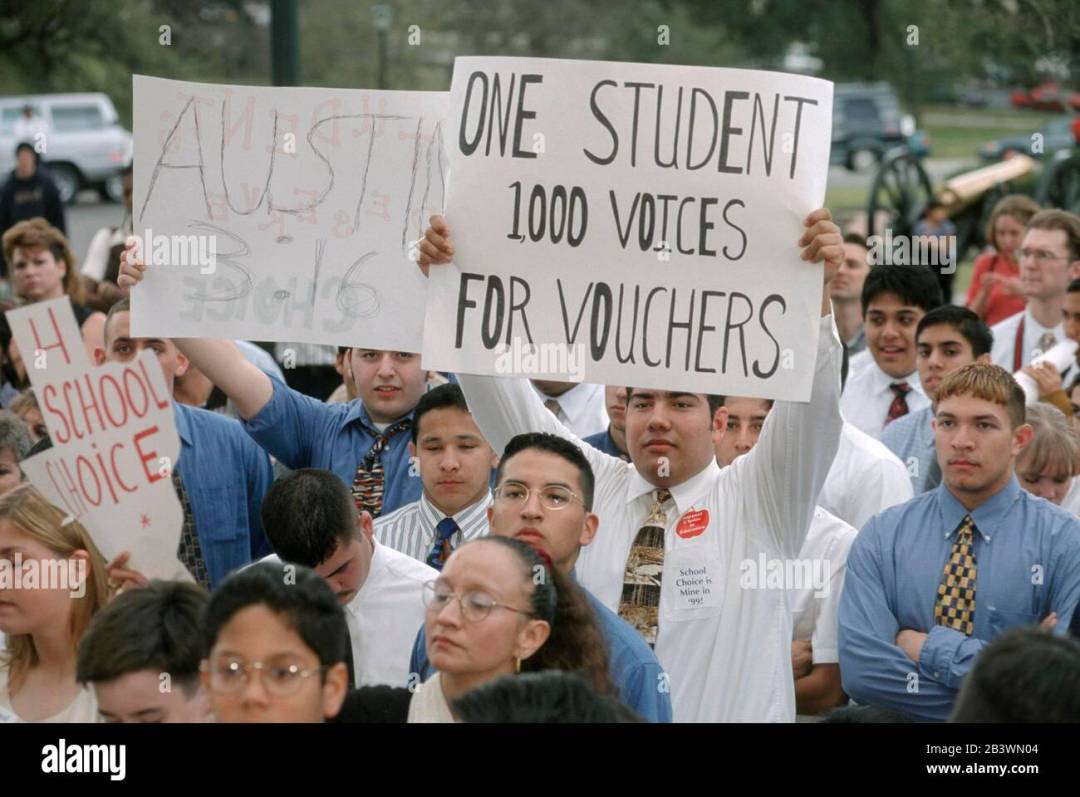
Recently, Rose Lounsbury, one of Oakwood’s most vocal opponents of EdChoice and other Ohio private school voucher programs, admitted to me that she would never want her own kids in a troubled school district like Dayton Public Schools (DPS), given the intolerable conditions there that I cited in my April 2nd letter to the Oakwood Register editor from a former DPS high school teacher (i.e., routinely disruptive classrooms making teaching extremely difficult, students resisting doing any schoolwork, and violence even towards that teacher). Despite the fact that EdChoice has allowed students to escape failing schools like DPS for private schools for nearly 20 years, she defended her support for dismantling those programs by claiming it would stop them from “defunding” failing districts like DPS so the needs of its students can be better served. Of all the specious arguments propounded by voucher opponents, this one is the least credible: that eliminating vouchers will somehow improve failing school districts by increasing their funding, when many such districts have already engaged in high spending levels with dismal results. Let’s walk though some numbers to see why.
First, with all the voucher opponents’ hysteria over the nearly $1 billion spent on Ohio’s vouchers last year, for context, that equaled less than 3% of the $30 billion in funding Ohio’s public schools received in 2024. The EdChoice program, the focus of the voucher controversy, accounted for $677.6 million, or only 5.2% of the $13 billion the Ohio government spent on all K-12 schools, and it equaled only 7.97% of the State’s $8.5 billion spent on traditional K-12 public school districts. So, would eliminating EdChoice and increasing the State’s public school funding by 7.97%, plus some additional funding from increased public enrollment by former EdChoice students, have significantly improved student outcomes in those failing districts?
Start with our own school district. In 2024, Oakwood City Schools spent $16,846 per student1, and among 8th graders, 90.4% were proficient in math and 83.6% were proficient in English language arts, and the district’s four-year high school graduation rate was 98.3%. Very respectable metrics. Meanwhile, the DPS district spent about 38% more, for a staggering $23,209 per student1, which was among the top 10% spending levels per student among all Ohio districts in 2024 (hardly a “defunded” district, is it?). Nevertheless, among that district’s 8th graders, only 8.9% were proficient in math and only 11.5% were proficient in English language arts, and the four-year high school graduation rate was only 72.3%. Why didn’t this far greater spending translate into better student outcomes, versus these far worse metrics, compared to our own district? Do we simply need to spend even more to overcome the troubled circumstances surrounding these districts? How much more?
If EdChoice had been eliminated and the money spent on it in 2024 was instead allocated to a 7.97% increase in State public school funding, that would only yield an additional $796 in per-student spending for the DPS district since 43% of the district’s funding came from the State (i.e., $23,209 times 43% times 7.97%). If that district’s metrics were so dismal with $23,209 per student of spending, do we really think another $796 per student, plus a small increase in State funding from enrollment of returning former EdChoice students, would have been the transformative catalyst that would have significantly improved those outcomes? How about $7,000 more, for $30,209 per student? Think again. Last year, the East Cleveland City School district spent over twice as much ($14,240) more, for a whopping $37,449 per student1, the second highest per-student spending level among all Ohio districts. Rather than generating better student outcomes, by most metrics they were even worse than DPS. Among 8th graders, only 3.5% were proficient in math and only 11.5% were proficient in English language arts.
If spending more money translates into better student outcomes, how do we explain these results for these two troubled school districts? Another school district’s story helps answer this question. The Baltimore City Schools district made local and national headlines in 2017 and again in 2023, when in each year there were 13 high schools without a single student proficient in math. In 2017, the district also had five high schools and one middle school without a single student proficient in either math or reading, and among 8th graders, only 11% were proficient in math and only 13% were proficient in reading. Any educator reading this should be appalled at those statistics. If you think this was due to a lack of spending, think again. In 2017 the district had among the top 10 highest levels of spending per student among all districts in the United States, and yet it had about the same dismal 8th grade proficiency levels as the DPS district last year. In 2023 it spent $22,424 per student, which adjusted for 2024 dollars was almost exactly the same as DPS last year, and it had $1.7 billion in funding. In an interview, the Baltimore City Schools district’s CEO, who holds a Ph.D. in education from Harvard, advised that the root cause of this problem – despite such profligate spending – was chronic absenteeism. That refers to a student being absent at least 10% of the days of the school year. In fact, a study by the National Center for Educational Statistics found a strong correlation between chronic absenteeism and poor standardized test performance. In the Baltimore City Schools district, 30% of students were chronically absent in 2017, followed by 54% by 2023.
With that in mind, let’s return to these three Ohio districts discussed above. When comparing last year’s data for the Oakwood, DPS, and East Cleveland school districts in that order, we see dramatically increasing levels of spending and yet dramatically declining math and English proficiency. Here’s what else we see: dramatically increasing rates of chronic absenteeism, from 8% in Oakwood, to 45.1% in Dayton to 63% in East Cleveland. It’s not hard to understand this relationship between chronic absenteeism and poor standardized testing or academic performance; chronically absent students have significantly less exposure to classroom teaching and schoolwork that helps develop the knowledge and skills measured on standardized tests. But it also reveals a more fundamental cause: a lack of overall engagement or motivation in one’s education by the students, and most troubling, by their parents or guardians. Those are obviously the people in the best position to ensure students make it to school each day, and to undertake disciplinary and other corrective measures when students are found to be chronically absent. As further evidence of this, the former DPS high school teacher also shared with me that on parent-teacher conference nights, virtually no parents or guardians would show up to meet with teachers, leaving them to resort to doing lesson planning or other tasks to pass the time while they sat there. Think about that; with such serious problems among students in that district, from low math and English proficiency, to neglected schoolwork (per the teacher), chronic absenteeism, behavioral problems and likely very poor grades, there should be a line out the door of concerned parents and guardians eager to discuss these many problems regarding their kids. Instead, it was the opposite.
These are not problems we can remedy with even more spending, clearly it’s not a money problem; as shown above, some of the highest levels of spending in the State of Ohio and even the entire United States have proven that. During a May 14th anti-voucher presentation by Oakwood Advocates for Public Education, the group attempted to counter this by asserting that State-subsidized pre-K programs (funded by eliminating vouchers, presumably) would solve the problem. However, studies have instead shown that among economically disadvantaged kids, the beneficial effects of such programs on student performance and behavior are short-lived and fade out after a few years, and studies are mixed as to purported long-term beneficial impacts (see, e.g., here, here and here). Again, spending even more money in these failing districts won’t solve these problems. Feel free to offer other arguments for doing away with vouchers, but that is the least credible of them all.
Here’s how we can move the needle and make a difference: keep in place a voucher program for students in those failing districts, so that the students and parents who are motivated enough to do so can get out of those troubled schools and take advantage of a much better educational environment that can be life changing for those kids and their families. In fact, a study published last month, and cited in the Wall Street Journal, found that students who enrolled in Ohio’s EdChoice program during 2008-2014 (when EdChoice was primarily for students in failing schools) were significantly more likely to attend and graduate from college than their classmates who remained in public schools. Note the study also narrowed the comparison to students from the same public schools, with similar racial, socioeconomic and other demographics, and with similar pre-enrollment standardized test scores. Note also that, in the actual study report downloadable from this article, the researchers refute the common claim of Ohio’s voucher opponents: that private schools supposedly provide inferior education based on the fact that students who left public schools for private schools showed slight declines in performance on state standardized tests. The researchers point out that unlike various private schools, Ohio public schools’ academic curricula are designed to align with those state tests, and those public schools have a powerful incentive to tailor their curricula and lesson plans for state tests since unlike private schools, they are publicly graded and ranked based on their students’ performance on those state tests.
-Trevor F. Hoffmann
1 For all per pupil spending and funding levels of Ohio districts, and the State’s share of funding, go to this Ohio Board of Education website, then click the link titled “click here to access the report” to download the spreadsheet, then refer to the second tab of the spreadsheet for this data. For each school district, per pupil spending is shown in column AU, the state’s share of the district’s revenue is in column AW, and per pupil revenue is under column BD.
 OCSS
OCSS 