Why You Should Vote for Andrea White

In this election, we have a choice between our experienced, incumbent Ohio House representative, Andrea White, who has championed mainstream policies fostering economic and job growth, affordability, public safety, assisting the needy and increased funding of public and private education, and her second-time challenger Rose Lounsbury, whose inexperience, polarizing partisan messaging, apparent unfamiliarity with core issues and controversial platform pose real concerns, including for our economy, affordability, healthcare and education.

In her six years representing us, Andrea White has supported the above priorities via legislation including: reduced taxes and regulations on businesses, bolstering economic and job growth and affordability; overhauling Ohio’s single-family homeowner’s tax credit and property tax exemptions to improve home affordability; supporting law enforcement and first responders; anti-crime measures such as legislation imposing tougher penalties, upgrading criminal background checks and combating vehicle thefts; increased funding of vocational and career training; and additional resources addressing Ohioans’ mental health needs (see generally, here). Andrea has worked across the aisle on bipartisan legislation, such as to combat infant mortality, assist low-income mothers and strengthen child support enforcement. She has repeatedly supported increased funding of both traditional public education and Ohio’s popular EdChoice voucher program for affordable access to private schools that can be life-changing for students in low-income families and failing school districts, and students whose public schools aren’t meeting their needs, most recently for her vote for Ohio House Bill 96 (see here and here).

Rose Lounsbury, while deservedly well-regarded, supports an agenda detrimental to Ohioans, and her inexperience is apparent in numerous inaccurate or misleading campaign statements that I doubt were intentionally false, but indicate a lack of understanding of key issues cloaked in boilerplate party talking points. As noted in my May 13th letter to the Oakwood Register editor (see sourced online version here), in one of her negative ads against Mrs. White and Ohio GOP leadership, she made outlandishly false claims that Ohio House Bill 249 would criminalize cross dressing and mainstream theatrical performances with cross-dressing characters, likely from her failure to either read the bill or to read it accurately, which are vital functions of a competent legislator.

In two other negative campaign ads (here and here), Rose falsely accused Mrs. White of voting to cut public education funding by diverting the funds to EdChoice vouchers via her vote for HB 96, when HB 96 actually increases Ohio’s K-12 public school funding by $226 million for the 2026-2027 budget versus the already record-high 2025 levels (see here and here). She has falsely claimed that Ohio Republicans have “continually cut funding to our public schools” (see here at 8:55), when funding of Ohio public schools on a per-pupil basis, from the state and overall, has been steadily increasing over the past 25 years (see here at page 10). She falsely claims EdChoice “drains” public school funding, when EdChoice doesn’t restrict Ohio’s budgeting levels for public schools, and EdChoice enrollments don’t withdraw funds that would otherwise cover public schools, including, as Rose claims (here at 8:25), by the fact that both being funded under the same budget line item. Ohio’s education budget includes funds for both public schools and EdChoice based on projected enrollment for each. Any leftover funds expire at the end of the budget cycle; they don’t go to public schools.

Rose blamed Republicans in Columbus for Ohio’s high property taxes and accused them of granting “tax cuts for the rich” at other Ohioans’ expense, when property taxes are driven mainly by local governments, mostly via voter-approved levies and bonds, have repeatedly given Oakwood among the highest property taxes of any municipality in the Dayton area. If she’s unhappy with her high property taxes, she has herself and other Oakwood voters to blame.  The taxes controlled by the Ohio government are actually quite low, with among the 10 lowest income tax burdens of states charging income tax, including for the middle class (see here).

Mrs. Lounsbury’s platform presents serious concerns, particularly for our economy and affordability. Her campaign kickoff speech featured affordability as a reason voters should “flip” control of the Ohio House and government to Democrats, with logic exemplifying the correlation-causation fallacy: affordability (cost of living) has worsened for Ohioans in recent years, and Republicans are to blame since they controlled Ohio’s government during that same time period. She never mentioned prices and living costs also rose everywhere else nationwide, due to unprecedented deficit spending by the federal government financed with printed money, beginning with emergency COVID spending, but then continuing under the previous administration even as the pandemic waned. This brought inflation from only 1.4% in January 2021 to a staggering 40 year-high 9.1% in June 2022. This had nothing to do with Republicans in Columbus.

Rose is correct, though, that state government policies profoundly impact affordability. However, by equating a state’s cost of living with the political party controlling its government, she ironically makes one of the most powerful arguments against her entire candidacy. Blue states typically have significantly higher living costs, representing 9 of the top 10, and 16 of the top 20, states with highest costs of living, while red states represent 9 of the bottom 10, and 18 of the bottom 20, states with the lowest living costs, per 2025 rankings. If Rose thinks Ohio has an extraordinary affordability problem, she hasn’t looked at the data; Ohio’s cost of living is not only below most states, it’s lower than every blue state in America excluding New Mexico, which is ranked right behind Ohio. In other words, affordability is worse than Ohio’s in virtually every state with Democrats in control, as she is advocating.

This isn’t merely a correlation; it’s a result of blue state policies, including those in Mrs. Lounsbury’s platform. Blue states impose significantly higher taxes and regulations on individuals and businesses. This leaves residents with less after-tax income for affordable living, and drives up operating costs on businesses, who respond either by reducing or eliminating hiring, staffing or pay increases to offset those costs (thus hampering affordability for the workforce), or by transferring those costs to customers via higher prices. This is why things are often more expensive in blue states than red states.

Blue states account for all of the 10 states with the highest income taxes, and none of the 10 with the lowest among states that charge income tax (see here). Presumably, Rose supports raising income taxes given her “tax cuts for the rich” rhetoric, and even limiting tax increases to “the wealthy” is a job killer and inflates consumer prices from its impact on businesses. This is because 95% of all businesses pay income taxes through their owners’ individual income tax returns and tax rates (aka “flow-through” taxation), and 91% of all taxable income from these “flow-through” businesses – the backbone of our economy and job creation – is reported in the top 20% income level and 57% is reported in the top 1% level (see here).

Blue states impose higher regulations detrimental to affordability, including zoning and permitting laws that elevate housing costs, and labor laws such as raising the minimum wage, which has consistently inflated consumer prices and reduced jobs while crushing small businesses (see, e.g., here and here). Mrs. Lounsbury supports the latter with her website’s “living wage” rhetoric.

Like most blue states, Mrs. Lounsbury supports expanding unions, which impose an average of 15% – 25% higher labor costs by coercing employers to provide above-market compensation and benefits packages, including pensions that are unaffordable to most private companies and a leading cause of state budget deficits (see here at p. 7). This results in higher consumer prices and job losses. A unionized can hardly provide competitively-priced products if its labor costs are up to 30% higher than its non-unionized competitors. Unsurprisingly, private sector union membership has therefore plummeted by over 70% since 1980 and is now five times more prevalent among government employees, whose employers can force taxpayers to pay the inflated labor costs. A 2018 Ohio State University study found that one of the two main causes of Ohio’s loss of manufacturing fueling its over 50-year economic decline was effectively labor unions; specifically, manufacturers relocating to other states with “right to work” laws that prohibit requiring workers to join unions.

Rose has an entire webpage promoting unions, and while she cites her personal and family history of union membership, don’t think that’s the only reason. Her 2024 and 2026 campaign finance disclosures show multiple unions lining her campaign’s pockets. Therefore, if you vote for Rose Lounsbury, you are voting to double-down on a leading cause of Ohio’s manufacturing and economic decline, for the enrichment of her union donors. A key step to revitalizing Ohio’s economy is actually the opposite of Rose’s agenda: make Ohio a “right to work” state so we can bring back those lost manufacturing jobs.

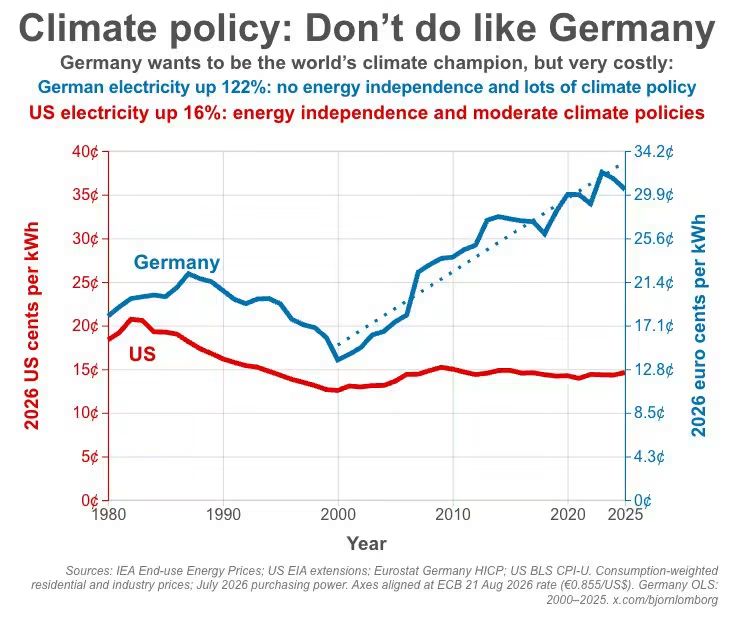
As with many blue states, Mrs. Lounsbury supports burdensome environmental regulations that inflate business operating costs and prices, including “cap-and-trade” initiatives that heavily tax and regulate fossil fuels to compel transitions to costly, inefficient and unreliable “green” energy such as wind and solar power, which her website ironically presents as making energy “affordable” as families struggle with high energy costs. In Germany, these policies increased consumer energy prices by over 120% to the highest in Europe and among the highest in the world (see here, here and here), with energy shortages in winter. Washington State’s similar program inflated energy prices by 41% in five years, and California’s program increased energy prices five times higher than anywhere else in the U.S. for a staggering 127% price increase, with periodic energy shortages. If you’d like your energy bills to balloon by 40% to 127% with possible shortages, then Rose Lounsbury is your candidate. While her campaign’s “Working Families” webpage laments high energy costs for families, her “Environment” webpage pushes these same energy policies. Further, that webpage suggests she supports restricting or banning fracking and other fossil fuel production, which would devastate eastern Ohio’s economy.

Similarly, Mrs. Lounsbury’s “Healthcare” webpage laments higher healthcare costs for families while prescribing policies that would drive them higher. Her proposal to mandate minimum staffing levels for healthcare facilities – likely higher than they would otherwise maintain – would trigger higher operating costs passed onto patients. Alternatively, facilities may resort to hiring staff willing to work for substandard compensation to satisfy the mandate, risking inferior healthcare, sanitation and overall patient experience.

Mrs. Lounsbury’s education agenda would produce poorer student outcomes and fewer educational choices, leaving many students trapped in schools that are failing or otherwise not meeting their needs. Her flawed education pitch blames sheer Republican control of Ohio’s government for Ohio supposedly ranking 30th in education (see here at 13:40) (it’s 12th per a July 2026 Ohio Capital Journal report), while falsely claiming Republicans have cut education funding (see here at 13:00) when the state’s funding of its public education has steadily risen over the past 25 years (see here at page 10). As with property taxes, she ignores the central role of local government. Ohio would rank significantly higher but for pockets of failing school districts with mismanaged municipal governments (e.g., Dayton, Toledo, Cincinnati, Cleveland, Columbus), and like most others in the U.S., the vast majority have been run by liberal Democrats and their teachers’ union donors for decades. A recent Progressive Policy Institute study found blue states with heavy teachers’ union influence frequently have worse student literacy than red states. Only 4 of 23 states with the highest scores were blue states (13 were red states), and 8 of the 10 states with the worst literacy scores were blue states with heavy teachers’ union influence. Teachers’ unions notoriously oppose any manner of education reform, accountability and school choice because they prioritize their self-interests over students. This hardly makes the case for “flipping” the Ohio House and government to Democrat control.

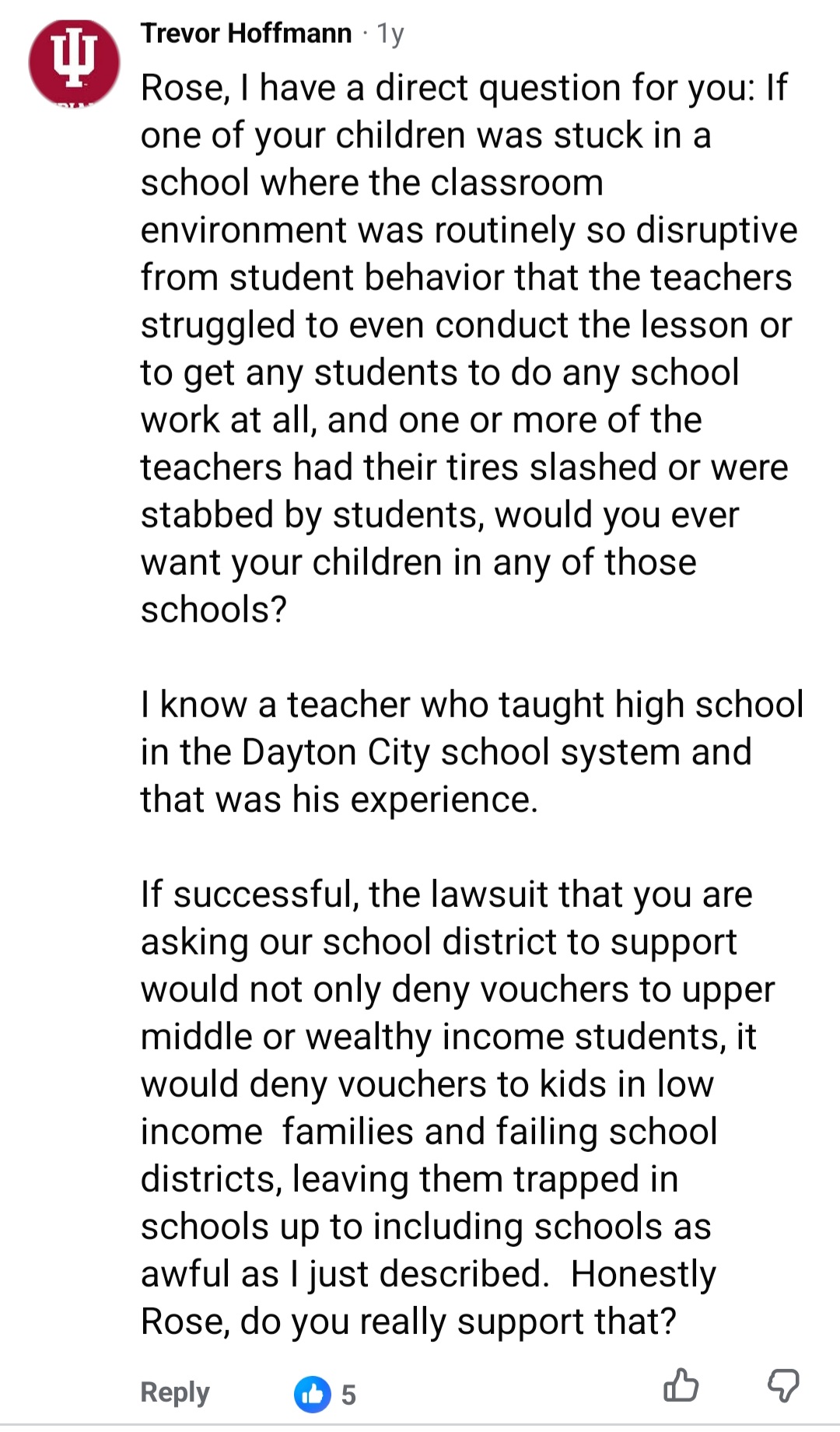
As a far-left Democrat and former teachers’ union representative, Rose Lounsbury would tow the line on policies that have perpetuated these pockets of failing districts and left their students without viable alternatives. Unsurprisingly, she vigorously supports eliminating Ohio’s entire EdChoice voucher program (not just the 2023 expansion). This would leave disadvantaged students trapped in troubled districts and learning environments that in the case of the Dayton Public Schools (DPS) district, Rose admitted to me she wouldn’t want to leave kids trapped in, given the disturbing conditions there as described by a former DPS teacher. She purportedly champions education, while seeking to deny disadvantaged students access to high-quality education such as her kids enjoy in Oakwood’s top-ranked district. I find this hypocritical.

Lastly, the abrasive, partisan tone of Mrs. Lounsbury’s campaign messaging with its continuous negative attacks against Mrs. White and other Ohio Republicans indicate that if elected, she will not work effectively across the aisle with the likely continuing Republican House majority to actually get things done. Rather, she will be a shrill, ineffectual performer, posturing from the margins of the House without delivering meaningful results for her constituents.

For these and many other reasons, I am voting for the candidate with years of experience successfully representing us that Mrs. Lounsbury lacks, and whose policies are grounded in a proven history of better affordability and opportunities for Ohioans. I am voting for Andrea White, and if you are concerned about Ohio’s future, I urge you to do the same.
Sam Dorf’s Collaboration with Activists for City Policies Included Proposed Ordinances That Would Stifle Free Speech

Oakwood City Council candidate Sam Dorf has a history of collaborating with outside, controversial activist groups for guidance on Oakwood City policies.

As noted in a recent letter to the Oakwood Register (posted here), in 2019 Mr. Dorf effectively accused Oakwood police of racial profiling based on a deeply flawed study by ABLE, an activist organization, including in the October and December 2019 City Council meetings. Mr. Dorf even stated that the study’s claims were consistent with his own observations of Oakwood police. Even after the study was thoroughly discredited by the City in both meetings for lacking numerous critical facts to justify the accusations, Mr. Dorf doubled down on the study in the December City Council meeting, claiming it was nonetheless important to follow the study’s recommendations to address the “perception of Oakwood”. This can all be seen in the minutes from those meetings here and here.

The traffic stop statistics of the ABLE study were also the basis for Mr. Dorf’s writing to City Council members to urge the police department to end the practice of stopping drivers based on random license plate checks, even though the City noted it is a nationwide best police practice to catch drivers with suspended or revoked licenses or who are under arrest warrants (accounting for nearly 25% of criminal suspects under arrest warrants apprehended by Oakwood police) (see here). Mr. Dorf’s stated reason was to reduce the racial disproportionality of racial minority drivers stopped by police as reported in that study, with no mention of the impact on public safety from ending that practice (see here). Records obtained from Oakwood police show a significant drop in traffic enforcement since then and resident complaints of increased speeding and reckless driving, as noted in that letter to the editor on that issue.

Mr. Dorf’s call for a policy of suspending without pay and publicly identifying, and thus effectively doxing, Oakwood police officers who discharge their weapon against unarmed suspects (regardless of the circumstances), also noted in that letter, came from the Dayton unit of the NAACP (see here). Again, that would put officers at risk and deter them from making difficult but possibly necessary decisions in extraordinary circumstances.

In July 2020, Mr. Dorf wrote City Council members to encourage them to participate in Bridging the Gap, an activist march demonstration whose message included that Oakwood and other Dayton suburbs and their police are unwelcoming and prejudicial to racial minorities (see here). He also wrote City Council members and Chief Hill to encourage them to participate in a book study of How To Be an Anti-Racist by Ibram X Kendi, and of Raising White Kids by Jennifer Harvey. Mr. Kendi’s book specifically rejects a colorblind, racially neutral standard of treatment and explicitly calls for racial discrimination (i.e., actual racism) across society to engineer equal racial outcomes. It commends Karl Marx, it denounces capitalism as inherently racist and born out of racism (racism’s “conjoined twin”), and advocates implementing unspecified “anti-capitalist policies” throughout society. What does any of that have to do with the operations of City Council? What sorts of radical policies does Mr. Dorf want the City Council to implement based on these beliefs?

More recently, in September 2024, Mr. Dorf wrote to City Council members to encourage the City to adopt model ordinances drafted by the Anti-Defamation League, through his collaboration with Dr. Kelly Fishman, a staffer at the ADL’s office in Cleveland. Dr. Fishman also wrote a recent letter to the Oakwood Register editor endorsing Mr. Dorf for City Council. These model ordinances would stifle and penalize a wide range of free speech, including speech having nothing to do with the ADL’s stated purpose of combatting demographic hatred. For example, under one the ordinances (Model Ordinance #4), someone who overlooks a “No Solicitations” sign on someone’s property or who is unfamiliar with the ordinance could be fined, or even criminally prosecuted, simply for leaving a flyer or pamphlet on the property to advertise their business or promote a candidate for office, or for ringing the doorbell to fundraise for their church or their child’s little league team.

It’s also easy to see how the enforcement of this ordinance could be susceptible to politicization and abuse. For example, someone who leaves a pamphlet or knocks on a door to promote a Republican candidate for office or fundraise for their church is fined, while someone who does so for a Democratic candidate or other reason is not, or vice-versa. In light of this and Mr. Dorf’s political orientation, what other sorts of overbearing regulations he would seek to impose on Oakwood if elected to City Council?

The City Council is not a platform for the sort of divisive political and social activism that has been the focus of Mr. Dorf’s extracurricular activity since moving to Oakwood. It is a non-political governing body entrusted with the stewardship of our community facilities, services, ordinances and fostering its economic development.

Oakwood needs City Council members who will focus on these nonpartisan tasks rather than activist causes and policies that could harm and divide the community.

Sam Dorf’s Vacancy Tax Advocacy: Misguided Policy That Would Harm Oakwood’s Business District

“We should collaborate with landlords to explore a vacancy tax on chronically empty storefronts” – Sam Dorf in the Oct 22, 2025, edition of the Oakwood Register

Oakwood residents, as we approach the city council election, it’s crucial to scrutinize the proposals put forward by candidates like Sam Dorf. As a left-wing activist with a vocal online following, Dorf has advocated for a vacancy tax on empty storefronts in our shopping and business district — a policy he frames as a solution to our community’s limited growth opportunities. While this may sound like a progressive fix to encourage leasing and revitalize our “pocket community,” a closer look reveals it as a risky, one-size-fits-all approach that ignores the realities of our small, well-maintained town with its older housing stock and modest business ecosystem. Drawing from experiences in other cities and economic analyses, this proposal could lead to unintended consequences that exacerbate our challenges rather than resolve them. Let’s examine why Dorf’s stance on this issue raises serious questions about his suitability for council.

Dorf’s advocacy for a vacancy tax stems from a desire to penalize property owners for unoccupied spaces, ostensibly to spur quicker rentals or sales. However, in a low-demand area like Oakwood, where empty storefronts reflect broader issues like e-commerce shifts and limited local foot traffic, this policy doesn’t address root causes. Rather, it piles additional financial burdens on owners already grappling with maintenance, taxes, and insurance costs. As seen in places like Oakland and Los Angeles, such taxes have led to increased defaults and foreclosures, with property values plummeting and owners forced to sell at losses. For Oakwood’s modest business district, this could mean fewer investors willing to step in, deepening the cycle of vacancy rather than breaking it.

Consider the deterrence to economic growth: A vacancy tax signals to potential investors that Oakwood is hostile to property ownership, especially when leasing can take 12-24 months due to marketing, negotiations, and costly tenant improvements—often exceeding $200,000 for a mid-sized space. In high-demand markets, this might work, but in our small community with little room for expansion, it risks scaring away the very capital needed for renovations or new ventures. Dorf’s left-leaning activism overlooks these market realities, prioritizing punitive measures over incentives like grants or zoning reforms that could genuinely attract businesses.

Worse still, this policy could accelerate an urban “doom loop” in our tight-knit town. By adding fees without boosting demand, it may lead to neglected properties, falling values, reduced city revenues, and even heightened crime—issues that hit small communities like ours hardest. Nationwide data reveals nearly one-third of office loans in distress, with cities like Chicago seeing over 75% affected, illustrating how such burdens shrink markets and limit options. In Oakwood, where our well-kept homes and limited commercial space define our charm, Dorf’s proposal threatens to undermine the vibrancy we cherish, potentially straining resources for essential services like schools and safety.

The inequities are stark: Smaller property owners, including low-income or minority individuals, bear the brunt, facing unaffordable penalties that force abandonment. Surviving landlords might pass costs to tenants via higher rents, making it tougher for local small businesses to thrive—leading to mismatched leases and more failures down the line. Oakwood’s limited resources should focus on proactive growth strategies, not punitive approaches.

Parents, teachers, students, and community members: Sam Dorf’s push for a vacancy tax exemplifies a pattern of ideological activism that prioritizes broad-stroke penalties over practical, community-tailored solutions. In light of his candidacy, this stance highlights a disconnect from Oakwood’s unique needs—a small town with old-world charm but real constraints on expansion. We can’t afford policies that risk further emptying our streets. Instead, let’s support approaches that foster investment and preserve our way of life.

If you’re concerned, join the discussion on our Facebook page for updates and stay informed ahead of the election. Oakwood deserves leaders who protect, not penalize, our local economy. Make sure to vote!

Sam Dorf Proposes Low Income Housing In Oakwood Shops??

Sam Dorf’s radical proposal would further deteriorate Oakwood’s commercial district

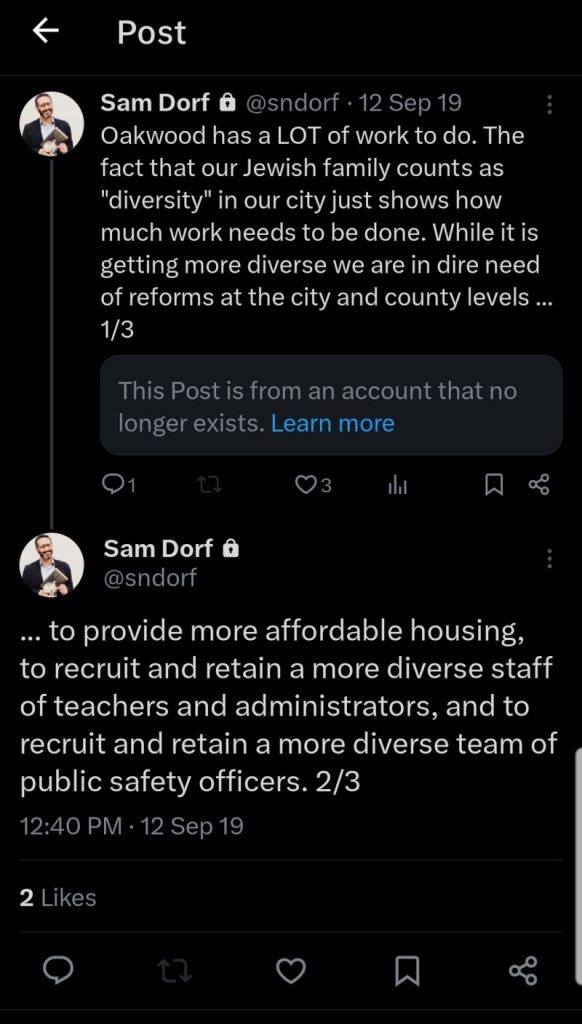
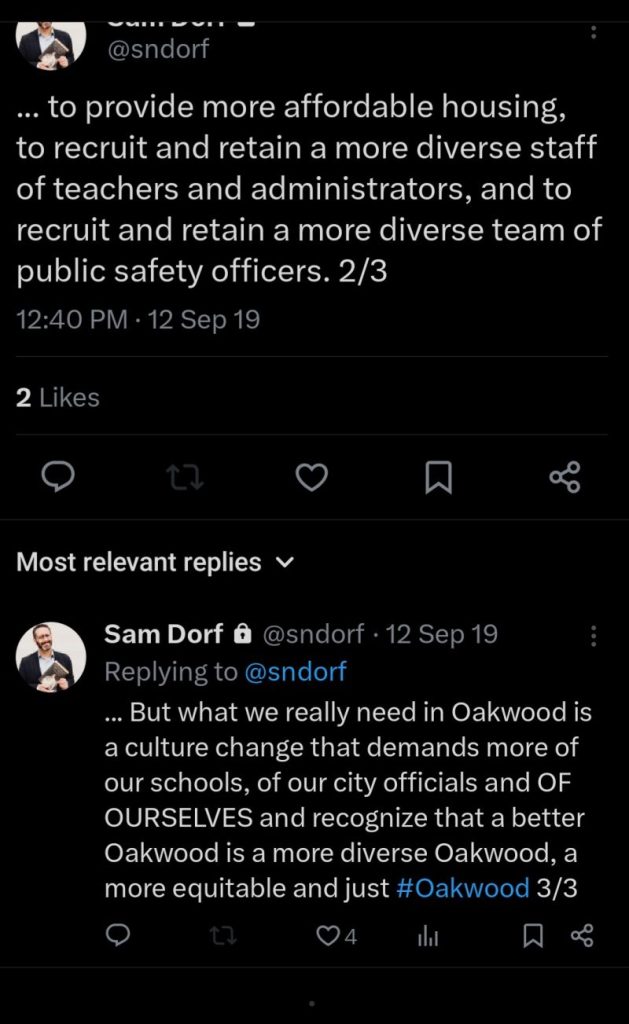
In the past several years, Oakwood City Council candidate Sam Dorf has repeatedly expressed great interest in expanding low income and multi-unit (aka “affordable”) housing in Oakwood, in conversation with residents and on social media. For example:

However well intended this idea may be, Oakwood is simply not designed for significant levels of this type of housing. Adding more of it here would likely bring in more congestion, more crime, possibly strain Oakwood’s schools, and lower our property values. Online crime maps show areas with this type of housing have higher crime rates, including around Oakwood (for example, see here). Oakwood residents living near existing low income housing have already reported problems with loitering, vagrants, drug paraphernalia and litter in and around those properties.

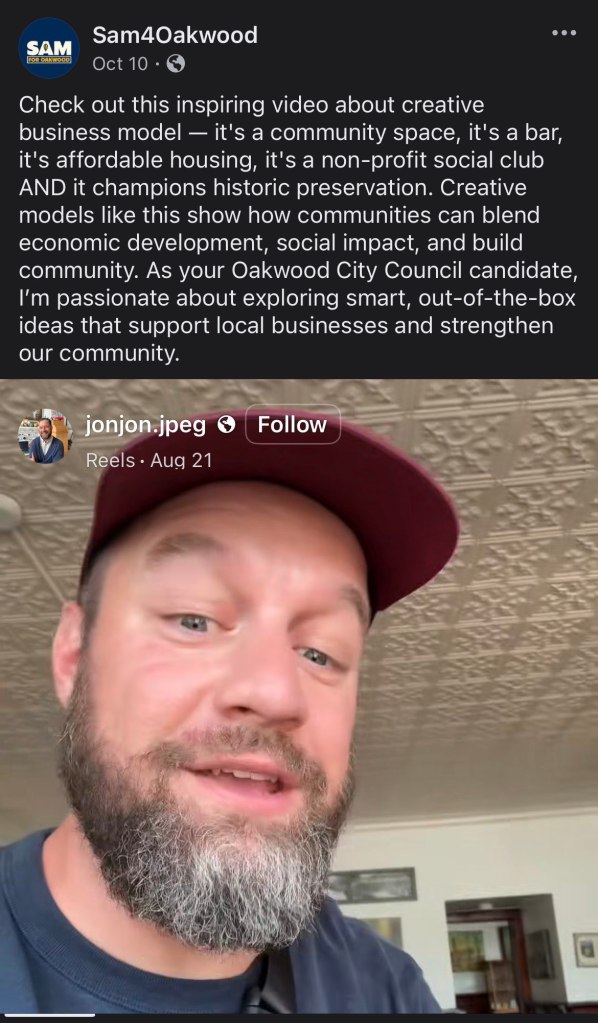
Now, the City Council election is in full swing, and one of the major issues in the election is addressing the vacant buildings and overall conditions in the shops of Oakwood. Mr. Dorf’s latest idea for expanding this type of housing is to bring it right into this very area the City is trying to revitalize. He recently proposed the following solution on his campaign Facebook page: converting vacant buildings to community resident-owned, non-profit businesses that sidestep “traditional access to capital”, with “affordable” rental housing right above them:

The video featured in his post can be viewed here.

Oakwood shops property owners have already struggled to bring in new businesses to their vacant stores and office spaces. Business owners have indicated one of the main reasons is the high rent, which owners must charge to cover Oakwood’s high property costs and taxes in that area. Another problem is restrictive zoning, which would have to be radically altered to allow housing in the shops area. One has to wonder how avoiding larger investors and relying on residents buying shares into a non-profit would raise enough funds to make Mr. Dorf’s proposal feasible, and whether the City would appreciate the loss of tax revenue that could otherwise be generated from for-profit businesses.

But the larger concern is the impact of having residential tenants living above the shops and offices, especially low-income or even subsidized tenants if that is part of the plan. How many business owners would appreciate having the commotion of families with infants or small children, wild parties or altercations, or a leaking shower or toilet right above their restaurant, store, salon or professional office? How would they like to have any of the more serious problems described above, which Oakwood residents have already seen with some of this housing, in or around their business properties? How many customers, or residents living near the shops area, would like more of those problems?

This sort of collectivist approach to improving Oakwood’s commercial district may look appealing from the ivory-towered vacuum of academia. But for real world business owners, that, together with Oakwood’s high rent and zoning issues, would be one more compelling reason to set up shop elsewhere. And for businesses already here, it would be one more reason to leave. In short, Mr. Dorf’s idea of injecting low-income housing in Oakwood’s commercial district would likely exacerbate its decline by driving away business and investment, and it could prove to be one of the worst things to happen to the district, to Oakwood’s economy and to the City as a whole.

Oakwood needs City Council members with more sensible approaches to this issue – approaches that are better attuned to the needs and concerns of businesses and residents, and to economic realities.

A Risk Oakwood Can’t Afford: Why Sam Dorf’s Record Matters

Sam Dorf’s run for Oakwood City Council should raise concerns for Oakwood voters as his divisive and partisan approach to politics undermines the public safety of our community.

Sam has publicly supported expansion of multi-unit and low-income housing in Oakwood. While that may sound compassionate, it’s not practical for our small city. I am concerned this will lead to more congestion, increased crime, strain on schools and services, and lower our property values. Oakwood residents living near existing multi-unit housing have reported seeing vagrants, drug paraphernalia and litter in and around those areas. We need a candidate who is dedicated to strong zoning and maintaining high neighborhood standards.

Sam has repeatedly criticized the Oakwood Public Safety Department in ways that have damaged morale and public trust.  In 2019, Sam accused Oakwood police of racial profiling based on a flawed and discredited report from a partisan activist group. Regardless, he claimed its recommendations should still be followed to improve the “perception of Oakwood”. Following these divisive claims, police data show traffic enforcement has dropped significantly (average annual citations by more than one third, and fewer than half of traffic stops result in citations). Residents have noticed more reckless driving and reduced police presence. The timing hardly seems a coincidence — it appears our officers pulled back after being unfairly disparaged, and Oakwood is less safe as a result thanks to Sam’s advocacy.

Sam called for the department to end its use of random license plate checks, a standard policing practice that enables officers catch drivers with suspended or revoked licenses, no insurance, or open arrest warrants (accounting for nearly one-fourth of Oakwood police apprehensions of arrest warrant suspects). Sam opposed this because he didn’t like the racial breakdown of drivers stopped. But should that outweigh our responsibility to keep dangerous drivers off Oakwood’s streets?

Sam advocated a policy requiring any officer who discharges a weapon against an unarmed suspect – regardless of the circumstances – to be suspended without pay and publicly identified, effectively doxxing them. This would endanger good officers and discourage them from making tough but necessary decisions in extraordinary situations.

Sam’s polished ads and campaign website tell a story that doesn’t square with his record. He says he’ll “work collaboratively and transparently,” and support “open communication,” yet his past approach has divided neighbors and undermined trust in city leadership. He now praises the very Public Safety Department he once accused of bias. He claims to champion unity, but his history shows a pattern of divisive politicization. Oakwood deserves steady, reasonable leaders who protect our community, support our officers, and rely on facts – not polarizing activists who rely on flawed assumptions and put their politics ahead of public safety.

Sam Dorf Oakwood City Council Attack Ad Sparks Controversy Over Negative Campaigning

October 18, 2025

Controversy recently erupted on the eve of the Oakwood City Council election, when a negative ad appeared on internet streaming and television channels regarding City Council candidate Sam Dorf, which can be seen here: https://youtu.be/sdA9BnqtPro?si=RvzGn-jXe62FZuVm

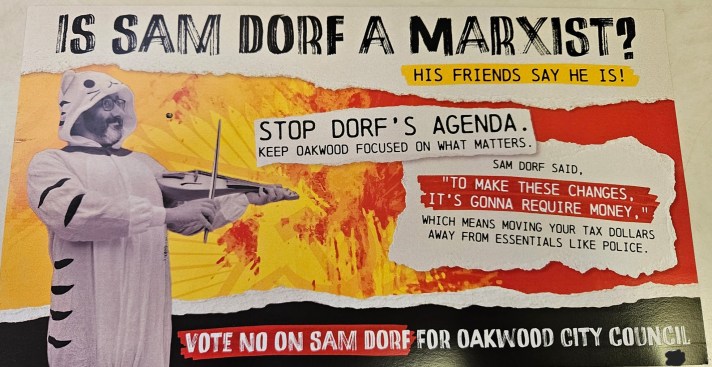
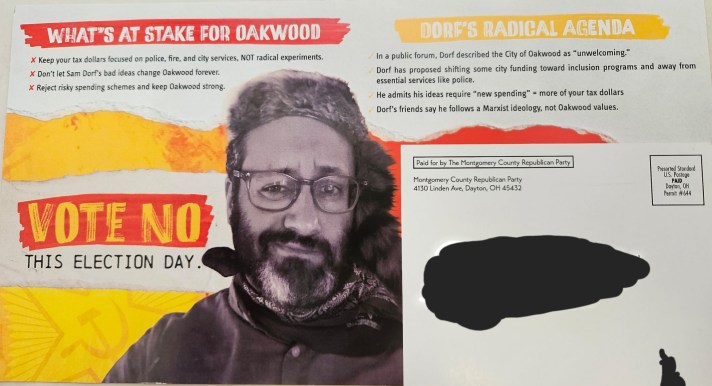
The ad says it was funded by the Montgomery County Republican Party, and the other two candidates in the election promptly confirmed no association with the ad and denounced negative campaigning of this sort, pledging to continue running positive campaigns focused on the issues. Mr. Dorf also condemned the ad, claiming it is inaccurate and “xenophobic”. The ad was then followed by this mailer, also from the Montgomery County GOP:

Like it or not, negative ads like this are typical during election season, though usually in larger elections. But how effective are negative ads in delivering their intended results? At a time of concern about the tone of our political discourse, are they the best approach versus purely positive campaign messaging? Look at the above examples. Do they discourage you from voting for Mr. Dorf, motivate you to vote for him, or have no effect on your voting decision? While these ads touch upon some policy issues, like claiming Mr. Dorf has called for diverting funds away from police, negative ads are often more substantive, focusing on a candidate’s record and stances on the issues. These appear aimed more at simply making the candidate look bad, rather than offering critiques that could be raised of Mr. Dorf’s extensive controversial record.

It is unusual to see these large ad campaigns in such local-level elections, and candidates for Oakwood’s City Council and Board of Education elections have generally run positive campaigns promoting their strengths. However, Oakwood has seen negative campaign messaging before, from sources other than the candidates, and their impact on election results is questionable.

In the 2023 Board of Education election, screenshots and pictures of one conservative candidate were circulated by residents, including by Mr. Dorf, and it fueled heated and sometimes rude criticism of the candidate on social media for her expressed religious and other views on social and political issues.

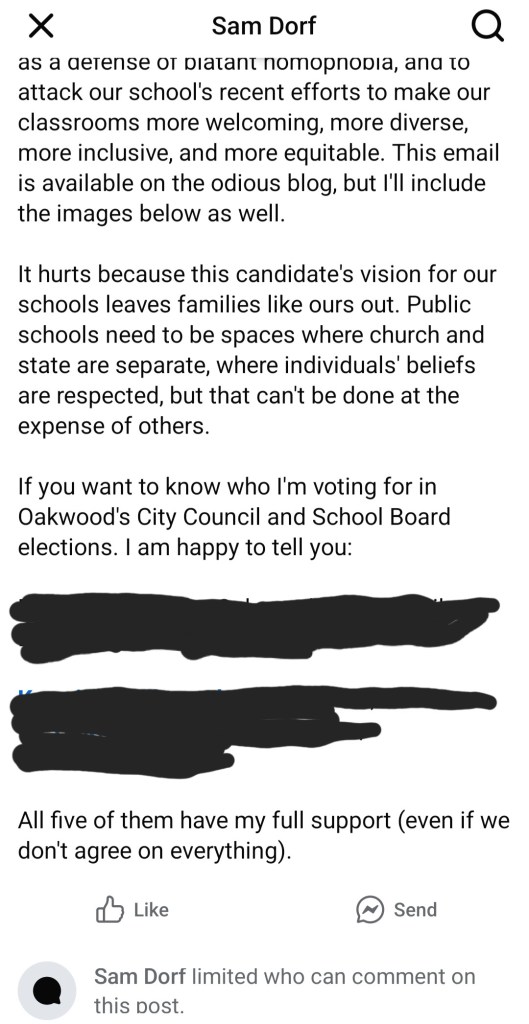
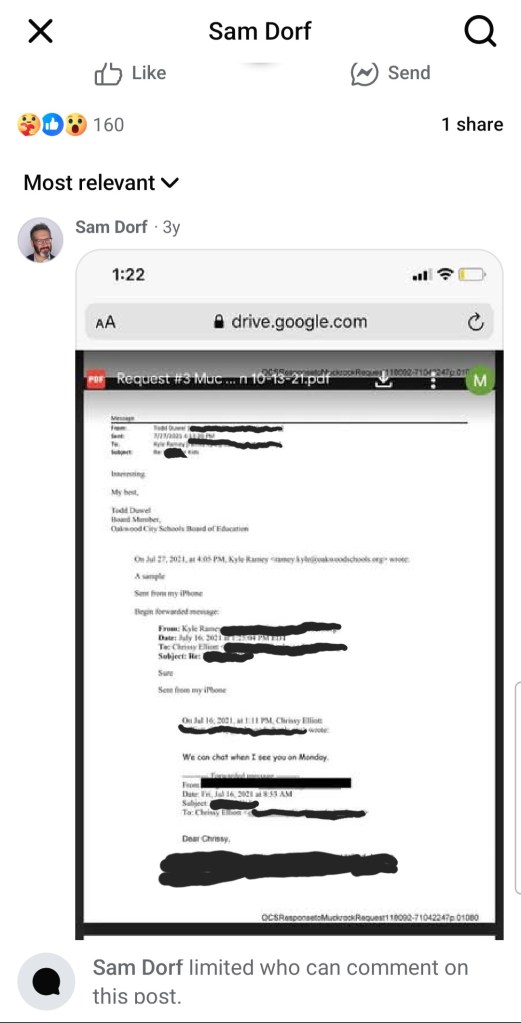
In the 2021 Board of Education election, a conservative candidate was vilified by progressive residents on social media and elsewhere, for statements she made in a private email to an Oakwood school official after the school district disclosed the email in response to a public records request. She expressed her religious reasons for asking the school to opt her children out of controversial classroom instruction on sexuality and gender identity. Her statements were entirely within mainstream Christianity, and her expressed view that public schools should be neutral on those topics is the most mainstream position on that issue. Her email was also personal, private, and sent before she was a candidate, in her role as a mother concerning her children. Nevertheless, residents posted the private email on social media during the election and used it as fodder to attack the candidate for her religious and other views on those topics, including Sam Dorf himself, who called her beliefs “homophobic” (candidate’s email is left out for privacy reasons):

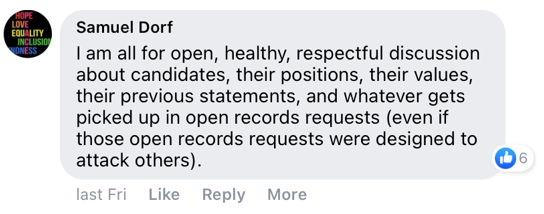
Mr. Dorf even defended the attacks (which were hardly “respectful”), and the use and disclosure of the candidate’s email for that purpose:

The Democratic Party even included the candidate’s email in campaign literature distributed in Oakwood.

This demonstrates a flagrant disrespect for the candidate, for her and her children’s privacy, and for her religious beliefs. It was later revealed that the Oakwood school district had disclosed the email in violation of student privacy laws, from a lawsuit the candidate filed against the district, which district settled with a public apology. And yet, that email remained published by Mr. Dorf and others on social media.

Mr. Dorf now presents himself as a victim of negative campaigning, but could one say that what is good for the goose is good for the gander? What was done to that candidate in 2021 was actually far more egregious than what these ads are doing to Mr. Dorf in this election. Or, is it better stick to positive campaigning to take the high road? Is some degree of negative campaigning acceptable as a way of informing voters of a candidate’s record if it is done respectfully?

Also, did that negative messaging affect those prior Board of Education elections? Those two disparaged candidates received about the same share of votes as the other conservative or Republican candidates in those elections, whose campaigns were not subjected to any negative messaging or controversy.

The effectiveness and propriety of negative campaign messaging is highly debatable, but one thing is certain: for better or for worse, it’s likely here to stay.

Killing Vouchers Won’t Improve Failing Schools

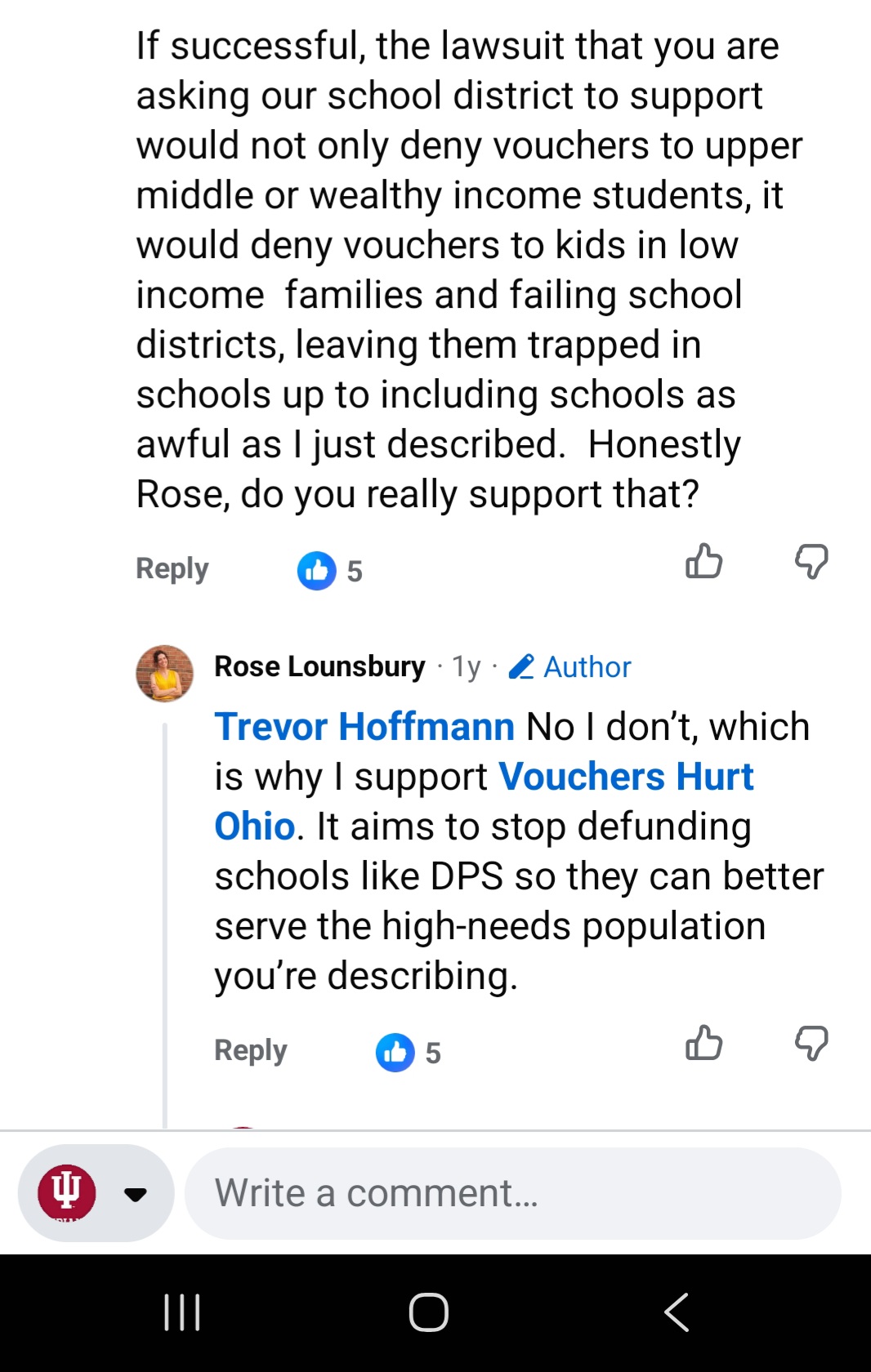
Recently, Rose Lounsbury, one of Oakwood’s most vocal opponents of EdChoice and other Ohio private school voucher programs, admitted to me that she would never want her own kids in a troubled school district like Dayton Public Schools (DPS), given the intolerable conditions there that I cited in my April 2nd letter to the Oakwood Register editor from a former DPS high school teacher (i.e., routinely disruptive classrooms making teaching extremely difficult, students resisting doing any schoolwork, and violence even towards that teacher). Despite the fact that EdChoice has allowed students to escape failing schools like DPS for private schools for nearly 20 years, she defended her support for dismantling those programs by claiming it would stop them from “defunding” failing districts like DPS so the needs of its students can be better served. Of all the specious arguments propounded by voucher opponents, this one is the least credible: that eliminating vouchers will somehow improve failing school districts by increasing their funding, when many such districts have already engaged in high spending levels with dismal results. Let’s walk though some numbers to see why.

First, with all the voucher opponents’ hysteria over the nearly $1 billion spent on Ohio’s vouchers last year, for context, that equaled less than 3% of the $30 billion in funding Ohio’s public schools received in 2024. The EdChoice program, the focus of the voucher controversy, accounted for $677.6 million, or only 5.2% of the $13 billion the Ohio government spent on all K-12 schools, and it equaled only 7.97% of the State’s $8.5 billion spent on traditional K-12 public school districts. So, would eliminating EdChoice and increasing the State’s public school funding by 7.97%, plus some additional funding from increased public enrollment by former EdChoice students, have significantly improved student outcomes in those failing districts?

Start with our own school district. In 2024, Oakwood City Schools spent $16,846 per student1, and among 8th graders, 90.4% were proficient in math and 83.6% were proficient in English language arts, and the district’s four-year high school graduation rate was 98.3%. Very respectable metrics. Meanwhile, the DPS district spent about 38% more, for a staggering $23,209 per student1, which was among the top 10% spending levels per student among all Ohio districts in 2024 (hardly a “defunded” district, is it?). Nevertheless, among that district’s 8th graders, only 8.9% were proficient in math and only 11.5% were proficient in English language arts, and the four-year high school graduation rate was only 72.3%. Why didn’t this far greater spending translate into better student outcomes, versus these far worse metrics, compared to our own district? Do we simply need to spend even more to overcome the troubled circumstances surrounding these districts? How much more?

If EdChoice had been eliminated and the money spent on it in 2024 was instead allocated to a 7.97% increase in State public school funding, that would only yield an additional $796 in per-student spending for the DPS district since 43% of the district’s funding came from the State (i.e., $23,209 times 43% times 7.97%). If that district’s metrics were so dismal with $23,209 per student of spending, do we really think another $796 per student, plus a small increase in State funding from enrollment of returning former EdChoice students,  would have been the transformative catalyst that would have significantly improved those outcomes? How about $7,000 more, for $30,209 per student? Think again. Last year, the East Cleveland City School district spent over twice as much ($14,240) more, for a whopping $37,449 per student1, the second highest per-student spending level among all Ohio districts. Rather than generating better student outcomes, by most metrics they were even worse than DPS. Among 8th graders, only 3.5% were proficient in math and only 11.5% were proficient in English language arts.

If spending more money translates into better student outcomes, how do we explain these results for these two troubled school districts? Another school district’s story helps answer this question. The Baltimore City Schools district made local and national headlines in 2017 and again in 2023, when in each year there were 13 high schools without a single student proficient in math. In 2017, the district also had five high schools and one middle school without a single student proficient in either math or reading, and among 8th graders, only 11% were proficient in math and only 13% were proficient in reading. Any educator reading this should be appalled at those statistics. If you think this was due to a lack of spending, think again. In 2017 the district had among the top 10 highest levels of spending per student among all districts in the United States, and yet it had about the same dismal 8th grade proficiency levels as the DPS district last year. In 2023 it spent $22,424 per student, which adjusted for 2024 dollars was almost exactly the same as DPS last year, and it had $1.7 billion in funding. In an interview, the Baltimore City Schools district’s CEO, who holds a Ph.D. in education from Harvard, advised that the root cause of this problem – despite such profligate spending – was chronic absenteeism. That refers to a student being absent at least 10% of the days of the school year. In fact, a study by the National Center for Educational Statistics found a strong correlation between chronic absenteeism and poor standardized test performance. In the Baltimore City Schools district, 30% of students were chronically absent in 2017, followed by 54% by 2023.

With that in mind, let’s return to these three Ohio districts discussed above. When comparing last year’s data for the Oakwood, DPS, and East Cleveland school districts in that order, we see dramatically increasing levels of spending and yet dramatically declining math and English proficiency. Here’s what else we see: dramatically increasing rates of chronic absenteeism, from 8% in Oakwood, to 45.1% in Dayton to 63% in East Cleveland. It’s not hard to understand this relationship between chronic absenteeism and poor standardized testing or academic performance; chronically absent students have significantly less exposure to classroom teaching and schoolwork that helps develop the knowledge and skills measured on standardized tests. But it also reveals a more fundamental cause: a lack of overall engagement or motivation in one’s education by the students, and most troubling, by their parents or guardians. Those are obviously the people in the best position to ensure students make it to school each day, and to undertake disciplinary and other corrective measures when students are found to be chronically absent. As further evidence of this, the former DPS high school teacher also shared with me that on parent-teacher conference nights, virtually no parents or guardians would show up to meet with teachers, leaving them to resort to doing lesson planning or other tasks to pass the time while they sat there. Think about that; with such serious problems among students in that district, from low math and English proficiency, to neglected schoolwork (per the teacher), chronic absenteeism, behavioral problems and likely very poor grades, there should be a line out the door of concerned parents and guardians eager to discuss these many problems regarding their kids. Instead, it was the opposite.

These are not problems we can remedy with even more spending, clearly it’s not a money problem; as shown above, some of the highest levels of spending in the State of Ohio and even the entire United States have proven that. During a May 14th anti-voucher presentation by Oakwood Advocates for Public Education, the group attempted to counter this by asserting that State-subsidized pre-K programs (funded by eliminating vouchers, presumably) would solve the problem. However, studies have instead shown that among economically disadvantaged kids, the beneficial effects of such programs on student performance and behavior are short-lived and fade out after a few years, and studies are mixed as to purported long-term beneficial impacts (see, e.g., here, here and here). Again, spending even more money in these failing districts won’t solve these problems. Feel free to offer other arguments for doing away with vouchers, but that is the least credible of them all.

Here’s how we can move the needle and make a difference: keep in place a voucher program for students in those failing districts, so that the students and parents who are motivated enough to do so can get out of those troubled schools and take advantage of a much better educational environment that can be life changing for those kids and their families. In fact, a study published last month, and cited in the Wall Street Journal, found that students who enrolled in Ohio’s EdChoice program during 2008-2014 (when EdChoice was primarily for students in failing schools) were significantly more likely to attend and graduate from college than their classmates who remained in public schools. Note the study also narrowed the comparison to students from the same public schools, with similar racial, socioeconomic and other demographics, and with similar pre-enrollment standardized test scores. Note also that, in the actual study report downloadable from this article, the researchers refute the common claim of Ohio’s voucher opponents: that private schools supposedly provide inferior education based on the fact that students who left public schools for private schools showed slight declines in performance on state standardized tests. The researchers point out that unlike various private schools, Ohio public schools’ academic curricula are designed to align with those state tests, and those public schools have a powerful incentive to tailor their curricula and lesson plans for state tests since unlike private schools, they are publicly graded and ranked based on their students’ performance on those state tests.

-Trevor F. Hoffmann

1 For all per pupil spending and funding levels of Ohio districts, and the State’s share of funding, go to this Ohio Board of Education website, then click the link titled “click here to access the report” to download the spreadsheet, then refer to the second tab of the spreadsheet for this data. For each school district, per pupil spending is shown in column AU, the state’s share of the district’s revenue is in column AW, and per pupil revenue is under column BD.