
October 18, 2025
Controversy recently erupted on the eve of the Oakwood City Council election, when a negative ad appeared on internet streaming and television channels regarding City Council candidate Sam Dorf, which can be seen here: https://youtu.be/sdA9BnqtPro?si=RvzGn-jXe62FZuVm
The ad says it was funded by the Montgomery County Republican Party, and the other two candidates in the election promptly confirmed no association with the ad and denounced negative campaigning of this sort, pledging to continue running positive campaigns focused on the issues. Mr. Dorf also condemned the ad, claiming it is inaccurate and “xenophobic”. The ad was then followed by this mailer, also from the Montgomery County GOP:

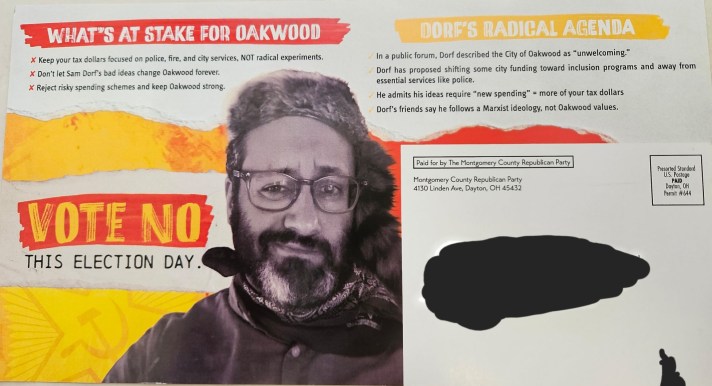
Like it or not, negative ads like this are typical during election season, though usually in larger elections. But how effective are negative ads in delivering their intended results? At a time of concern about the tone of our political discourse, are they the best approach versus purely positive campaign messaging? Look at the above examples. Do they discourage you from voting for Mr. Dorf, motivate you to vote for him, or have no effect on your voting decision? While these ads touch upon some policy issues, like claiming Mr. Dorf has called for diverting funds away from police, negative ads are often more substantive, focusing on a candidate’s record and stances on the issues. These appear aimed more at simply making the candidate look bad, rather than offering critiques that could be raised of Mr. Dorf’s extensive controversial record.
It is unusual to see these large ad campaigns in such local-level elections, and candidates for Oakwood’s City Council and Board of Education elections have generally run positive campaigns promoting their strengths. However, Oakwood has seen negative campaign messaging before, from sources other than the candidates, and their impact on election results is questionable.
In the 2023 Board of Education election, screenshots and pictures of one conservative candidate were circulated by residents, including by Mr. Dorf, and it fueled heated and sometimes rude criticism of the candidate on social media for her expressed religious and other views on social and political issues.
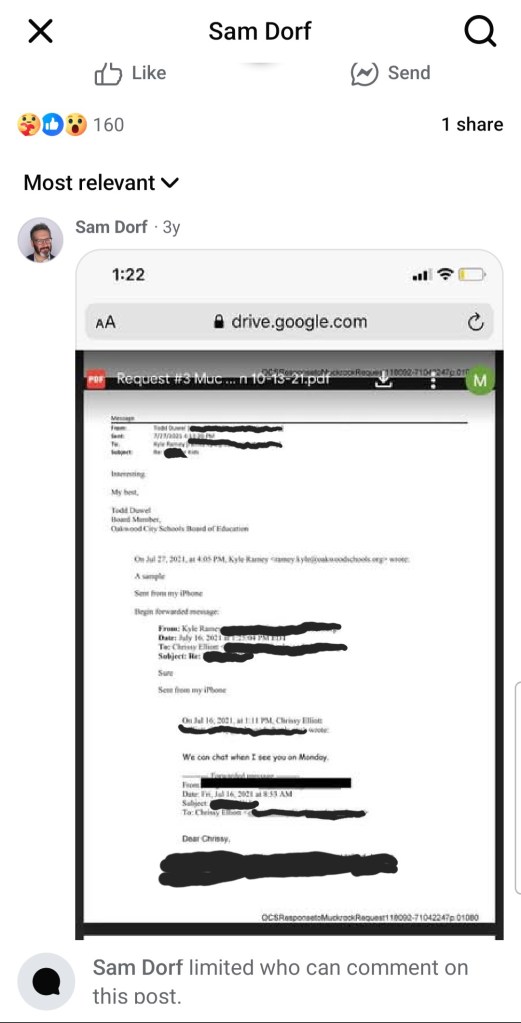
In the 2021 Board of Education election, a conservative candidate was vilified by progressive residents on social media and elsewhere, for statements she made in a private email to an Oakwood school official after the school district disclosed the email in response to a public records request. She expressed her religious reasons for asking the school to opt her children out of controversial classroom instruction on sexuality and gender identity. Her statements were entirely within mainstream Christianity, and her expressed view that public schools should be neutral on those topics is the most mainstream position on that issue. Her email was also personal, private, and sent before she was a candidate, in her role as a mother concerning her children. Nevertheless, residents posted the private email on social media during the election and used it as fodder to attack the candidate for her religious and other views on those topics, including Sam Dorf himself, who called her beliefs “homophobic” (candidate’s email is left out for privacy reasons):
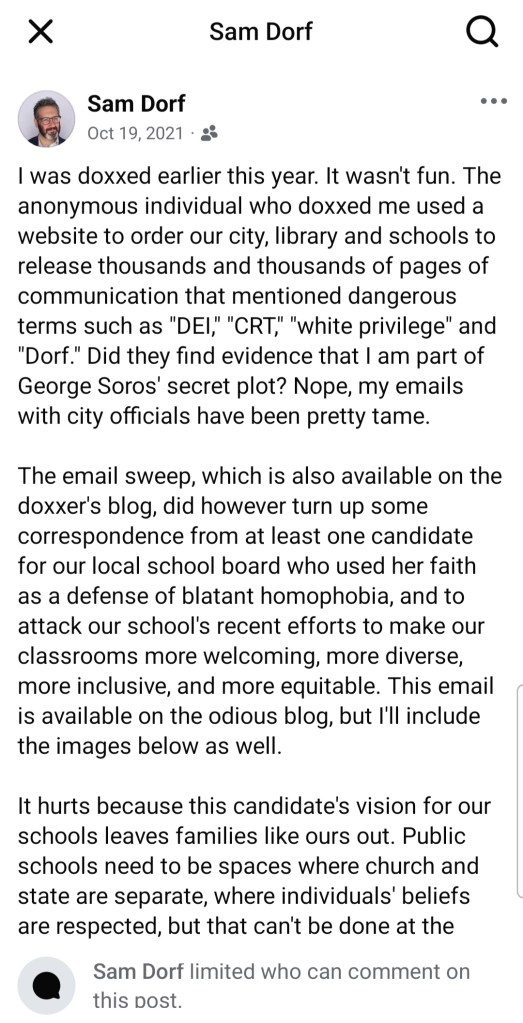
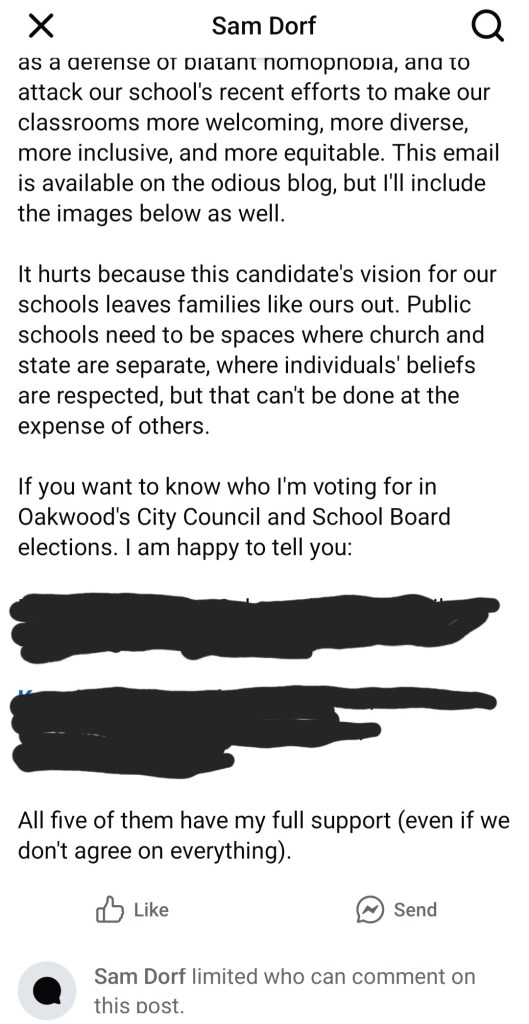
Mr. Dorf even defended the attacks (which were hardly “respectful”), and the use and disclosure of the candidate’s email for that purpose:
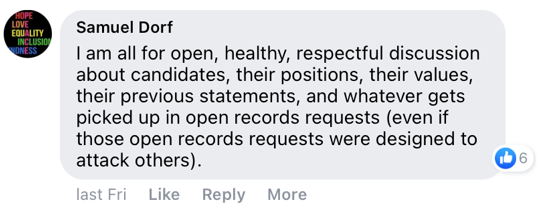
The Democratic Party even included the candidate’s email in campaign literature distributed in Oakwood.
This demonstrates a flagrant disrespect for the candidate, for her and her children’s privacy, and for her religious beliefs. It was later revealed that the Oakwood school district had disclosed the email in violation of student privacy laws, from a lawsuit the candidate filed against the district, which district settled with a public apology. And yet, that email remained published by Mr. Dorf and others on social media.
Mr. Dorf now presents himself as a victim of negative campaigning, but could one say that what is good for the goose is good for the gander? What was done to that candidate in 2021 was actually far more egregious than what these ads are doing to Mr. Dorf in this election. Or, is it better stick to positive campaigning to take the high road? Is some degree of negative campaigning acceptable as a way of informing voters of a candidate’s record if it is done respectfully?
Also, did that negative messaging affect those prior Board of Education elections? Those two disparaged candidates received about the same share of votes as the other conservative or Republican candidates in those elections, whose campaigns were not subjected to any negative messaging or controversy.
The effectiveness and propriety of negative campaign messaging is highly debatable, but one thing is certain: for better or for worse, it’s likely here to stay.
 OCSS
OCSS 