Correcting Rose Lounsbury’s Education Misinformation

In her campaign social media posts, website and speeches, Ohio House District 36 candidate Rose Lounsbury has made a number of false or misleading statements regarding the Ohio state government’s funding of public education, and of Ohio’s popular EdChoice voucher program. Assuming this was unintentional on her part, they represent, at a minimum, a lack of proper understanding of public education funding and of the EdChoice program.

The following is the most recent example:
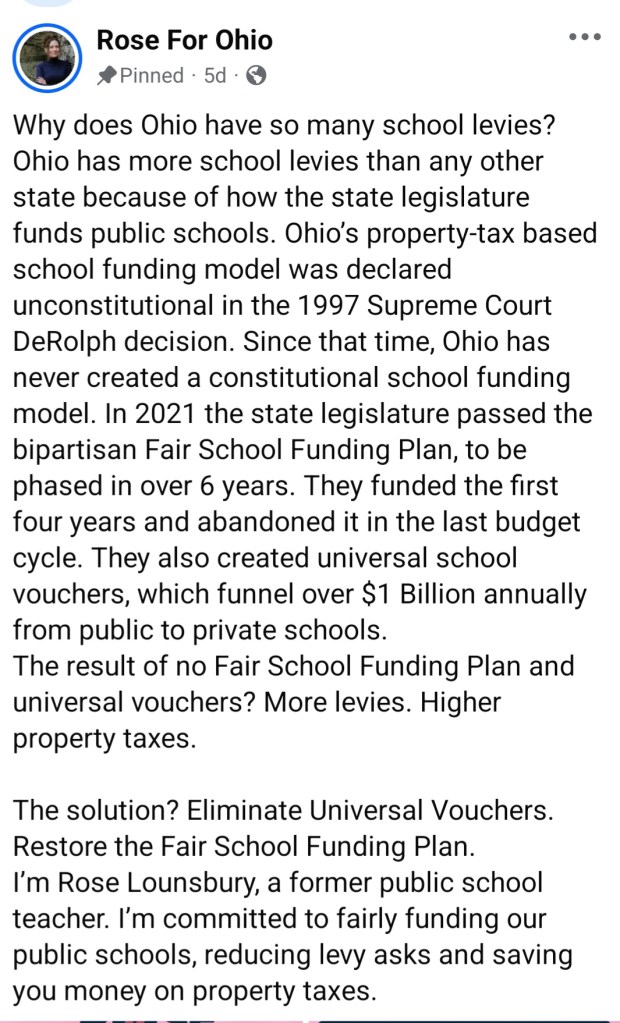
Here are the key facts and resources you need to know:

  • The state has NOT been cutting public school funding, such as to channel it to vouchers.

Rose’s above post implies the state has been cutting its public education funding. She also falsely claimed that Ohio Republicans have “continually cut funding to our public schools” (see here at 8:55). The reality is that the state’s funding of its public schools on a per-pupil basis, and adjusted for inflation, has steadily increased over the past 25 years both before and since the creation of EdChoice and other voucher programs. See this State Auditor’s report on school revenues here at its pages 9 and 10 for more information on that. In two other negative campaign ads (here and here), Rose falsely accused her election opponent, incumbent Ohio House Representative Andrea White, of voting to cut public education funding by diverting the funds to EdChoice vouchers via her vote for HB 96. To the contrary, HB 96 increases Ohio’s K-12 public school funding by $226 million for the 2026-2027 budget versus the already record-high 2025 levels (see here and here).

For in-depth analysis debunking these and other false claims about Ohio’s public school funding and how it is impacted by EdChoice vouchers, see the outstanding research articles published by the Thomas B. Fordham’s Institute here in Dayton, starting with this one: Don’t Blame EdChoice for District Budget Woes. This article notes that Ohio public school enrollment is down 15% since 2010 which reduces (the nevertheless increased) state funding from what it would otherwise be, since enrollment numbers are a factor under the state’s funding formula. However, rather than reducing staffing accordingly, school districts only reduced their teacher staffing by 5% and actually increased administrative staffing by 3% during that same time period. This article also points out that Ohio public school districts actually received nearly $1 billion more funding for 2026 than they had projected in a spring 2022 five year budgetary forecast, which was made prior to the 2023 EdChoice expansion. Therefore, EdChoice is not the cause of Ohio public schools’ budgetary challenges, it’s quite plausibly inadequate financial management and cost control to a significant extent.

  • The state has NOT been disregarding the funding changes required by the DeRolph v. State decision.

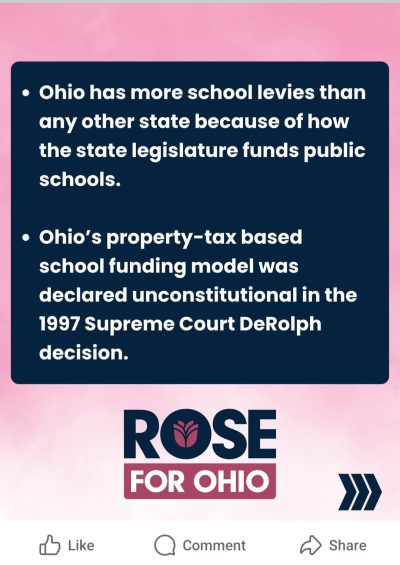
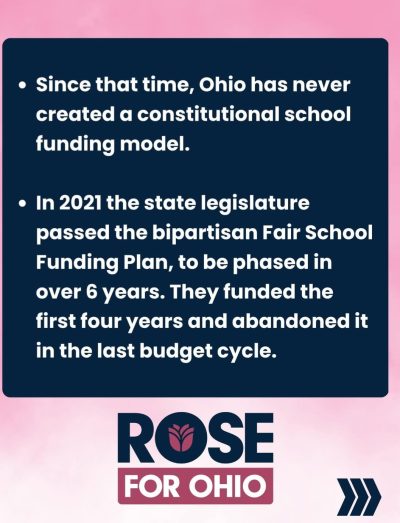
The DeRolph decision held the state’s then funding formula unconstitutional, based significantly on the formula’s primary reliance on local taxes for funding. Since 2022, the state has been phasing in the Fair School Funding Plan (FSFP), a bipartisan plan enacted precisely to comply with the requirements of the DeRolph decision. That plan shifts most funding to sources other than local taxes, with more funding from the state. The FSFP creates a more equitable distribution of state funding as well, based on a number of factors including property values and income levels of districts, and their actual costs and expenses of educating kids. Also, the Ohio government did NOT abandon that plan last year, it has continued phasing it in to the present day.  See here. For sure, Democrats and Republicans disagree on whether the FSFP funding can and should be phased in more rapidly and on the adequacy of public education funding overall (Democrats will always favor higher spending), but it is not true that the Republican-led Ohio legislature or Governor have abandoned the FSFP.

Regarding the ongoing lawsuit seeking to eliminate the EdChoice Program, see these Fordham Institute articles here and here for further critiques of the lawsuit, and decision of the lower court, on the state’s public school funding and how it is impacted by EdChoice.

  • It is NOT true that school districts across Ohio have all had to pass numerous levies to compensate for insufficient state funding.

Rose may have a skewed perception on this from her unusual experience as an Oakwood resident. Ohio’s districts vary widely on the state funding they receive, and on the number and size of levies they pass. The latter is partially due to the former, and to differences in voter preferences. The Fair School Funding Plan varies state funding based in part on property values and income levels of a given district as a form of “equity”: poorer districts that lack the income and property values to carry as much of the funding load receive more state funding, while wealthy districts such as Rose’s in Oakwood receive less funding, since they are better able to “pay their fair share” of the funding burden. This is why, for instance, the relatively poor Dayton Public Schools district had, on a per-pupil basis, 19.6% more funding and 25% higher spending (just outside the top 5% highest of all Ohio districts) than Oakwood in 2025, despite having passed only ONE levy in the past 15 years. Further, Oakwood residents are more willing to pass more levies, whether needed or not, because they place a high priority on their prized, top-ranked schools, which are the community’s flagship attraction, and Oakwood’s voter turnout also leans heavily Democratic by 60-65%, thus favoring higher levels of government and school spending. If Rose is upset with her high property taxes from these levies, she has herself and other liberal Oakwood voters to blame. See this chart for the 2025 school funding and spending data.

  • Public school funding is NOT being “channeled” to, or “drained” by, EdChoice and other voucher programs.

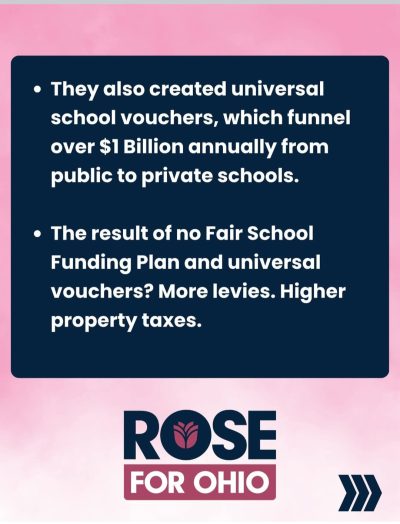
Rose Lounsbury falsely claims EdChoice “drains” public school funding, when EdChoice doesn’t restrict Ohio’s budgeting levels for public schools. EdChoice enrollments don’t withdraw funds that would otherwise cover public schools, including, as Rose claims (here at 8:25), by the sheer fact that both are funded under the same Education budget line item. Ohio’s education budget line item includes funds for both public schools and EdChoice based on projected enrollment for each during the biennial budget cycle. Any leftover funds expire at the end of the budget cycle; they don’t go to public schools.

Further nothing in EdChoice’s design limits the amount the state can budget for public schools; the state and budget as much as it wishes for public schools. The most Rose can do is speculate that if these vouchers did not exist, state might have budgeted even more increased funding for public schools, but that is pure conjecture. There is no withdrawal of money to EdChoice that somehow belonged to or was allocated to public schools.

Again, see this and other Fordham Institute articles for analysis debunking these and other false claims about Ohio’s public school funding and how it is impacted by EdChoice vouchers: Don’t Blame EdChoice for District Budget Woes.

  • Eliminating vouchers would NOT significantly increase public school funding, even if all of the funding for the former were allocated to the latter, which is unlikely to happen.

The $1.09 billion the state budgeted for EdChoice for 2025 sounds like a large number, but that equals only 8.1% of the $13.51 billion the state budgeted for K-12 public schools in 2025. See here. A mere 8.1% increase in state funding of public schools would be a negligible funding increase, on a per pupil basis and if it were actually needed, the state could simply budget more for public schools without compromising EdChoice.

For example, for the academically struggling Dayton Public Schools district (DPS), if EdChoice had been eliminated and the money spent on it that year was instead allocated to an 8.1% increase in State public school funding, that would have only yielded an additional $919 in per-student spending for the DPS district (i.e., $11,343 state funding per pupil increased by 8.1%) See here for this funding data. In 2024, among that district’s 8th graders, only 8.9% were proficient in math and only 11.5% were proficient in English language arts, and the four-year high school graduation rate was only 72.3%. That is despite $23,209 in total spending that year, do we really think another $919 per student, plus a small increase in State funding from enrollment of returning former EdChoice students, would have been the transformative catalyst that would have significantly improved those outcomes?

For further information, see this article on this page, refuting Rose’s prior claims that eliminating EdChoice vouchers and allocating those funds to public schools would somehow improve failing school districts in Ohio. Higher levels of spending have not produced better outcomes, as seen by the dismaying student performance results in some of the highest-spending districts (Dayton, East Cleveland, or Baltimore City for an out-of-state example) versus those of Oakwood City Schools.

Why You Should Vote for Andrea White

In this election, we have a choice between our experienced, incumbent Ohio House representative, Andrea White, who has championed mainstream policies fostering economic and job growth, affordability, public safety, assisting the needy and increased funding of public and private education, and her second-time challenger Rose Lounsbury, whose inexperience, polarizing partisan messaging, apparent unfamiliarity with core issues and controversial platform pose real concerns, including for our economy, affordability, healthcare and education.

In her six years representing us, Andrea White has supported the above priorities via legislation including: reduced taxes and regulations on businesses, bolstering economic and job growth and affordability; overhauling Ohio’s single-family homeowner’s tax credit and property tax exemptions to improve home affordability; supporting law enforcement and first responders; anti-crime measures such as legislation imposing tougher penalties, upgrading criminal background checks and combating vehicle thefts; increased funding of vocational and career training; and additional resources addressing Ohioans’ mental health needs (see generally, here). Andrea has worked across the aisle on bipartisan legislation, such as to combat infant mortality, assist low-income mothers and strengthen child support enforcement. She has repeatedly supported increased funding of both traditional public education and Ohio’s popular EdChoice voucher program for affordable access to private schools that can be life-changing for students in low-income families and failing school districts, and students whose public schools aren’t meeting their needs, most recently for her vote for Ohio House Bill 96 (see here and here).

Rose Lounsbury, while deservedly well-regarded, supports an agenda detrimental to Ohioans, and her inexperience is apparent in numerous inaccurate or misleading campaign statements that I doubt were intentionally false, but indicate a lack of understanding of key issues cloaked in boilerplate party talking points. As noted in my May 13th letter to the Oakwood Register editor (see sourced online version here), in one of her negative ads against Mrs. White and Ohio GOP leadership, she made outlandishly false claims that Ohio House Bill 249 would criminalize cross dressing and mainstream theatrical performances with cross-dressing characters, likely from her failure to either read the bill or to read it accurately, which are vital functions of a competent legislator.

In two other negative campaign ads (here and here), Rose falsely accused Mrs. White of voting to cut public education funding by diverting the funds to EdChoice vouchers via her vote for HB 96, when HB 96 actually increases Ohio’s K-12 public school funding by $226 million for the 2026-2027 budget versus the already record-high 2025 levels (see here and here). She has falsely claimed that Ohio Republicans have “continually cut funding to our public schools” (see here at 8:55), when funding of Ohio public schools on a per-pupil basis, from the state and overall, has been steadily increasing over the past 25 years (see here at page 10). She falsely claims EdChoice “drains” public school funding, when EdChoice doesn’t restrict Ohio’s budgeting levels for public schools, and EdChoice enrollments don’t withdraw funds that would otherwise cover public schools, including, as Rose claims (here at 8:25), by the fact that both being funded under the same budget line item. Ohio’s education budget includes funds for both public schools and EdChoice based on projected enrollment for each. Any leftover funds expire at the end of the budget cycle; they don’t go to public schools.

Rose blamed Republicans in Columbus for Ohio’s high property taxes and accused them of granting “tax cuts for the rich” at other Ohioans’ expense, when property taxes are driven mainly by local governments, mostly via voter-approved levies and bonds, have repeatedly given Oakwood among the highest property taxes of any municipality in the Dayton area. If she’s unhappy with her high property taxes, she has herself and other Oakwood voters to blame.  The taxes controlled by the Ohio government are actually quite low, with among the 10 lowest income tax burdens of states charging income tax, including for the middle class (see here).

Mrs. Lounsbury’s platform presents serious concerns, particularly for our economy and affordability. Her campaign kickoff speech featured affordability as a reason voters should “flip” control of the Ohio House and government to Democrats, with logic exemplifying the correlation-causation fallacy: affordability (cost of living) has worsened for Ohioans in recent years, and Republicans are to blame since they controlled Ohio’s government during that same time period. She never mentioned prices and living costs also rose everywhere else nationwide, due to unprecedented deficit spending by the federal government financed with printed money, beginning with emergency COVID spending, but then continuing under the previous administration even as the pandemic waned. This brought inflation from only 1.4% in January 2021 to a staggering 40 year-high 9.1% in June 2022. This had nothing to do with Republicans in Columbus.

Rose is correct, though, that state government policies profoundly impact affordability. However, by equating a state’s cost of living with the political party controlling its government, she ironically makes one of the most powerful arguments against her entire candidacy. Blue states typically have significantly higher living costs, representing 9 of the top 10, and 16 of the top 20, states with highest costs of living, while red states represent 9 of the bottom 10, and 18 of the bottom 20, states with the lowest living costs, per 2025 rankings. If Rose thinks Ohio has an extraordinary affordability problem, she hasn’t looked at the data; Ohio’s cost of living is not only below most states, it’s lower than every blue state in America excluding New Mexico, which is ranked right behind Ohio. In other words, affordability is worse than Ohio’s in virtually every state with Democrats in control, as she is advocating.

This isn’t merely a correlation; it’s a result of blue state policies, including those in Mrs. Lounsbury’s platform. Blue states impose significantly higher taxes and regulations on individuals and businesses. This leaves residents with less after-tax income for affordable living, and drives up operating costs on businesses, who respond either by reducing or eliminating hiring, staffing or pay increases to offset those costs (thus hampering affordability for the workforce), or by transferring those costs to customers via higher prices. This is why things are often more expensive in blue states than red states.

Blue states account for all of the 10 states with the highest income taxes, and none of the 10 with the lowest among states that charge income tax (see here). Presumably, Rose supports raising income taxes given her “tax cuts for the rich” rhetoric, and even limiting tax increases to “the wealthy” is a job killer and inflates consumer prices from its impact on businesses. This is because 95% of all businesses pay income taxes through their owners’ individual income tax returns and tax rates (aka “flow-through” taxation), and 91% of all taxable income from these “flow-through” businesses – the backbone of our economy and job creation – is reported in the top 20% income level and 57% is reported in the top 1% level (see here).

Blue states impose higher regulations detrimental to affordability, including zoning and permitting laws that elevate housing costs, and labor laws such as raising the minimum wage, which has consistently inflated consumer prices and reduced jobs while crushing small businesses (see, e.g., here and here). Mrs. Lounsbury supports the latter with her website’s “living wage” rhetoric.

Like most blue states, Mrs. Lounsbury supports expanding unions, which impose an average of 15% – 25% higher labor costs by coercing employers to provide above-market compensation and benefits packages, including pensions that are unaffordable to most private companies and a leading cause of state budget deficits (see here at p. 7). This results in higher consumer prices and job losses. A unionized can hardly provide competitively-priced products if its labor costs are up to 30% higher than its non-unionized competitors. Unsurprisingly, private sector union membership has therefore plummeted by over 70% since 1980 and is now five times more prevalent among government employees, whose employers can force taxpayers to pay the inflated labor costs. A 2018 Ohio State University study found that one of the two main causes of Ohio’s loss of manufacturing fueling its over 50-year economic decline was effectively labor unions; specifically, manufacturers relocating to other states with “right to work” laws that prohibit requiring workers to join unions.

Rose has an entire webpage promoting unions, and while she cites her personal and family history of union membership, don’t think that’s the only reason. Her 2024 and 2026 campaign finance disclosures show multiple unions lining her campaign’s pockets. Therefore, if you vote for Rose Lounsbury, you are voting to double-down on a leading cause of Ohio’s manufacturing and economic decline, for the enrichment of her union donors. A key step to revitalizing Ohio’s economy is actually the opposite of Rose’s agenda: make Ohio a “right to work” state so we can bring back those lost manufacturing jobs.

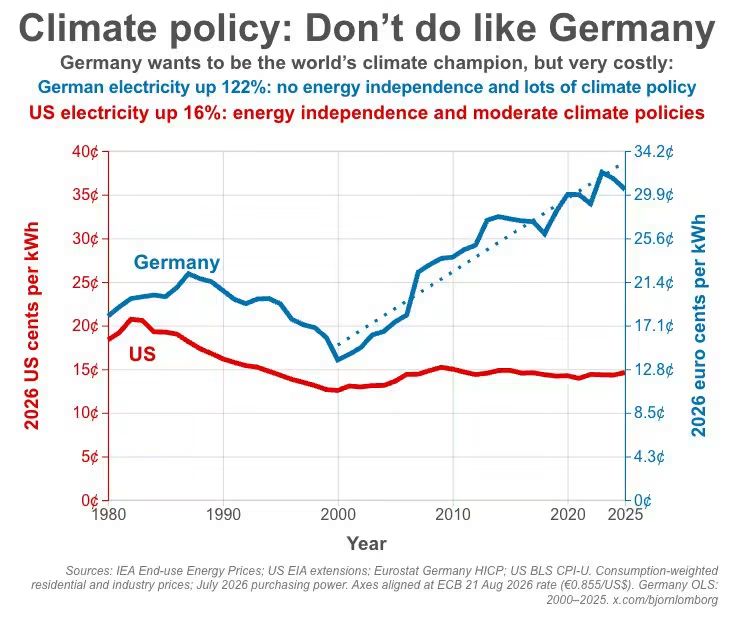
As with many blue states, Mrs. Lounsbury supports burdensome environmental regulations that inflate business operating costs and prices, including “cap-and-trade” initiatives that heavily tax and regulate fossil fuels to compel transitions to costly, inefficient and unreliable “green” energy such as wind and solar power, which her website ironically presents as making energy “affordable” as families struggle with high energy costs. In Germany, these policies increased consumer energy prices by over 120% to the highest in Europe and among the highest in the world (see here, here and here), with energy shortages in winter. Washington State’s similar program inflated energy prices by 41% in five years, and California’s program increased energy prices five times higher than anywhere else in the U.S. for a staggering 127% price increase, with periodic energy shortages. If you’d like your energy bills to balloon by 40% to 127% with possible shortages, then Rose Lounsbury is your candidate. While her campaign’s “Working Families” webpage laments high energy costs for families, her “Environment” webpage pushes these same energy policies. Further, that webpage suggests she supports restricting or banning fracking and other fossil fuel production, which would devastate eastern Ohio’s economy.

Similarly, Mrs. Lounsbury’s “Healthcare” webpage laments higher healthcare costs for families while prescribing policies that would drive them higher. Her proposal to mandate minimum staffing levels for healthcare facilities – likely higher than they would otherwise maintain – would trigger higher operating costs passed onto patients. Alternatively, facilities may resort to hiring staff willing to work for substandard compensation to satisfy the mandate, risking inferior healthcare, sanitation and overall patient experience.

Mrs. Lounsbury’s education agenda would produce poorer student outcomes and fewer educational choices, leaving many students trapped in schools that are failing or otherwise not meeting their needs. Her flawed education pitch blames sheer Republican control of Ohio’s government for Ohio supposedly ranking 30th in education (see here at 13:40) (it’s 12th per a July 2026 Ohio Capital Journal report), while falsely claiming Republicans have cut education funding (see here at 13:00) when the state’s funding of its public education has steadily risen over the past 25 years (see here at page 10). As with property taxes, she ignores the central role of local government. Ohio would rank significantly higher but for pockets of failing school districts with mismanaged municipal governments (e.g., Dayton, Toledo, Cincinnati, Cleveland, Columbus), and like most others in the U.S., the vast majority have been run by liberal Democrats and their teachers’ union donors for decades. A recent Progressive Policy Institute study found blue states with heavy teachers’ union influence frequently have worse student literacy than red states. Only 4 of 23 states with the highest scores were blue states (13 were red states), and 8 of the 10 states with the worst literacy scores were blue states with heavy teachers’ union influence. Teachers’ unions notoriously oppose any manner of education reform, accountability and school choice because they prioritize their self-interests over students. This hardly makes the case for “flipping” the Ohio House and government to Democrat control.

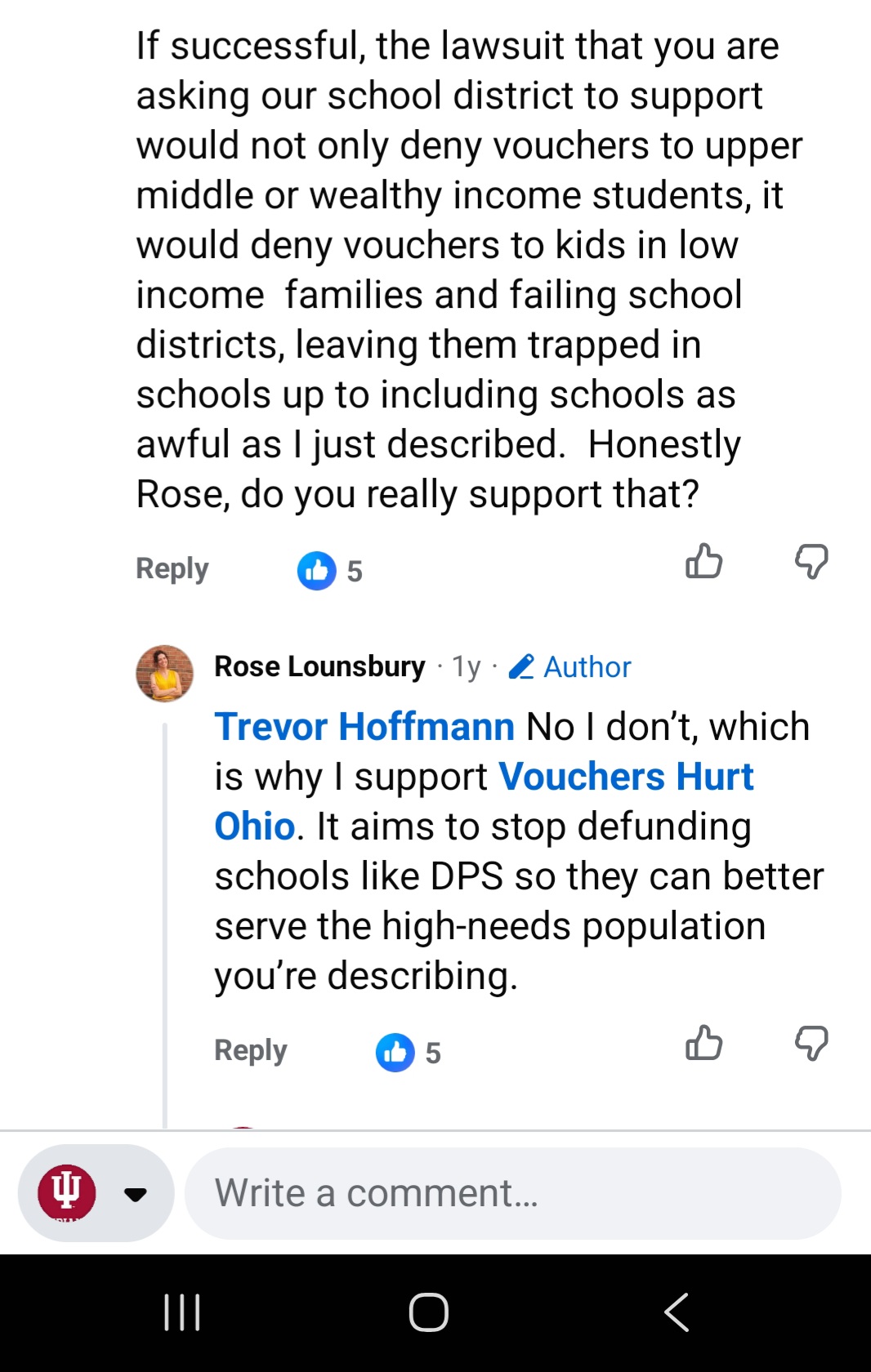
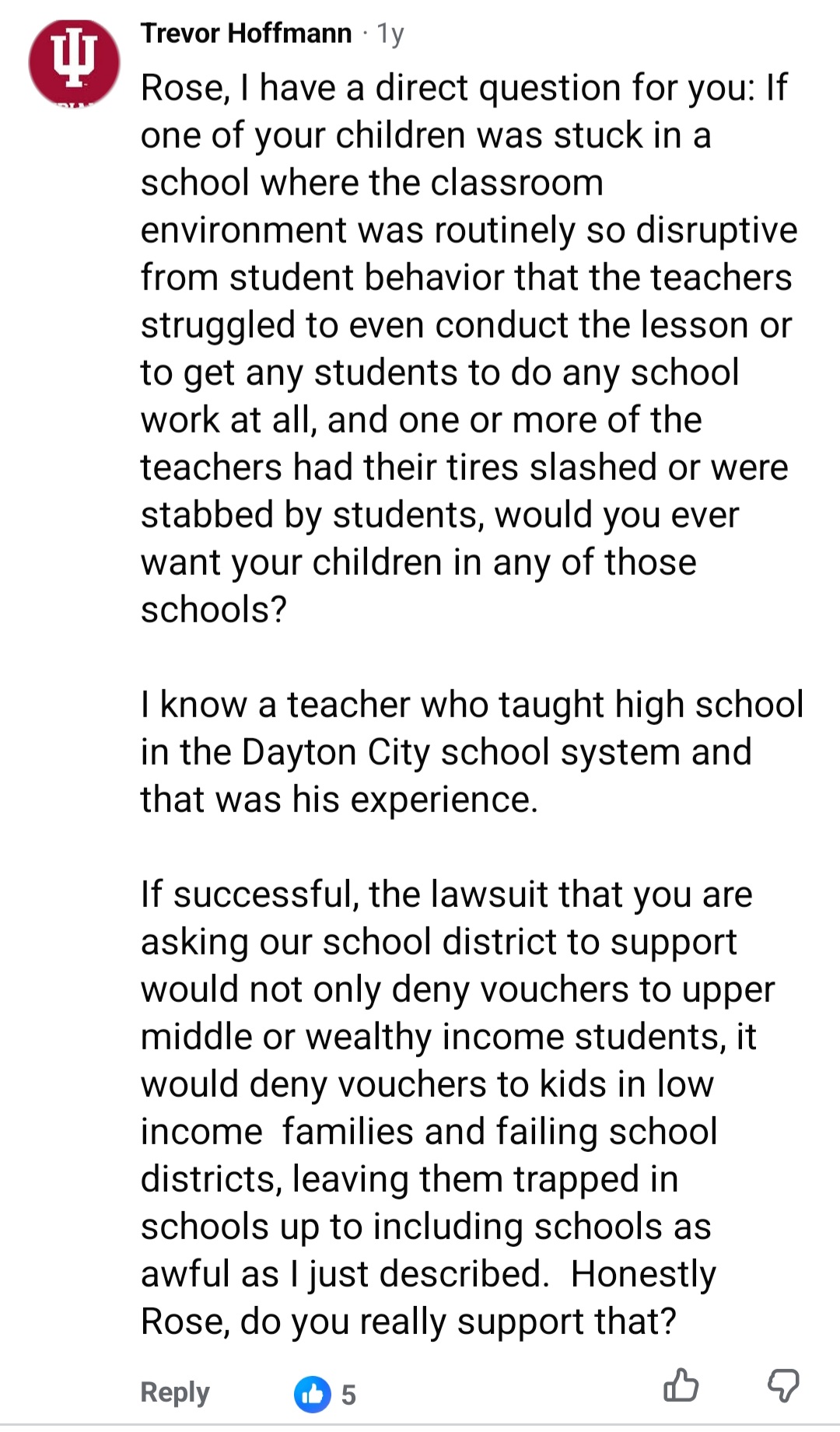
As a far-left Democrat and former teachers’ union representative, Rose Lounsbury would tow the line on policies that have perpetuated these pockets of failing districts and left their students without viable alternatives. Unsurprisingly, she vigorously supports eliminating Ohio’s entire EdChoice voucher program (not just the 2023 expansion). This would leave disadvantaged students trapped in troubled districts and learning environments that in the case of the Dayton Public Schools (DPS) district, Rose admitted to me she wouldn’t want to leave kids trapped in, given the disturbing conditions there as described by a former DPS teacher. She purportedly champions education, while seeking to deny disadvantaged students access to high-quality education such as her kids enjoy in Oakwood’s top-ranked district. I find this hypocritical.

Lastly, the abrasive, partisan tone of Mrs. Lounsbury’s campaign messaging with its continuous negative attacks against Mrs. White and other Ohio Republicans indicate that if elected, she will not work effectively across the aisle with the likely continuing Republican House majority to actually get things done. Rather, she will be a shrill, ineffectual performer, posturing from the margins of the House without delivering meaningful results for her constituents.

For these and many other reasons, I am voting for the candidate with years of experience successfully representing us that Mrs. Lounsbury lacks, and whose policies are grounded in a proven history of better affordability and opportunities for Ohioans. I am voting for Andrea White, and if you are concerned about Ohio’s future, I urge you to do the same.

Rose Lounsbury Campaigns with False Advertising

In her second attempt to unseat our Ohio House representative, Andrea White, Rose Lounsbury posted an ad early last month on her campaign’s Facebook and Instagram pages, in which she attacks her opponent and the Ohio Republican Party for backing Ohio House Bill HB 249 (the Indecent Exposure Modernization Act), which the House recently passed. This bill is best known for seeking to prohibit sexualized drag queen and other graphic adult performances in public settings.

See the ad here.1

In her ad, Mrs. Lounsbury claims HB 249 would “ban Mrs. Doubtfire” from being shown or performed and “make it a felony, actually, to dress like a member of the opposite sex”. She sarcastically questioned if HB 249’s backers would make a citizen’s arrest at this month’s performance of Mrs. Doubtfire at the Schuster Center, and she criticized Representative White and the Ohio GOP for prioritizing “banning Mrs. Doubtfire” over more pressing issues facing Ohioans. In comments beneath her ad, she also affirmed claims that HB 249 would ban performances of Shakespearean plays with males playing female characters, and Hairspray and Chicago among other theatrical classics.

I reviewed HB 249, and if these claims sound too outlandish to be true, it’s because they are blatantly false. I don’t think Mrs. Lounsbury would deliberately make false statements in her campaign, but that leaves only two explanations: either she didn’t bother to read the bill before releasing her ad, or her reading of the legislation was astonishingly careless and inept, especially for someone campaigning to serve as a legislator. Either way, it gives little confidence she would properly perform those basic responsibilities of the office she is running for, which will often involve legislation substantially more complex than HB 249. If elected, her constituents would rightfully expect her to competently review and understand pending legislation before taking a public position or voting on it, and to communicate about it accurately to her district.

Nowhere in HB 249 does it make it a crime merely to dress like the opposite sex (see the text of the bill here). The bill prohibits “adult cabaret performance(s)” in settings other than restricted adult venues or other exempt locations where minors may be present, such as in public. That term does include performances involving cross dressing along with five other defined categories of performances (e.g., nude and other adult performances). However, the bill only prohibits such performances under limited conditions; most importantly, they must be “harmful to juveniles” or “obscene”, as those terms are defined in an Ohio sex crime statute (RC 2907.01) (see HB 249, lines 153-155; 174-175).

Go read those terms in RC 2907.01 (see here at paragraphs (E) and (F)). They refer to extremely graphic and salacious adult content that virtually no one would deem acceptable for public display in front of children – nothing like Mrs. Doubtfire or those other classic works mentioned beneath Mrs. Lounsbury’s ad. For example, they apply to highly explicit sexual material that: (a) involves nudity or graphic depictions of sexual acts without any serious literary, artistic, scientific or educational value; (b) is “patently offensive to prevailing standards in the adult community”; or (c) has a predominant appeal of inciting sexual arousal or sexual interest that is “prurient” (unhealthy or shameful under prevailing community standards).

Neither Mrs. Doubtfire nor any of those other works contain such explicit content to my knowledge, but if they did, they are hardly lacking in serious literary or artistic value or patently offensive to prevailing community standards; they are widely performed, highly acclaimed theatrical or literary works. I’m also quite certain that sexual arousal or unhealthy sexual interest are not their predominant audience appeal, least of all Mrs. Doubtfire’s character.

In case it wasn’t obvious enough that HB 249 would not criminalize Mrs. Doubtfire or those other works simply for including some element of cross dressing, the bill’s drafters went out of their way to make that clear with a provision stating that the prohibition of adult cabaret performances will not apply to “any bona fide film, theatrical, or other artistic endeavor or performance that is not obscene or harmful to juveniles”.  Mrs. Doubtfire and those other celebrated works are unquestionably bona fide films and theatrical performances (see HB 249, lines 320-323).

In a comment beneath her ad, I politely asked Mrs. Lounsbury if she or her campaign had reviewed HB 249 before releasing the ad, and to explain the basis for her ad’s claims about the bill given its provisions. While she promptly and enthusiastically responded or reacted to all other comments to her ad, as she typically does, she never answered mine. Ironically, at the same time she was apparently ignoring my reasonable questions about her position on HB 249, she posted her next attack ad against her opponent, stating “I’m so done with politicians who [don’t] listen to the voters”. I totally agree.

Perhaps most striking about her ad is that it completely ignores the obvious, true focus of HB 249: to prevent displays of sexually graphic, patently obscene adult performances in public areas where children may be exposed to them without their parents’ prior knowledge or consent. Why? Does she see nothing wrong with that, and if so, is the “Mrs. Doubtfire” angle meant to distract from that larger reason for her opposition to the bill? If Mrs. Lounsbury believes that exposing children to such performances in public without their parents’ knowledge or consent is perfectly acceptable, then she should be transparent about it. But that would likely reveal that her position on this issue is at odds with the prevailing views and values of the district she’s campaigning to represent.

It might behoove her to recall that in her previous unsuccessful campaign for this House seat, she herself was the subject of a scathing ad from her opponent, based partially on her support for allowing transgender-identifying biological males to compete in female sports. Apparently, taking the 20% side of 80/20 social issues is not a winning campaign strategy2.

See that ad here.1

1Fair Use Disclaimer

2For example, a Suffolk University/USA Today poll showed only 21% of Ohioans support allowing biological males who identify as transgender girls to play on girls’ sports teams, while 70% are opposed and 9% are undecided. See here.